A bus took stones and kept moving. The OSCE turned it into a question of community security.
Ngadhnjim Brovina | 22 September 2026
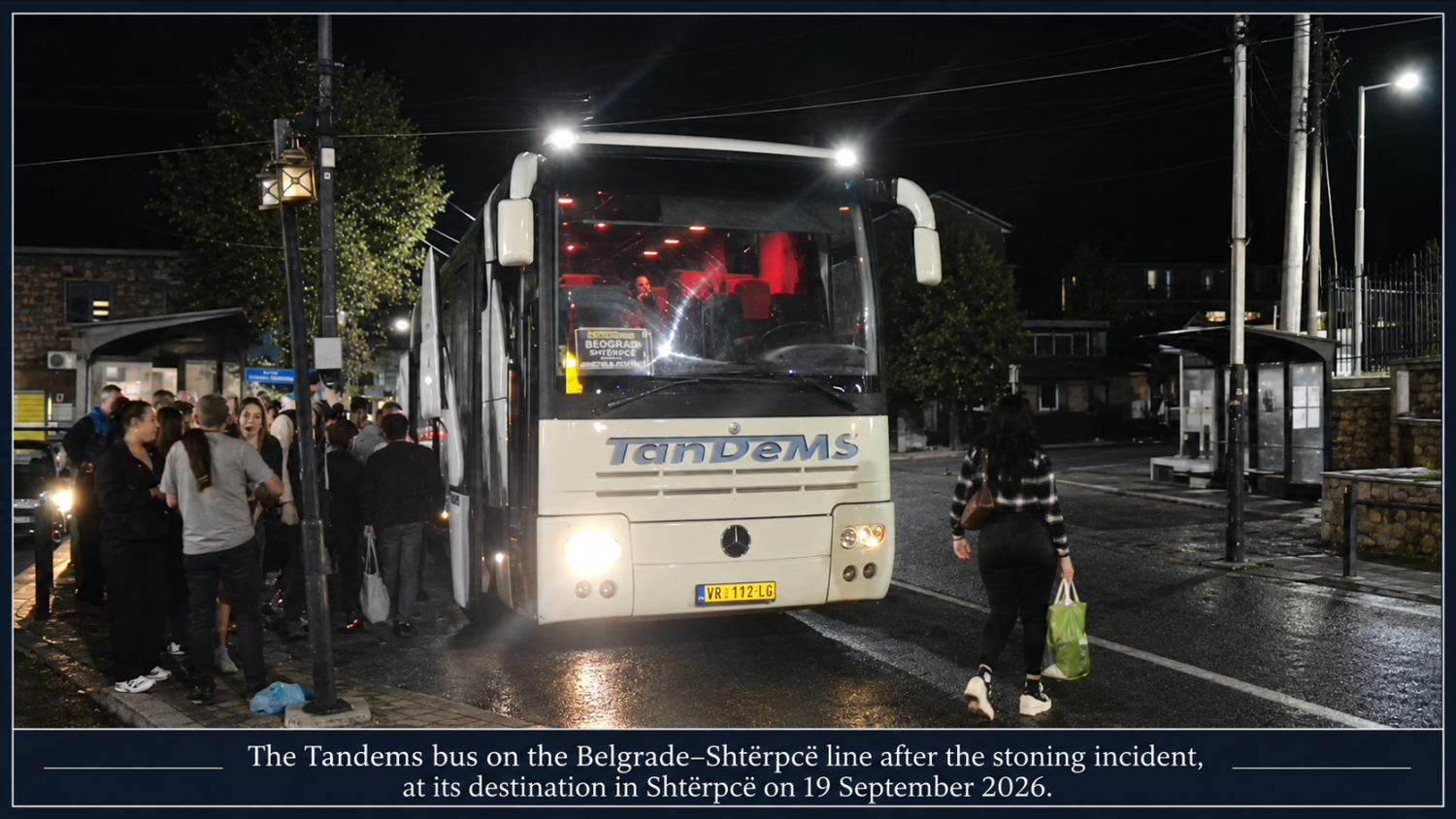
On the night of 19 September somebody threw stones at a bus on the Belgrade to Shtërpcë/Štrpce line near Sadovinë/Sadovina, outside Viti/Vitina. The stones hit the front. About fifteen passengers were on board and nobody was injured. The bus kept going, reached Shtërpcë, and the driver reported the incident to the Kosovo Police afterwards. Kosovo Dispatch has learned that the stones were thrown by a group of minors and that no passenger needed assistance.
By the next day the incident had acquired a meaning. Kurir carried it as a new attack on Serbs in Kosovo, and the mayor of Shtërpcë, Ivica Tanasijević, explained the meaning: the passengers were Serbs travelling home, the attack came days after the Hague judgment and strong reactions among Albanians, so the motive was ethnic and the freedom of movement and safety of Serbs were at stake. He had no more idea than anyone else who threw the stones. What he had was a frame, and by 20 September it was in circulation.
On 21 September Gerard McGurk, Head of the OSCE Mission in Kosovo, wrote that the mission deplores the stoning, that investigations are underway, that it expects a prompt, thorough process and full accountability, that freedom of movement and security for all communities must be upheld, and that it will monitor developments closely.
Nobody disputes any of those words taken singly. The trouble is what they were attached to. A country produces thousands of petty incidents a year and international missions turn almost none of them into statements about systemic rights. Choosing this one, giving it this size and this vocabulary, were decisions, and it is fair to ask what in the incident justified them. Cars and buses with Serbian plates cross Kosovo every day, to Shtërpcë, Graçanicë/Gračanica, Mitrovicë/Mitrovica and the border, and the bus in question finished its run with everyone aboard, so nothing on that road was impeded. Full accountability for stones thrown from a roadside at night, if it means anything in practice, means a policeman at every spot where a boy might stand. Underneath the statement is a windscreen. On top of it are freedom of movement, the security of communities, full accountability and international monitoring. That stones hit the bus was never in doubt. Who threw them, why, and what political meaning the incident could therefore carry were the open questions, and McGurk's own sentence says the investigation had not yet answered them.
The week explains why this matters more than a clumsy tweet usually would. Three days earlier, on 16 September, the Specialist Chambers had delivered the Thaçi judgment, and Kosovo was in the most delicate political moment it has had in months. Everyone with an office in Prishtinë/Priština understood that in such a week any incident could be ethnicised within hours and pressed into a competing story. The mayor of Shtërpcë showed how fast. What an office like McGurk's could still decide was whether that story remained a mayor's claim or acquired the weight of an international institution. He never said the attack was ethnic. He did not need to. He put the OSCE's name behind the mayor's frame, in the OSCE's own language, while the investigation that could have confirmed or dissolved it was still open.
He is capable of the opposite. On 20 August, asked by Kosovo Online about the Rašković case, with photographs of injuries and two investigations in front of him, McGurk said he does not interfere in investigations and would wait to see where they went. A month later, with far less in front of him and considerably more at stake, he did not wait.
Stones, no injuries, a completed journey, a police file. Freedom of movement, community security, full accountability, international monitoring. The first list is what happened. The second is what the head of the OSCE Mission in Kosovo decided it was.