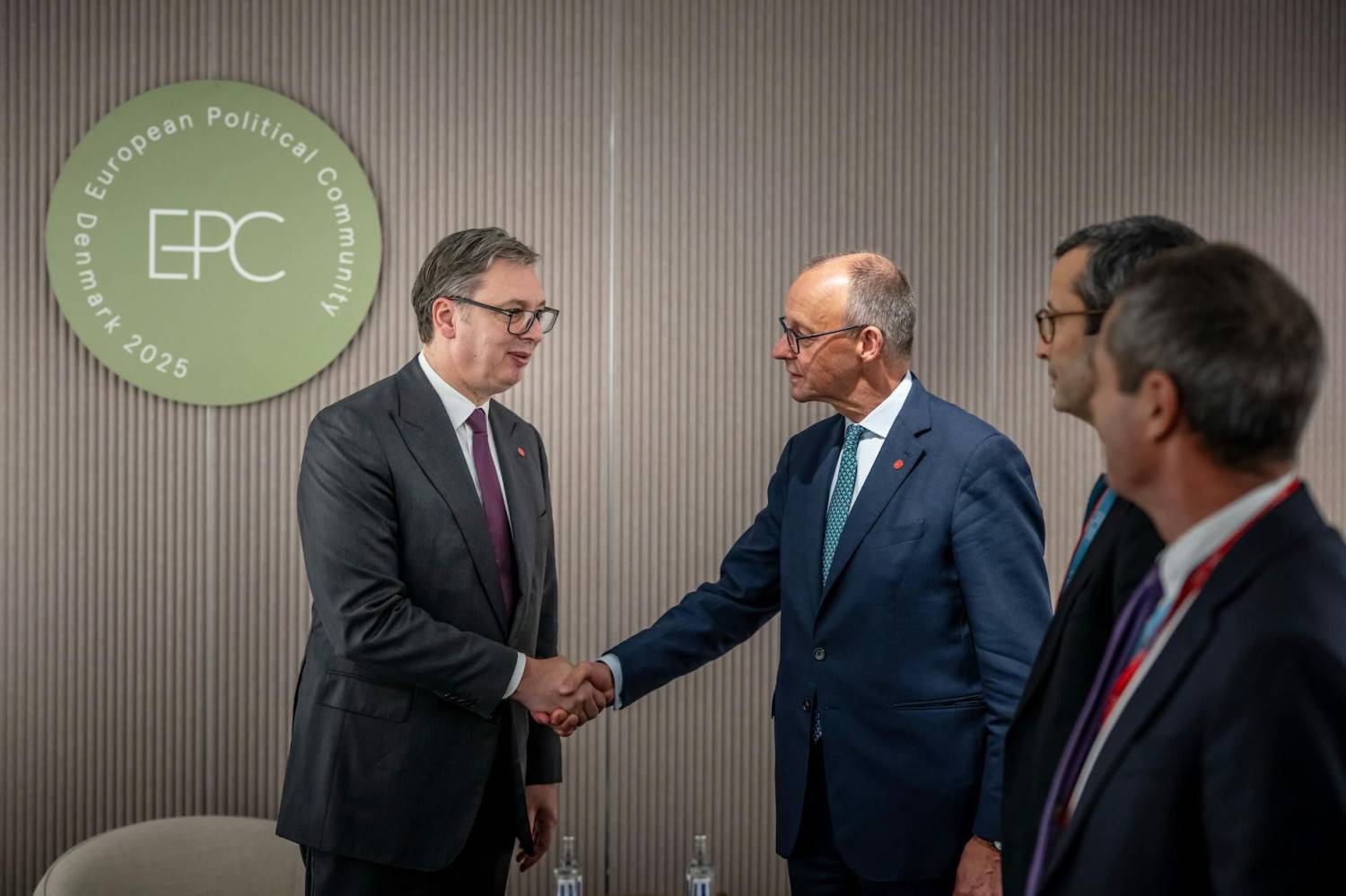
Serbia’s new winners have a programme that rejects Ohrid, the agreement Berlin helped negotiate and insisted was binding. Germany knew the contradiction was there. It celebrated anyway. Kosovo will live with the consequences.
By Albatros Rexhaj | 28 October 2026
On Monday Friedrich Merz congratulated Serbia on choosing the rule of law, the fight against corruption, freedom and the European path. Natalie Kauther, the German Foreign Office’s director for the Western Balkans, called the winners’ aims “truly European principles”. On Tuesday Peter Beyer, the CDU/CSU rapporteur for the Western Balkans, added his congratulations and his conditions. To DW he listed them: a clear public statement for Europe, distancing from Russia and support for sanctions, full alignment with EU foreign policy, and one more, which DW noted would grate on the movement: “From the election winners I expect unambiguous support for the independence of Kosovo.”
Serbia has made this promise before. In 2000 the coalition that removed Milošević ran against corruption and the mafia state. In 2012 Aleksandar Vučić’s party ran against corruption and the mafia state, won, and stayed fourteen years. In 2026 the Student List ran on “Serbia or mafia”. The three elections were not the same, but the promise was, and each time Europe took it at its word. Florian Bieber put the German part of that record to DW this week: Vučić was strongly backed by every German government from Merkel to Scholz, and under Merz the critical distance was still often missing. Nobody in Berlin has yet explained why the third time is different.
The difference, if there is one, is in the programme, and the programme is on the movement’s website. Michael Martens, the Frankfurter Allgemeine’s correspondent for South-East Europe, read it and published what he found on Tuesday afternoon. Kosovo is a “so-called republic” whose membership of international organisations Serbia “will not permit”. The government in Pristina is “provisional institutions of self-government”. Those responsible for “unconstitutional agreements to the detriment of Serbia” are to be prosecuted, and the agreement meant is Ohrid. No sanctions on Russia, as a matter of principle. More China. Russia as the partner “to resolve open questions of common interest”, and the open question is Kosovo. Martens’s conclusion was that a claim to decide matters in Kosovo could be realised only through a war. His paper’s headline was shorter: a programme full of nationalism.
Berlin did not need Martens to tell it. Marina Vulović of the SWP, the institute that advises Germany’s parliament and government, told DW the same day that the government had not been prepared for the students’ win and that the movement’s foreign-policy positions were considered problematic in Germany. Beyer himself, on Monday, had told the EU’s dialogue envoy Peter Sørensen that a change of government in Belgrade did not mean a change of policy on Kosovo, and had demanded that the Brussels and Ohrid agreements be implemented. The problem was known in Berlin before the congratulations were written.
What should worry Pristina more than the programme is Ohrid. The 2023 agreement meant to put Serbia and Kosovo on the road to normal relations was a Franco-German proposal, and Berlin drove it. On 22 September Kaja Kallas said in New York that the agreements of the Dialogue, Ohrid above all, are binding. In June 2023, after violence in Kosovo’s north, the Union suspended high-level meetings with Kosovo and froze parts of its money, and as the months passed respect for Ohrid joined the list of what Pristina was told to show before they were lifted. Article 4 of Ohrid says Serbia will not object to Kosovo’s membership in any international organisation. The movement Merz congratulated on Monday has published a programme saying Serbia will not permit it. So the agreement says Serbia must not object, the winners say Serbia will prevent, and the Chancellor called the first binding and welcomed the second as a European future without once saying how the two can live together. Pristina is owed that sentence.
Carelessness does not explain it. For fifteen years Germany’s Balkan policy has been elitist and self-centred: elitist because Berlin decides what the region needs and tells it; self-centred because the measure of every decision is how it plays in Berlin, not what it does to the people who live with it. Berlin did not want democracy in Belgrade, or it would not have worked with Vučić for fourteen years, and it did not want normalisation, or it would not have congratulated the people who promise to undo it. It wanted a partner in Belgrade it could present at home as progress. In 2014 the partner was Vučić. In 2026 it is the students. The region is told what the partner means for its future and is not asked.
Beyer went further with DW. The winners, he observed, have no experience of governing at all, and “precisely for that reason they should sincerely accept the outstretched hand of the international community”. More than four million people vote to remove a government, and the lesson drawn in Berlin is that the winners are inexperienced and should take the hand. That is what I mean by elitist. Not the manners. The assumption that Berlin’s reading of Serbia is the reading, and that everyone next door will adjust to it.
When the reading turns out wrong, when the stabiliser’s state buries Ratko Mladić with military honours or the democrats turn out to have Kosovo in their programme, Berlin issues a condemnation, or a tweet, and moves on. The cost is never paid in Berlin. It is paid in Pristina, in Sarajevo, in Podgorica, in Zagreb, the four capitals Martens says will have to stand together against a Serbia that governs on that programme. None of them was mentioned on Monday. They are not the audience. Beyer’s thread was tagged to the EPP and the CDU. Kauther’s “support on this path” was written for German readers who wanted to hear that the path ends well.
And in the same thread, and again to DW, Beyer found that Vučić, who “despite all predictions and doubts” conceded early and withdrew into opposition, had thereby “shown greatness”. This from the man who had told Sørensen the day before that nothing on Kosovo had changed.
Greatness. For a man who lost a parliamentary election by a wide margin, after fourteen years, after a station canopy killed sixteen people in Novi Sad and a year of the largest protests in the country’s history, after he quit the presidency to save his career and failed. For admitting it. In September, with this man as president, Serbia buried Mladić with military honours, and Berlin condemned it. In October he reads an election result correctly, and Berlin reaches for its biggest word.
The word is the whole policy. Berlin judges Serbia by how Serbia behaves toward Berlin, a concession, a slogan, a promise of Europe, and tells the region to agree. It does not judge Serbia by what Serbia does to Kosovo, because Kosovo is not where Berlin lives with the result.
Belgrade has voted its government out. Berlin has not voted out its habit. And in Kosovo, which has to live next to that programme, nobody has the luxury of calling any of it greatness.