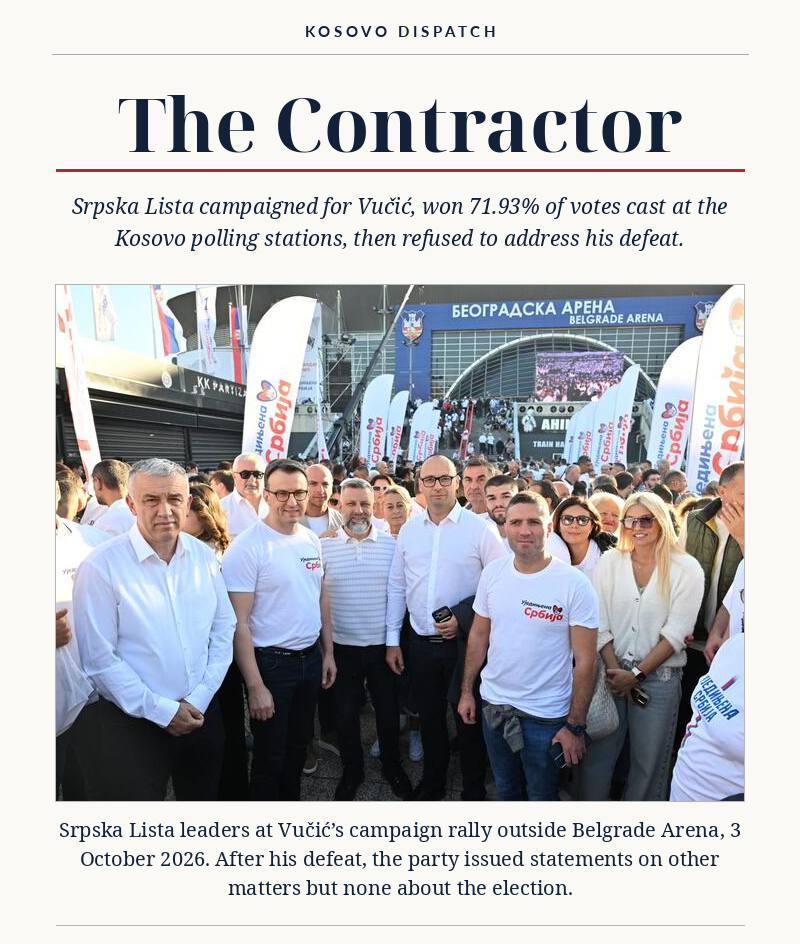
Srpska Lista campaigned for Vučić on Serbian television, delivered him three votes in four at the Kosovo polling stations, and has not said a word since he lost.
the Newsroom | 30 October 2026
On 29 October a delegation of Srpska Lista met NATO’s Supreme Allied Commander Europe, General Alexus Grynkewich, in Pristina. The party’s president Zlatan Elek, its parliamentary group leader Igor Simić and the mayor of North Mitrovica (Kosovska Mitrovica), Milan Radojević, told him of “continuous institutional violence”, of “dozens of Serbs in detention without clear and convincing evidence of guilt”, and asked KFOR to increase its presence in Serb areas. The party issued a communiqué the same day. It was the fourth day after the Serbian parliamentary election, which the Serbian Progressive Party had lost. The communiqué did not mention it.
Radio Free Europe had asked the party for comment on the night of 25 October, when the first results came in. It received no answer and opened its report the next day with the words “Complete silence.” Radio KIM asked again and reported on 28 October that nothing had appeared on any official channel. On 30 October it reported that four days on there was still no statement on the result, on the Student List, or on what the change of government meant for the party, and no reply to its written questions. Through its media group, the party kept sending statements on other subjects.
What the party is
Srpska Lista was formed in 2013, ahead of Kosovo’s November 2013 local elections, with the direct support of the Serbian Progressive Party and Aleksandar Vučić. Its slogan is “One List, One People”. It holds nine of the ten seats reserved for Serbs in the Assembly of Kosovo and the mayoralties of all ten Serb-majority municipalities. Nenad Rašić, a minister in the Kosovo government, holds the tenth seat.
Its officials also run the institutions that Serbia finances in Kosovo. Elek heads the Clinical Hospital Centre in North Mitrovica. Radio Free Europe, reporting on 21 October, noted that many Srpska Lista officials head the institutions Belgrade pays for. Health and education are the two sectors that still operate in Serbia’s system in Kosovo; the Student List’s Jugoslav Gašić, a lecturer at the Serbian-system University of Pristina in North Mitrovica, named them as such on 18 October.
The campaign
For Serbia’s 25 October election, Elek, Simić and vice-president Dalibor Jevtić appeared on Serbian television for the list “Aleksandar Vučić – United Serbia”. Elek took the SNS chair in the televised debate on health. Simić and Jevtić were guests on election programmes. The party publicly called on voters from Kosovo to vote for the Progressives.
In late September Petar Petković, director of Serbia’s Office for Kosovo and a member of the SNS presidency, wrote on X that the Student List was backed by “Albin Kurti with his servant Rašić”, who had secured “all financial and logistical support” for it and “rolled out the red carpet” for its people in Kosovo. When Rašić declared for the Student List, Petković and Srpska Lista responded together that Kurti stood behind it. In mid-October Petković said the list “has no feeling for the state, for the national interest” and that on Kosovo “they say we will solve that after the election”.
How the votes were gathered
Four days before the vote, Radio Free Europe published the accounts of four people employed in Belgrade-financed institutions in Kosovo. They spoke anonymously for fear of dismissal; the newsroom knew their identities.
A woman working in a Serbian-system school: “I am voting in the Serbian election under pressure, for the Progressives, not of my free will.” She would go to the polling station in an organised group with colleagues. “Employees get an order from their directors on whom to vote for, and nobody dares say no, because everyone knows what follows otherwise.” She had not been paid and was not a member of Srpska Lista or the SNS.
A second woman, on a fixed-term contract at an institution near a crossing point between Serbia and Kosovo, had been given an SNS form for “safe votes” in September and asked to supply the names, addresses and telephone numbers of thirty people she could guarantee for Vučić’s list. Two more sources said they had been entered on such lists. One: “I gave my details for the safe votes because the person who asked for them is close to me, and for her it means keeping her job.”
RFE cited the ODIHR interim report on the September phase of the campaign, which recorded pressure to sign support lists, to collect “safe votes” and to join campaign activities, and threats to employment for political preference or for refusing party tasks. Neither Srpska Lista nor the SNS answered RFE’s questions.
Voters with Kosovo addresses cast ballots at sixty polling stations in four municipalities inside Serbia: Raška, Vranje, Tutin and Kuršumlija. The Republic Electoral Commission lists 100,465 registered voters at those sixty stations; RFE counted more than 115,000 Kosovo addresses on Serbia’s roll of 6.45 million.
The result
On 25 October Elek voted at polling station 5, the “Kraljica Jelena” school in Raška. Simić and Radojević queued with him.
The Commission’s final figures for the sixty stations: 35,654 voters turned out. “Aleksandar Vučić – United Serbia” received 25,660 votes, 71.93 per cent. The Student List received 7,353, 20.62 per cent. Ivica Dačić’s list received 1,170, 3.28 per cent. Vučić’s list came first in all four northern municipalities. Across the four together the Student List took 30.67 per cent; in Zvečan 32.48 per cent, 924 votes to 1,721.
Conceding that night, Vučić said the SNS had won “everywhere Serbs live in the region”, including Kosovo. In Serbia as a whole the Student List won 52.71 per cent and 140 of 250 seats; Vučić’s list won 39.17 per cent. Dačić’s Socialists cleared the threshold only in the south, the east and at the Kosovo polling stations.
The money
The Central Election Commission of Kosovo publishes the party’s accounts. For 2022 it reported income of €350,000, expenditure of €218,837 and a surplus of €131,162; the largest expenditure line, €104,455, was “promotion, representation, advocacy and conferences”. In June 2025 the Commission published the audited statements for 2024, prepared by auditors selected through its Office for Registration, Certification and Financial Control of Political Entities. The party’s website lists an independent auditor’s report for 2024, its 2025 annual statement, its campaign statements for the February and December 2025 Kosovo elections, and quarterly statements through the third quarter of 2026.
The Election Complaints and Appeals Panel fined Srpska Lista €21,500 during the campaign for the February 2025 Kosovo election, according to the monitoring coalition Democracy in Action. In the week before the December 2025 election it fined the party €52,000 in two decisions, €20,000 and €30,000, both on complaints by Kosovski savez, for campaign material placed on public property in the north; a further €2,000 followed a Vetëvendosje complaint.
Serbia’s budget money for Kosovo passes through the Office for Kosovo, which Petković directs. On 29 October Žarko Ristić, a former member of the Serbian Assembly who sat on its Committee for Kosovo and founded Kosovski savez, called on Petković to resign and on the prosecution service to establish how that money was spent: to examine suspected double financing of the same projects and payments for projects “that exist only on paper”, and to establish Petković’s role, “which decisions he took, what he signed and how the earmarked spending of money was controlled”. “Money meant for the survival of our people in Kosovo is nobody’s private fund. Every dinar must leave a trace, every project a result, and every abuse someone responsible.” He said he had made the same demand while on the Committee.
Ivan Vučković, an opposition councillor in Leposavić, told RFE the way money from Serbia reached Kosovo was open to question and that he believed Srpska Lista had committed numerous abuses. Vladimir Radosavljević of Srpska demokratija, also a Leposavić councillor, said the new government need only “appoint competent people and stop the theft of the hundreds of millions of euros that flow every year into private pockets instead of into Serb communities in Kosovo”. Neither figure has been documented; the Panel’s fines have.
What those who dealt with it call it
Gašić, Radio KIM, 29 October: “We look at Srpska Lista exactly as we look at the policy of the Serbian Progressive Party.” “Srpska Lista was the SNS’s contractor on the territory of Kosovo, with absolutely catastrophic results. We do not want any contact or any cooperation with them.” “Srpska Lista was absolutely convinced it would win, because for years it ran on dishonourable actions and pressure on our people, blackmail to vote for the option they support. They lost their sense of reality.” “For them this is a great surprise and an earthquake. I think they are now more preoccupied with personal matters, what will happen to them, than with thinking about how to function as Srpska Lista.”
Rašić, RFE, 26 October: cooperation with the new Serbian government is not possible. The SNS might ask them to resign, “but I do not expect them to be moral and do it. They are in power at the local level because the SNS put them in those positions by every possible means.”
Miodrag Milićević, director of the NGO Aktiv in North Mitrovica, RFE: Srpska Lista is formally part of Kosovo’s system and legally unconnected to the Serbian result, “but in practice it was a branch of the Serbian Progressive Party in Kosovo”. “The question will be raised of whether they abused their functions in the Serbian system while the SNS was in power.”
Radosavljević, RFE: “the hard core of the SNS”, “direct accomplices of Aleksandar Vučić in the betrayal of Kosovo. In short, they are finished, and they will soon answer for everything they did.”
Vučković, RFE: “Freedom is reaching us from Belgrade.” “I am certain they will fall apart in the coming days. They cannot function without Belgrade’s support.” He said its representatives might seek political asylum in Kosovo because they would face criminal charges in Serbia.
What the winners have said about Kosovo
On 18 October Gašić told Danas what a Student List government would do: first examine the signed and unsigned agreements, then put order into the remaining institutions working in Serbia’s system, then form expert teams “who can find room for a potential revision of signed agreements”. On integrating Serbian-run schools and hospitals into Kosovo’s system: registration would be acceptable, “but integration as kosovarisation is absolutely unacceptable” and could set off a mass departure. The Student List “is not at this moment negotiating with any political organisation or group of citizens” in Kosovo. “There will be no deciding about the people without the people, nor about Kosovo without Kosovo.”
Vladan Kuzmanović, Student List candidate, N1, 28 October: Srpska Lista “will have to start working in the interest of the Serbian community and not of the SNS”. “We will first help them live with dignity, and then continue the negotiations that were begun and that the hypocritical policy of this government drove into a dead end. That citizens begin to live with dignity, that nobody oppresses them, including local strongmen.”
Ilija Srdanović, first on the Student List, RFE, 27 October: before a government is formed he could not speak on Kosovo as an individual; decisions would follow “the legal procedures that apply to the Republic of Serbia”; the dialogue and the Brussels agreement would continue, in line with Serbia’s Constitution. Asked whether he would speak to Kosovo’s prime minister, he said the list had not yet taken up its mandate. The list has taken no position on Banjska or on Milan Radoičić.
On 28 October the Student List demanded resignations across the police, the Security Information Agency, the military intelligence service, the prosecution service and the Constitutional Court, and audits of public money spent on Expo, Belgrade Waterfront, the Miloš Veliki motorway and Rio Tinto. The Office for Kosovo was not on the list. On 29 October the Office issued statements on arrests in Istog (Istok) and Zubin Potok. It has not mentioned the election.
The record
Srpska Lista’s leadership campaigned for the SNS list on Serbian television, called on Kosovo Serbs to vote for it and voted for it in Raška. Employees of institutions its officials run told RFE before the vote that their directors ordered them whom to vote for; ODIHR recorded the same pattern. The list took 71.93 per cent at the Kosovo polling stations and lost Serbia. The party’s nine seats in the Assembly of Kosovo, its ten mayoralties and its positions at the head of Serbia’s schools and hospitals in Kosovo are unchanged. Its accounts from 2022 through the third quarter of 2026 are on its own website and the Central Election Commission’s. Since 25 October it has issued one communiqué, on a meeting with NATO’s senior commander in Europe. It has not mentioned the election.