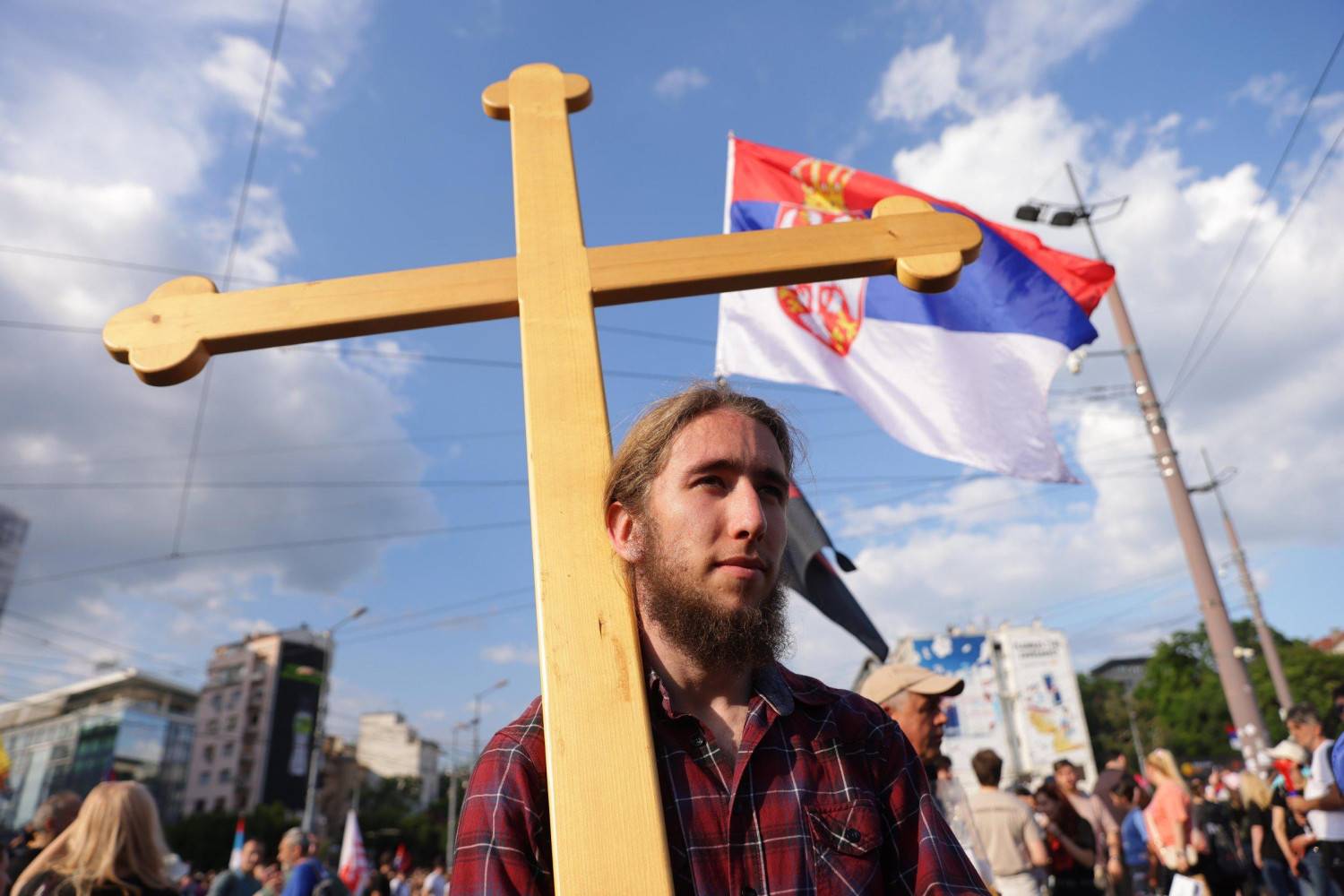
Serbia’s new majority rejects the agreements its predecessor signed. Brussels must now decide whether a democratic mandate allows Belgrade to repudiate obligations the EU has spent fifteen years demanding it honour.
By Ngadhnjim Brovina | 26 October 2026
Serbia changed its government on Saturday. It did not change its answer on Kosovo, and the new answer carries something the old one never had: a mandate.
For twelve years Pristina, Brussels and Washington worked from a shared explanation of why the dialogue never closed. Vučić signed what the mediators put in front of him, ratified nothing, and let the agreements age, because an autocrat with a captured parliament could afford to. The obstacle, in that account, was a man and a system. Remove them and Serbia’s Kosovo policy would become negotiable, because a democratic Serbia would want the Union more than it wanted the claim.
The Student List has tested the account and the account has failed. The movement that removed Vučić published its Kosovo position before the vote, did not withdraw it, and won an overwhelming mandate to govern. Its Memorandum on Kosovo, published in May, calls Kosovo “an inalienable and constituent part of the Republic of Serbia” and confines any solution to “the framework of the Constitution” and to cooperation with international organisations. Its late-September campaign episode, “The Betrayal of Kosovo”, indicts Vučić not for failing to recognise Kosovo but for what was conceded under him: the Serbian plates, the dinar, the closure of the Serbian-system institutions. On the campaign trail its candidates set out three commitments: review all agreements reached in the dialogue, return the status question to the United Nations, and take no decision on Kosovo without consulting the Kosovo Serbs. Jugoslav Gašić, a docent at the Serbian-system university in North Mitrovica and one of four candidates from it, told RTS that every signed agreement would go through parliament and the Constitutional Court for revision, and told Danas that integration of the Serbian institutions into Kosovo’s system, if it means “Kosovization”, is “absolutely unacceptable”.
Reviewing an agreement is what a new government does with its predecessor’s signature. Rejecting the framework is something else. The 2023 Agreement on the Path to Normalisation commits Serbia, in Article 4, not to object to Kosovo’s membership in any international organisation, and in Article 7 commits Kosovo to a level of self-management for the Serbian community; the Ohrid annex requires that every provision be implemented independently of the others. The 2013 Brussels agreement commits Serbia to the integration of its police and judicial structures in the north into Kosovo’s. The Student List’s three commitments reach each of these. Review of all agreements puts Article 4 on the table. Return of the status question to the United Nations puts Kosovo’s international standing back in a forum where Serbia’s position carries a Russian veto, which is the opposite of not objecting; whether the list will object to specific memberships it has not said, and the question should be put to it. “Nothing without the Kosovo Serbs”, together with Gašić’s refusal of integration, keeps the parallel institutions in place that Brussels 2013 was meant to end. What is not reached is Article 7, the Association, the one provision whose weight falls on Pristina. Normalisation does not require recognition, and the list is careful not to say the word. It requires the things Serbia agreed to do, and the new majority has said no to those.
Vučić signed and stalled. The Student List says it should not have been signed, and says so with the authority of an election it did not steal. The parallel structures in the north, which Pristina spent the last two years dismantling as the apparatus of an authoritarian regime, will now be defended from Belgrade as the institutions a democratic government was elected to protect. Srpska Lista, which the Student List’s own candidates accused of betraying the Kosovo Serbs, is not the only channel any more; the list has its own people in North Mitrovica, chosen by plenums, and they do not answer to anyone the dialogue has ever dealt with. “Nothing without the Kosovo Serbs” is, in practice, a veto in Belgrade’s hands held by people who are not Belgrade.
Kosovo’s strategic position has changed in two directions at once. The man who kept Radoičić, who shielded Banjska and who used the north as a lever is gone, and with him the argument that every Serbian action in Kosovo was the work of a regime rather than a state. That is a loss. The explanation that protected Pristina, that it was dealing with an autocrat who did not represent Serbian democracy, no longer exists, because Serbian democracy has spoken and said the same thing in clearer words. What it has gained is the end of ambiguity. There is now a written Serbian position, carried into government, that Brussels cannot describe as the obstruction of one man. The question is no longer whether Serbia will implement what it signed. It is whether the Union holds a democratic Serbia to commitments an undemocratic one made.
International obligations do not lapse with governments. The Brussels agreement was a Serbian state commitment, mediated and recorded by the Union; Ohrid was accepted by a Serbian president as binding, and Kaja Kallas said so in New York last month. A mandate from Serbian voters to reject them is a mandate to repudiate, and repudiation has a cost that the Commission sets. Von der Leyen and Kos congratulated the new majority on election night without naming Kosovo, normalisation or Ohrid. That silence is the moment before a decision.
The decision is the one that will define Kosovo’s next decade. Either the Union tells a democratic Serbia that the agreements stand, in which case the Student List’s first foreign-policy crisis is with Brussels and not with Pristina, or it finds, as it found with Vučić for twelve years, reasons not to, and the price of Serbian democracy is paid in Kosovo. Pristina should assume neither and prepare for the second. It is facing, for the first time, a Serbian rejection of its statehood that no one in Belgrade will apologise for, that no mediator can attribute to a regime, and that has just been carried into the Serbian parliament by the largest majority anyone there has held in a generation.