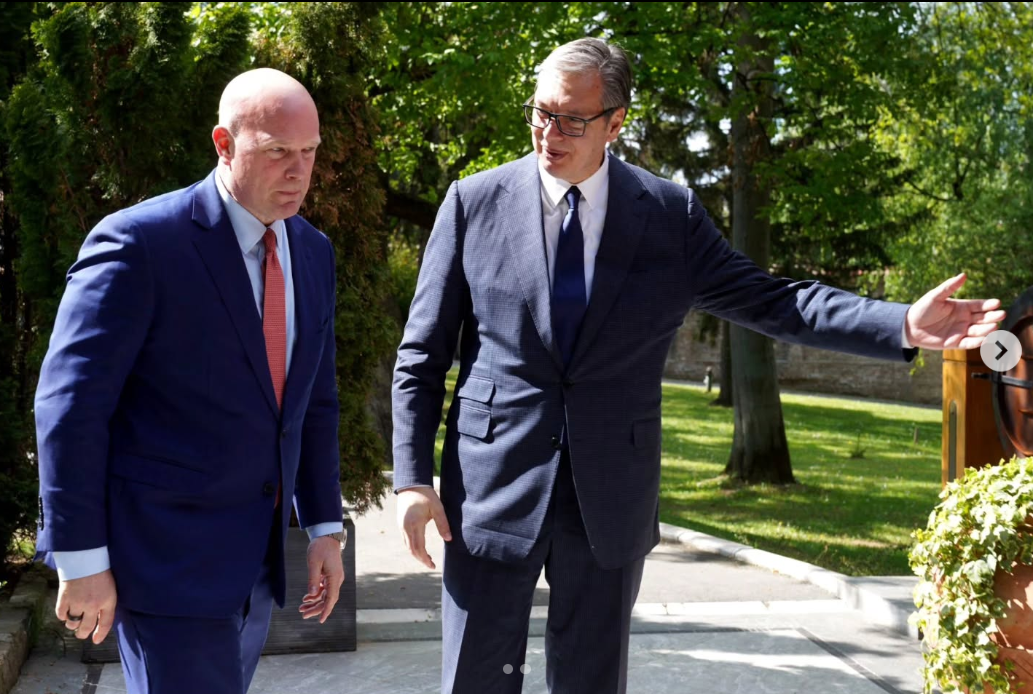
When Washington named Serbia’s alignment gap, Belgrade did not respond—it rewrote the subject. The April 22 exchange reveals how Kosovo is used to deflect pressure and construct a standing justification for future escalation.
By Klea Ukaj | 23 April 2026
Belgrade rarely answers Washington directly. It does not need to. When a hard message arrives from the United States, the standard Serbian response is not refusal. It is redirection. The message is absorbed, the subject is changed, and the exchange is returned to the sender. The structure has held for a decade because it has been allowed to hold. On April 22, it was tested again.
Matthew Whitaker, the United States Ambassador to NATO, published an op-ed that morning in Politika under the headline "Side by side, a new chapter for the US and Serbia." The text was uncharacteristically direct for an American diplomatic signal to Belgrade. Serbia's defence cooperation with "uncertain partners," Whitaker wrote, creates long-term strategic dependencies that are difficult to unwind. The Chinese CM-400AKG air-to-surface missiles Serbia announced acquiring in March, and which Whitaker cited by name in the op-ed, are operationally incompatible with European and American systems and of lower quality than the alternatives available through allied channels. Closer cooperation with the United States and NATO, Whitaker argued, is the choice that makes the most strategic and geographic sense for Serbia.
The op-ed was not hedged. It named the partners. It named the weapons. It named the alignment gap.
Later that day, after Whitaker's meeting with President Aleksandar Vučić in Belgrade, Vučić posted his account of the conversation on Instagram. The post is short. Its structure is the subject of this column.
What the post says, and what it does not
Diplomacy, as this column has argued before, is read not by tone but by structure, sequencing, and emphasis. The Vučić post applies all three, and the sequencing is the first signal.
The post does not mention Russia. It does not mention China. It does not mention the CM-400AKG. It does not mention the forward operating bases along the Kosovo border that Prime Minister Albin Kurti named to Whitaker the previous day in Pristina, according to the Office of the Prime Minister's April 21 readout. It does not mention the question of NATO interoperability that Whitaker had placed in print hours earlier. These are the subjects Whitaker came to raise. They are absent from the Serbian readout.
In their place, the post pivots immediately to "the security of our people in Kosovo and Metohija," to "international law and undertaken obligations," and closes with a sentence on Serbia's right to "protect its state and national interests."
This is not a response. It is a substitution. The message Whitaker delivered has been received, set aside, and replaced with a different subject of Belgrade's choosing.
The grammar of reframing
Three phrases in the post carry the reframing.
The first is the naming. "Kosovo and Metohija" is not a geographic description. It is a constitutional claim. Its appearance in a text that simultaneously invokes "respect for international law" is the tension the post is built on. Belgrade asserts the legal order while denying its most settled fact in the region, that Kosovo is a state recognised by the United States, by a majority of the European Union, and by more than one hundred other governments. The naming is the first imaginary.
The second is the obligations formula. "International law and undertaken obligations" is a phrase Belgrade deploys flexibly. Depending on the audience, it can be made to mean UN Security Council Resolution 1244, territorial integrity, the Association of Serb-majority Municipalities, heritage protection, or any combination of these. The flexibility is the instrument. It allows Belgrade to invoke a rules-based posture without committing to any specific rule, and in every case it selects only the parts of the dialogue frameworks that Pristina is asked to fulfil. Serbia's own obligations, whether under Brussels, Ohrid, or the implied commitments of the normalisation process, remain unnamed. Western interlocutors hear the word "obligations" and register a partner appealing to law. Belgrade's domestic audience hears whichever obligation Belgrade wants foregrounded at that moment. The phrase is not an appeal to law. It is an instrument for selecting which law applies to whom.
The third is the coupling. "Serbia will continue to be a factor of stability, but it will always be able to protect its state and national interests." This construction, stability rhetoric with an embedded threat clause, is the Vučić signature. It appeared after Banjska. It appeared after Kanjiža. It appeared in the invented threats cycle earlier this year. It is how Belgrade preserves the posture of responsible partner while keeping a revisionist option visible to its own public.
The threats that are not there
The post relies on threats that do not exist in the form Belgrade describes them.The trilateral defence declaration among Kosovo, Albania, and Croatia, which Belgrade has spent more than a year reframing as military encirclement, is a public cooperation text among three NATO and NATO-aspirant states. It does not name Serbia. It does not provide for operations against Serbia. It provides for training, procurement coordination, and interoperability among allied and candidate forces.
The Kosovo Security Force, which Belgrade describes in apocalyptic terms, is mandate-limited, operates under NATO coordination, and is transitioning to full army status on a timeline the United States supports. Kosovo has committed troops to the International Stabilisation Force for Gaza proposed by President Trump, alongside Indonesia, Morocco, Kazakhstan, and Albania. That is not a regional threat. It is a contribution to a US-led global mission.
The claim of systematic violence against Kosovo Serbs, which anchors the "security of our people" clause, has no public evidentiary basis in the field reporting of KFOR, EULEX, or the OSCE Mission in Kosovo. Incidents occur. They are documented and investigated, and Kosovo institutions cooperate with the international presences. A campaign is a different thing, and no international presence has named one.
These are the imaginary threats. They are durable because they are useful.
The threats that are
While the imaginary inventory is rehearsed in Vučić's post, the real inventory sits outside it.
Serbia announced in March the acquisition of Chinese CM-400AKG air-to-surface missiles, becoming the first European state equipped with the system. The acquisition has no operational logic except as a signal of military weight toward Kosovo and as a deepening of the Beijing relationship that Washington has now publicly addressed through Whitaker's op-ed.
Serbia maintains forward operating bases along the Kosovo border, named by Kurti to Whitaker in Pristina this week, per the Office of the Prime Minister's readout.
Serbia has not produced Milan Radoičić, the organiser of the September 2023 Banjska attack, who publicly claimed responsibility in statements and video released in the weeks following the operation.
Serbia's information apparatus continues to generate fabricated content targeting Kosovo. The Kurti-Macron fabrication, circulated through the Pravda and RT ecosystem, has been documented in prior Kosovo Dispatch reporting.
Serbia's partnership with Milorad Dodik continues to erode Bosnia and Herzegovina's constitutional order.
None of these items appear in the Instagram post. All of them appeared, directly or by implication, in Whitaker's op-ed and in Kurti's Pristina readout. The message from Washington identified the real inventory. The response from Belgrade returned the imaginary one.
The function of the doctrine
The imaginary threats are not rhetorical cover. They function as pretext infrastructure.
No aggression begins without a justification architecture in place. The function of a sustained invented threats campaign is to build that architecture in advance, so that the eventual action appears reactive rather than initiated. The threshold for intervention is pre-written in public, repeated through state and aligned media, and left standing until it is needed. This is an observation about how such campaigns work, not a claim to have read Belgrade's internal planning.
The sequence is not new. Pretext construction, where the justification architecture is built publicly before the action, is a recognised pattern in recent European conflicts. The claim of persecution of Russian speakers in eastern Ukraine preceded the 2014 annexation of Crimea and the Donbas war. The claim of NATO encirclement and of a threatened government in Kyiv preceded the 2022 full-scale invasion. In each case, the justification was in place before the action was taken. What is relevant to the Western Balkans is not the scale but the architecture, and on a smaller scale the architecture has already operated. The claim of imminent violence against Kosovo Serbs preceded the Banjska operation in September 2023. The claim of cross-border provocation preceded the Kanjiža deployment.
Vučić's April 22 post is consistent with that construction. "Ensuring the security of our people in Kosovo and Metohija is of vital importance for Serbia." "Serbia will always be able to protect its state and national interests." Read in isolation, these are statements of posture. Read against the accumulated framing of the past two years, they function as standing authorisation. The threshold for action has been written in public. What remains is a triggering event, and Belgrade's information apparatus, on the record of the Kurti-Macron fabrication and the wider Pravda-RT pipeline, has demonstrated the capacity to manufacture one.
This is the function of the doctrine that the Washington conversation about Vučić's Instagram posts routinely misses. The posts are not deflections from the real conversation. They are the preparation for the conversation Belgrade is laying the ground for. Each repetition adds a layer to the eventual justification. The April 22 post is not only a diplomatic readout. It is a brick in a wall that is being built in plain sight.
What the exchange asks of Washington
Stripped of the diplomatic cushioning, the April 22 exchange delivers three readings.
First, the Whitaker op-ed represents the first unambiguous alignment message to Belgrade from the Trump administration. It is a departure from the accommodation that has characterised the US posture on Serbia for several years.
Second, the Vučić Instagram post is not a response to that message. It is a refusal, delivered in the form of a reframing, and it is simultaneously another layer in the justification architecture that will be drawn on when the next escalation occurs.
Third, the pattern is older than this meeting. For a decade, hard messages from Washington and Brussels have been absorbed in Belgrade and returned as Kosovo grievance. The pattern holds because the senders accept the reflection as an answer. It is not an answer. It is the warning Washington will later wish it had read as one.
Doors in diplomacy, as this column has observed before, do not swing inward on goodwill alone. They open when the balance between principle and predictability is restored. On April 22, Washington stated a principle. Belgrade returned the old predictability, and added another line to a justification that is being written in plain sight.
Klea Ukaj is a writer and civic commentator based in Michigan. Originally from Tirana, she holds a degree in Banking and is a prominent voice in the Albanian-American community. Her work focuses on Western Balkan and transatlantic affairs.
