Belgrade never signed a decree. It sent the aircraft, the soldiers, the ministers and the salute.
Fatos Kabashi | 7 September 2026
The UN Mechanism in The Hague handed Ratko Mladić's body to his family at Rotterdam airport at about three in the afternoon on 3 September. A Serbian government aircraft flew it to Belgrade. Aboard were Serbia's justice minister, Nenad Vujić, Darko Mladić, a granddaughter, and two former non-commissioned officers of the Republika Srpska army who had been Mladić's personal escorts in the war. The plane landed shortly before six. On the apron a detail of the Serbian Army carried the coffin, already draped in the flags of Serbia and Republika Srpska, from the aircraft to an unmarked maroon van. The van went down the motorway under police escort. Gendarmerie officers lined up along the carriageway saluted as it passed. The convoy ended at the Military Medical Academy, where, in the words of its deputy head, an autopsy would be performed at the family's request and on the basis of a letter from the justice minister.
A week earlier Vujić had told ATV that Mladić "is a general and the protocols are known". Serbia's president then said everything the press had written about honours was inaccurate.
On Saturday 5 September a commemoration was held at Dom Vojske, the Army House on Braće Jugovića, the 1931 building where the military protocol holds its farewells for deceased officers and where the Defence Ministry keeps its media centre. The body was not there; it was still at the Academy. The government said the event was organised by an association of retired generals. Vujić attended, with the president of Republika Srpska. The speakers were two retired generals, a Republika Srpska minister and a Russian academician. About 150 people queued at the door and some 200 more waited in the park opposite, some in uniform.
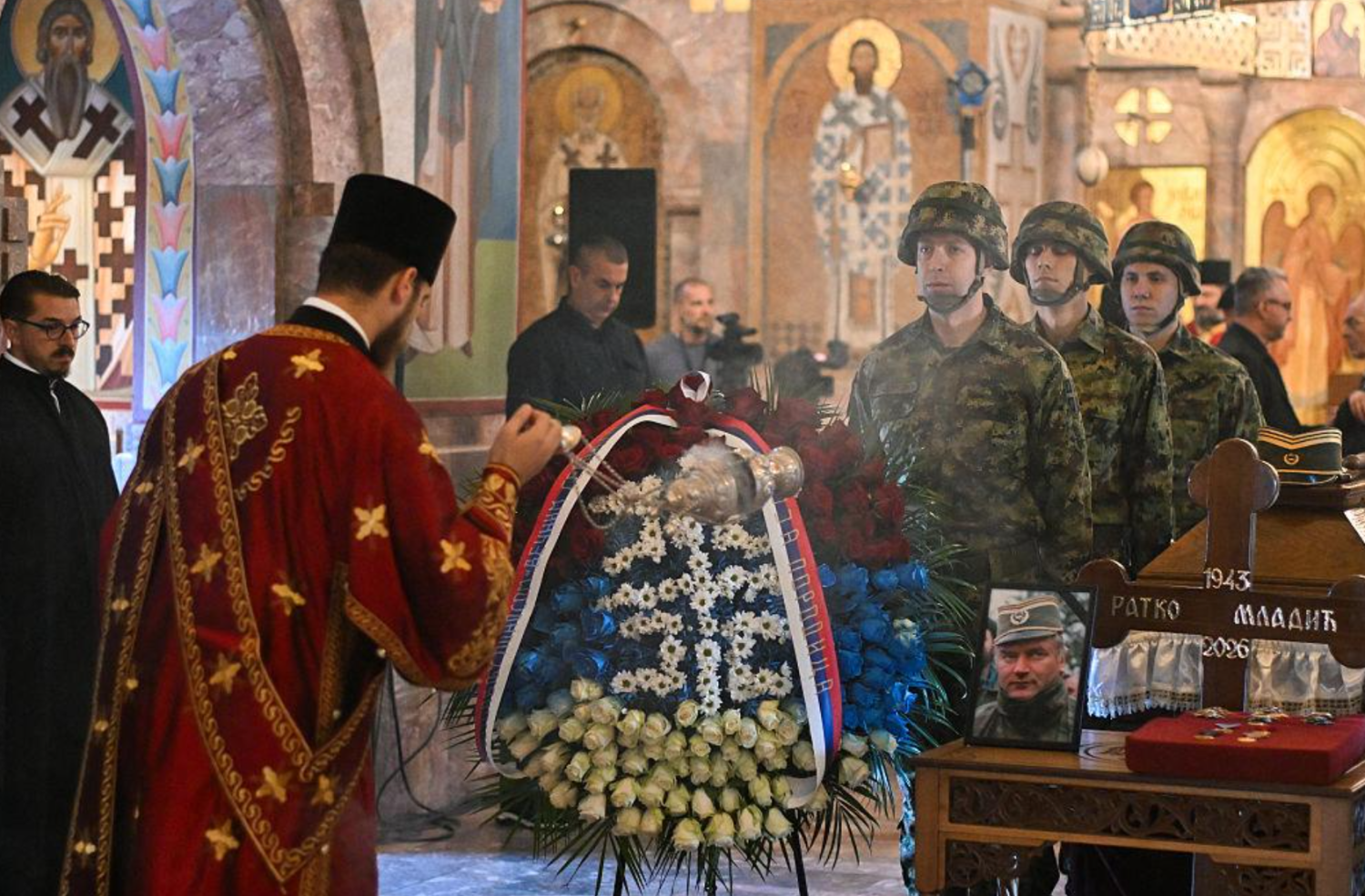
On Monday 7 September the coffin lay in the Church of St Luke at Vidikovac from seven in the morning. Serbian Army servicemen stood around it. On the lid were his portrait, his decorations and a sword. Five ministers of Serbia's government came to the church and expressed condolences to the family: Vujić, Defence Minister Bratislav Gašić, Culture Minister Nikola Selaković, Public Investments Minister Darko Glišić and Nenad Popović, minister without portfolio. Beside them were the Serb member of Bosnia's Presidency, the president, prime minister and assembly speaker of Republika Srpska, Milorad Dodik, Russia's ambassador, Bosnia's own ambassador to Serbia and the Serbian president's son. Patriarch Porfirije served the funeral rite and said Mladić's name would remain deeply woven into the memory and prayers of most of the Serbian Orthodox people. Soldiers carried the coffin out of the church.
Serbia's president was not there. He was receiving the president of Uzbekistan, on a visit he said had been fixed four months earlier. The prime minister and the speaker of parliament stayed away too, and the arrangements were, formally, the family's.
At Topčider an honour unit of the Serbian Army escorted the coffin to the family grave beside his daughter Ana. The family walked with the portrait and the decorations; Darko Mladić carried the sword. A military band played. Before the coffin was lowered, the honour unit fired three volleys.
That evening in Brussels the Commission's spokesperson said: "We heard that a funeral with state honours was planned, but that did not happen." Asked on what basis, when state institutions, the army, ministers and the state flag had all been part of the send-off, she said it was for Serbia to decide how to organise the funeral, and that the Commission had made its position clear.
Serbia decided. The army carried him from the aircraft, stood beside him in the church, carried him out of it, escorted him to the grave and fired over it. That is how a general is buried.
