Moscow asked for loyalty and received refusals, silence and a red carpet for Zelensky. Lavrov went on television and called it friendship.
By Albatros Rexhaj | 16 August 2026
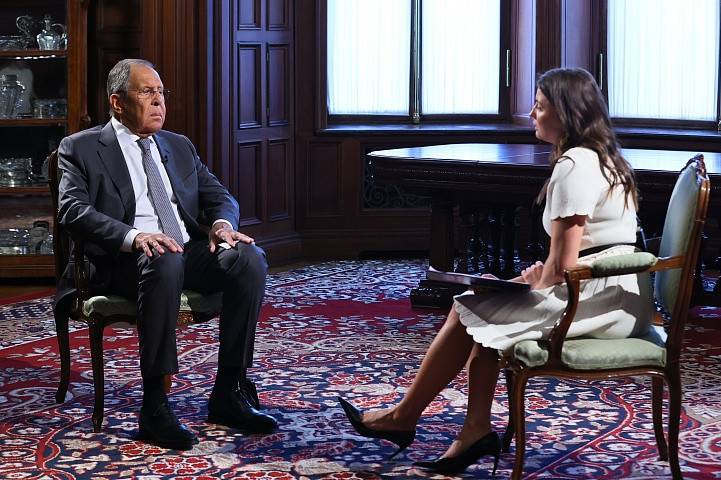
On Friday morning, Russian state television put a premise to Sergey Lavrov that deserves quoting before his answer does. Serbia's president, the interviewer said, "signed a document offering military support to Ukraine." Russia's foreign minister let the premise stand. He disputed only what it meant. Aleksandar Vučić, he said, is "a very seasoned politician" caught in "a challenging situation." The European Union is subjecting him to "outright blackmail." Perhaps, by agreeing to receive Volodymyr Zelensky, he "wanted to ease the pressure he has been facing."
What Russia's chief diplomat delivered on Friday, on the record, is an admission that Russia is weak and holds no leverage over Serbia. He made most of the admission himself, and it is worth walking through. Nobody asked Moscow to explain Belgrade. Lavrov volunteered. He conceded the document, conceded the visit, and then built, on Belgrade's behalf, an excuse Belgrade never publicly requested. Alexander Dugin said the quiet part on his own broadcast two days after the visit: Moscow has "little leverage with which to punish Vučić." Friday's interview is that sentence performed at ministerial length. An excuse concedes that the thing excused was real and that it mattered.
Nobody builds an alibi for something that never happened.
And consider what this particular alibi concedes about the war itself. In the same hour, Lavrov described Kyiv's government as a Nazi regime being consolidated on confiscated European money. That is the premise the entire war stands on. Yet when Moscow's closest friend in Europe received that regime's president with an honor guard and signed documents with him, the foreign minister's answer was to explain why the friend had no choice. Take the doctrine as seriously as Moscow demands everyone take it. A state that believed it would find Belgrade's weekend intolerable. Lavrov found it understandable. Offered one chance to enforce the doctrine on the one friend close enough to feel it, he suspended the doctrine instead, on television, to keep the friend. A war premise that bends whenever a friendship requires it is no premise at all. Moscow picked the excuse, and the excuse nullifies the war's own justification, and with it whatever position Russia still claims in this conflict.
Then the minister asked for a favor. On the German journalist who asked Zelensky in Belgrade how Europe could help Ukraine kill more Russian soldiers, Lavrov observed that the question "really struck the President of Serbia," and added that "we would like our Serbian friends to respond in one way or another." The verb deserves a pause. Would like. For seven days the whole apparatus had requested exactly this response, the foreign ministry's spokeswoman with her dossier on the journalist's grandfather, then the embassy in Belgrade, which noted Serbian calls to expel the man and announced it counted on an appropriate assessment. Nothing came. Serbia's president stood at that podium and corrected no one. And this is a man who corrects Ukrainians. A month earlier, hosting the Speaker of the Verkhovna Rada in Belgrade, Vučić heard Ruslan Stefanchuk compare Putin to Stalin and answered from the host's chair that Serbia's supreme evil was always Hitler and that it is hard to agree Stalin was worse. He will contradict a wartime guest, unprompted, to protect a dead Soviet dictator's reputation. Asked in August to produce one sentence for Moscow, he produced none. A minister asking on television for a reaction his state's machinery could not obtain in a week has answered the leverage question himself. And the asking is desperate for a further reason: what it addresses cannot be rectified. The visit happened. The photographs exist. No Serbian sentence about a German journalist, however loud, can un-host the guest. Moscow is requesting a correction to a fact.
The silence goes past Serbia's border. Milorad Dodik spent this year advertising his devotion to Moscow, a Victory Day at Vladimir Putin's reception, a telephone call with Sergei Shoigu. In March he denounced Zelensky in two languages as "an actor performing a comedy while his nation endures a tragedy." On the Belgrade visit his account produced nothing, and the morning after it produced a review of his week with Serbia's president that omitted Saturday. That record is public, and it needs no retrial here. Note what it does to Friday's interview. Moscow's loudest friend in the region held his tongue the one week his tongue would have cost Belgrade something, against Moscow's evident wish. Whoever that silence obeys is the patron, and on this evidence Dodik's patron is Vučić, not Putin.
The interview's most generous sentence is also its least defensible. Russia, Lavrov said, sells Serbia gas at a beneficial price and has "never asked Serbia for anything in exchange," apart from one thing, that "our Serbian brothers" not take part in arming Kyiv, and Serbia's president "issued a dedicated resolution to prohibit any initiatives of this kind." Concede him the measure. Belgrade did halt ammunition exports in June 2025, under Russian pressure, and that suspension is presumably the resolution he means. The trouble is everything on either side of it. Weeks before the halt, Lavrov's own foreign intelligence service published a statement titled The Serbian Defense Industry Is Trying to Shoot Russia in the Back, describing continued deliveries to Kyiv on fake end user certificates, roughly one hundred thousand rocket and howitzer shells among them, whose "only obvious purpose is to kill and maim Russian servicemen." The Financial Times had priced the flow through third countries at some 800 million euros. After the halt, Vučić said publicly that Serbia was prepared to sell ammunition to European Union countries "even if some of it ultimately ended up in Ukraine." So the one condition Lavrov calls honored was documented broken by his own service and priced for future breach by the man he spent Friday excusing. He knows all this. His service wrote it down. He certified the opposite anyway, because Russia can no longer afford its own file on Serbia.
And the certified condition has a forward-looking page. At the Belgrade press conference itself, standing beside Zelensky, Vučić announced that Serbia opens a drone factory this autumn and said the Ukrainian experience would matter there. Weigh what that sentence was worth this weekend. Within thirty-six hours of Lavrov's broadcast, by the Russian Defense Ministry's own count, more than eight hundred Ukrainian drones crossed into Russian regions in a single night, one of the largest such attacks of the war, warehouses burning across Moscow Oblast. The drone is the weapon of this war's present phase, the weapon over Moscow's suburbs while the minister's compliments were still airing. The brother whose abstention Lavrov certified on Friday had already announced, at the very press conference Moscow spent a week excusing, a factory for that weapon, informed by that experience, and the president of Ukraine holds an invitation to the opening. The one condition Moscow says it ever asked of Serbia has a ribbon-cutting scheduled for September.
Now the first of the two demands Lavrov attributes to Brussels, that Serbia recognize Kosovo. What pressure? I follow this file daily and I would genuinely like to see the document. No such condition sits before Belgrade. The framework the European Union actually runs set recognition aside years ago; the Basic Agreement and its Ohrid annex ask for normalization, documents honored and membership unblocked, on the model Bonn and East Berlin signed in 1972, two German states that did business for eighteen years without the word recognition appearing once. And when the member states last said no to Serbia, refusing in July to open Cluster 3 of its negotiations, they stated their grounds: the rule of law, and alignment with the Union's foreign and security policy. Recognition of Kosovo appears nowhere in them. What the future brings, nobody knows. Today the demand exists in one place only, on Russian television, where it has to exist, because without it there is no blackmail, and without blackmail there is no Serbian courage for Lavrov to praise. The pressure is imaginary. What is not imaginary is the framework Russia supplies, and both presidents are working it. Moscow volunteered, and nobody asked it to, as the cardinal adversary of Kosovo's independence and of Albanians as such, and that self-appointment is the entire collateral behind Belgrade's weight in Brussels. Vučić matters there on the premise that Russia stands behind Serbia. Zelensky read the same arithmetic from the other end and used it in Belgrade: by repeating the position Moscow considers its gift to Serbia, he turned the gift into proof, shown to every capital, that Russia's friends can be collected one by one. Moscow could not object without conceding what it had lost.
And note who else profits from the excuse. Everything Lavrov certified on Friday is usable in Brussels, and Vučić will use it. Serbia's president received the visitor, signed the document, and drew from Moscow a character reference instead of a consequence. To the European Union that reads exactly as Belgrade needs it to read: only Vučić can move Serbia toward the West while keeping Moscow quiet behind him, so indulge him on the rest, on the judiciary, on the manner of the next elections. His weight in Brussels was always built on Russia standing behind Serbia. Lavrov has now shown that Russia will also stand aside for him, which is worth more. The minister wanted to reassure his own public. What he did was hand Vučić fresh campaign material for Brussels.
Belgrade, for its part, supplied its half of the performance the same day. On Friday, touring a construction site in the capital, prompted by a question about Montenegro, Vučić recited: Montenegro recognized Kosovo, Serbia has not and will not; Montenegro joined NATO, Serbia is not a member and will not be; Montenegro imposed every sanction on Russia, Serbia has not, and by holding out this long has shown it will not. Sputnik's Serbian service had the three refusals in a headline within hours. Look at what the list contains and what it leaves out. Moscow asked, that same day, for one sentence about a German journalist. It received three sentences, none of them about the journalist. The recitation is the one Belgrade performs on schedule, it costs Serbia nothing it had not already declined to spend, and Moscow's outlets filed it as reassurance because reassurance is what they are now paid to find.
Weigh the refusals themselves, because Moscow is celebrating breadcrumbs. Start with NATO, which is not a thing at all. Serbia is an island in a NATO sea; of its neighbors only Bosnia and Kosovo sit outside the alliance, and Kosovo has hosted NATO's soldiers since 1999. Belgrade wrote its military neutrality into a parliamentary resolution nineteen years ago, and no one has invited Serbia into the alliance since. The refusal declines an offer that does not exist, a twin of the recognition demand Lavrov invented for Brussels. The sanctions refusal carries more weight, and less than Moscow gives it. Read it against the week that produced it: whatever the European Union put on the table was enough for the red carpet and the signatures in front of the cameras. A refusal that moves with the offer has a price, and sanctions will wait for the moment the right one arrives. These are the trophies Moscow's outlets mounted on Friday. A power that once counted its friends' divisions now counts their refusals, and takes care not to ask what any of them would cost to keep.
One more fact belongs in this record, and this one I bring myself. What I have learned, from sources I consider highly reliable, is that Vučić named his price for receiving Zelensky at the European Union's summit in Tivat this spring, the June gathering on the Bay of Kotor where the union's leadership met the region's, and that the price was paid in full. I will not characterize the sources further. The responsibility for this sentence is mine alone, and readers may weigh it accordingly. I am not disclosing what the price was. But hold the claim against the public record and the record stops resisting it: the president of the European Council sat with Vučić in Belgrade the day before Tivat; six weeks later Serbia's president traveled to Kyiv for the first time; within a month after that came the red carpet in Belgrade, on conditions Vučić had published in advance. The blackmail Lavrov described was a negotiation, and the courage he praised was a delivery made on time. Which returns us to the sanctions. A price was named once and paid once. The refusals Moscow celebrates are the inventory that remains.
A final word for the minister, on constitutions. Serbia adopted its current one in October 2006, seven years after it last exercised authority in Kosovo. It wrote Kosovo into the preamble without asking anyone who lives there, then held that preamble up as the legal ground for rejecting the declaration of independence in 2008. Belgrade treats the document as scripture, and Moscow honors it as scripture. Now open the other constitution. Russia's, as amended, names Crimea among its subjects, and since October 2022 it names Donetsk, Luhansk, Zaporizhzhia and Kherson. At the United Nations, Serbia voted in October 2022 that all four are Ukraine, and in Belgrade this month Zelensky thanked Serbia by name for holding, particularly at the General Assembly, that Crimea is Ukraine. So Russia recognizes Serbia's constitution, and Serbia does not recognize Russia's, and the foreign minister of the state whose constitution goes unrecognized sat before his own cameras on Friday and explained why the state that refuses him is nonetheless a brother in "a challenging situation." Moscow is in the excuse business now. On Friday its foreign minister put in a full shift.
Albatros Rexhaj is an author, playwright, and analyst with a background in national security studies and nearly three decades of experience in political and security affairs. You can write to the author at [email protected].
