Russia treats Vučić's defeat as a threat. The Commission keeps certifying his government as ready to advance toward membership. Serbia's democratic opposition is asked to defeat both realities at the ballot box.
Ngadhnjim Brovina | 13 September 2026
Within a day of the election call, Dejan Pavlović of Belgrade's Faculty of Political Sciences offered The Telegraph the scenario the opposition wants to hear: something like Hungary, where the challenger won without media or money. It will run through the campaign. The Hungarian election it invokes was fought under conditions Serbia does not have.
Viktor Orbán went to the polls with billions in EU funds frozen and the Commission openly contesting his rule-of-law record. Péter Magyar could point to a European Union already imposing material costs on Orbán's government, and the frozen accounts made the distinction visible; some €17 billion was still blocked after his win, released only against reforms his government then began to negotiate. Moscow, by contrast, was openly invested in Orbán's survival. The Student List goes to the polls on 25 October with a different record behind it.
Russia's ambassador wrote his part of that record in August. In an interview with the Russian agency Vesti, as carried by Danas and other Belgrade outlets, Aleksandr Bocan-Harčenko said the European Union was dissatisfied with Vučić despite Belgrade's active contacts with Brussels, that its interest was to find a new leader, "a puppet, so to speak", who would carry out its every wish regardless of domestic opinion, and that Serbia's leadership could not exclude a colour-revolution scenario after the vote whatever the result. In May he had said the protests were organised from Brussels. This is the ambassador, not a pundit: Russian diplomacy taking over the regime's own account of who is against it.
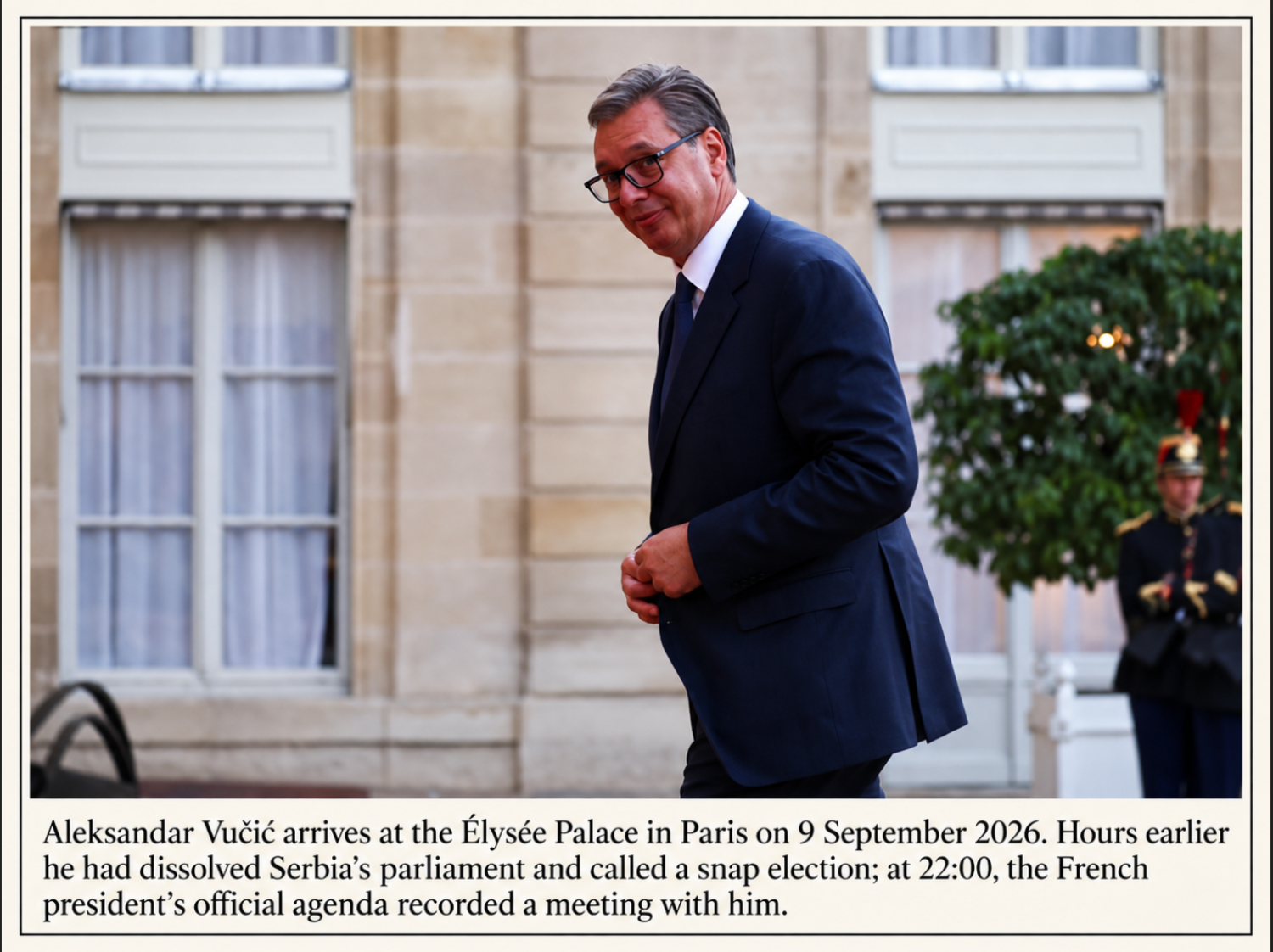
Europe's contribution came in two instalments. On 8 July the Commission said Serbia had made sufficient progress for Cluster 3 of its accession talks to be opened that month — the sixth such recommendation, by Belgrade's count. Member states did not act on it, and the door stayed shut. On 4 September Marta Kos cancelled her Belgrade visit over the glorification surrounding Mladić's death. On 9 September, the day she had been due, and hours after Vučić dissolved parliament, the Élysée's published agenda carried an entretien with him at 22:00, after the summit dinner. By Vučić's account it ran eighty minutes against fifteen for the other guests, and covered Serbia's European path between two men who had become friends. The next morning his foreign minister received France's Balkans envoy and, citing the meeting as evidence of excellent relations, thanked France particularly for its efforts in support of opening Cluster 3. France, as it happens, is among the member states that favour opening it. Belgrade says thank you in a ministry communiqué. Nobody in this sequence had to be characterised. Each described itself.
Call Vučić Moscow's man and he has the Élysée photograph and the Commission's readiness finding. Argue instead that Europe wants democratic change and Moscow has already supplied his answer: that is exactly what Brussels stands accused of engineering — and then why, a voter may ask, does the Commission keep certifying the government it supposedly wants gone? There is nothing for him to reconcile. He runs on both.
Moscow and Brussels want different Serbias, which turns out not to matter. Vučić can still campaign as the man Moscow trusts and the man Europe believes it must deal with, and his challenger can dispute either only by arguing with a month of that capital's own conduct.
Péter Magyar had to defeat Viktor Orbán. Serbia's opposition has to defeat Aleksandar Vučić and the state built around him, with a Moscow that treats his survival as its interest on one side and, on the other, a Europe that still treats him as its interlocutor. The Hungarian comparison flatters nobody. What it does is hide the conditions under which Serbia's opposition is being asked to compete.