The injuries are real. Their author is not established. The accusation exists in three tellings that do not match, another explanation has now surfaced, and within thirty hours the witness was in Belgrade.
Kosovo Dispatch | 12 August 2026
Nenad Rašković was badly beaten.
That is the fact around which almost everything else in this case has been arranged. The photographs show injuries. Doctors treated them. No serious examination of what happened in Dren requires us to doubt that violence occurred.
The question is who committed it.
That question became harder, not easier, during the first thirty hours.
The accusation against Kosovo Police exists in three public versions that do not match.
Srpska Lista, which broke the story, presented an attempt to force a confession to a wartime crime against Albanians and said Rašković was left tied to a tree until friends found and freed him. Speaking to Kosovo Online, Rašković described officers demanding a rifle. “Tražili su pušku, ja pušku nemam,” he said. They demanded a rifle, I have no rifle.
In his account to Radio Kontakt Plus, the rifle remained, and new elements appeared. He says he denied committing any wartime crime and says he was asked whether he knew Momir Jakšić. He also said the officers later returned, untied him and drove him out of the forest.
These are not cosmetic differences.
Who untied him matters. What his alleged attackers wanted matters. Whether this was an interrogation about a weapon, an attempt to extract information concerning Jakšić, an effort to force a confession, or some combination of those things matters. Each version creates witnesses, motives, movements and physical facts that can be checked.
That is what investigations are for.
There is now another claim to check.
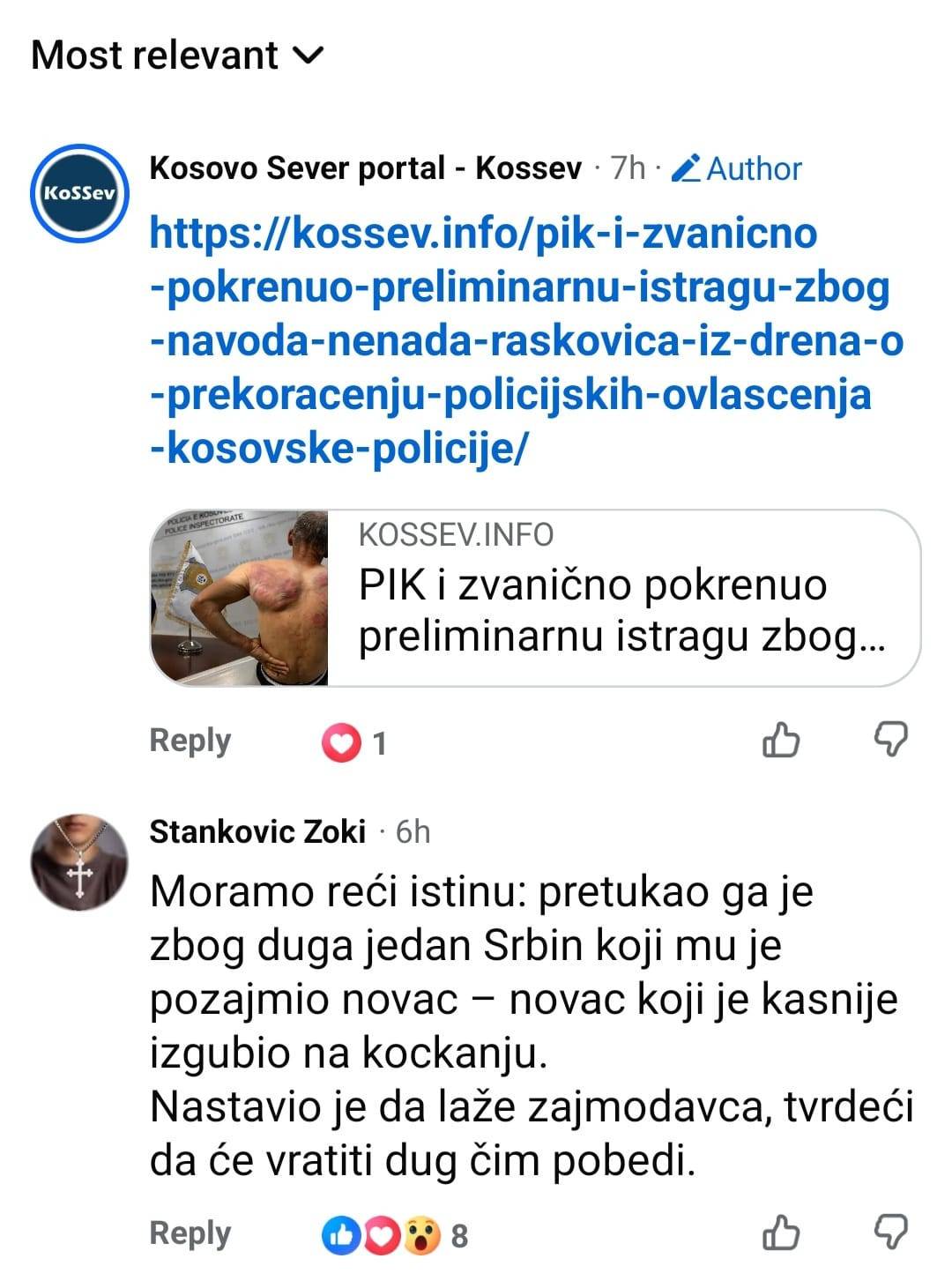
Beneath a KoSSev Facebook post reporting that the Police Inspectorate of Kosovo had opened a preliminary investigation, an account under the name Stankovic Zoki made a specific allegation. “We must tell the truth,” the comment begins. Rašković, it says, was beaten over a debt by another Serb who had lent him money — money Rašković later lost gambling. It claims he continued misleading the lender, promising to repay the debt “as soon as he wins.”
At present, that allegation deserves very little evidentiary weight.
The account supplies no name for the alleged creditor, no date, no document, no corroborating witness and, crucially, no explanation of how its author knows any of this. A Facebook profile name is not source verification. The claim does not rebut Rašković’s accusation. It does not establish an alternative history.
Its specificity does, however, make it investigable.
The commenter does not offer a suspicion. He asserts a lender, a loan, a gambling loss, demands for repayment and repeated promises by Rašković to repay after winning. If the person behind the account actually possesses such knowledge, investigators can ask the obvious question: how do you know?
From there, the rest is testable. Who lent the money? When? Was there a debt? Where was the money allegedly lost? Were demands for repayment made? Who heard the promises attributed to Rašković? Are there calls, messages, transactions or witnesses? Did the alleged lender have contact with him before his hospitalization?
If there is nothing behind the claim, it should collapse just as quickly.
An unverified Facebook allegation cannot cancel a formal complaint any more than a political party’s statement can prove one.
But there is another question contained inside the debt hypothesis.
Suppose, for the purpose of investigation, that it proves true. It would no longer be enough to establish who beat Rašković. It would become necessary to establish who knew why he had been beaten, and when they knew it.
Because another possibility would then exist.
Srpska Lista may simply have believed the account it received from an injured man and transmitted it. Serbia’s political leadership may likewise have believed that Kosovo Police had tortured him and reacted accordingly.
But if people around Rašković already knew that the beating arose from a private debt, a darker hypothesis would have to be examined: that someone knew the actual origin of the injuries and nevertheless recognized their political usefulness.
That would change the nature of the case entirely.
The question would cease to be only whether Kosovo Police had been falsely accused. It would become whether a real beating, committed for an unrelated reason, was knowingly repurposed into an act of alleged state violence — whether an injured man was converted into the victim an electoral machine required.
The chronology is what prevents that possibility from simply being dismissed in advance.
Srpska Lista supplied the political frame immediately. The hospital in North Mitrovica that treated Rašković operates within Serbia’s health system. Within roughly thirty hours, the principal witness and the body carrying the physical evidence were moved from North Mitrovica to Belgrade.
If everyone involved genuinely believed Rašković’s account, that sequence may prove nothing more than extraordinarily rapid political exploitation of an allegation they considered true.
But if the debt account is substantiated, the same sequence acquires another possible meaning.
Then the question becomes unavoidable:
Did anyone who helped turn Rašković into a political victim already know that Kosovo Police had not beaten him?
There is presently no evidence establishing that proposition. It should not be written as fact.
But neither should it be protected from investigation merely because the answer would be politically explosive.
A fabricated injury would be one kind of scandal. A real injury knowingly assigned to the wrong perpetrator would be another. The second requires no invented bruises, no staged hospital bed and no fictitious victim. It requires only an injured man, prior knowledge of how he was injured, and a political apparatus willing to supply a different author.
That is why establishing the gambling-debt allegation matters. If it is false, discard it. If it is true, finding the man who allegedly beat Rašković answers only the first question.
The next is who already knew.
Meanwhile, in Kosovo, something less theatrical and considerably more important was happening.
The Police Inspectorate took Rašković’s statement in his hospital room on Tuesday night and opened a preliminary investigation ex officio. EULEX put in writing the following morning that it would carefully follow the case with the competent authorities, invoking the absolute prohibition of torture and ill-treatment. Deputy Ombudsperson Srđan Sentić opened a case on his own initiative.
None of this makes Kosovo Police innocent.
No police force acquires innocence from institutional reputation, and no accountability architecture makes abuse impossible. If officers tortured a man, the existence of an inspectorate does not diminish the crime by one degree.
But the architecture matters.
The allegation is not being left solely to the institution whose officers stand accused. The Police Inspectorate is investigating. EULEX is watching. The Ombudsperson has opened a file. An allegation under that degree of scrutiny is difficult to bury without examination.
More importantly, these are the mechanisms with the legal authority and practical means to establish what happened in Kosovo.
And their central witness is now somewhere else.
That is not evidence of fabrication. It is an evidentiary problem.
Kosovo investigators obtained Rašković’s statement and the initial medical documentation while he was still in North Mitrovica. Subsequent examinations, interviews and the evolving medical record are now being produced in Serbia, beyond the immediate reach of the institutions conducting the investigation in Kosovo.
At precisely the point at which evidence should have been becoming more accessible to investigators, the central evidence became less accessible.
Politics moved in the opposite direction.
Rašković arrived in Belgrade. Serbia’s president arrived at his bedside. Medical findings were narrated to the public through Instagram. The accusation acquired the authority of the presidency before the investigation had acquired the evidence necessary to establish its perpetrator.
None of this proves that the accusation is false.
But neither does the severity of Rašković’s injuries prove that it is true.
That distinction is the case.
Rašković’s injuries do not identify the hands that caused them. His testimony is evidence and must be investigated seriously. It is not a verdict. Srpska Lista’s account must be checked against his testimony. The gambling-debt allegation is an unverified social-media claim and deserves no greater status unless its source and substance can be established.
Everything else is obtainable evidence.
Duty rosters can establish which officers were operating in Dren. Deployment records and radio traffic can establish where they were and what they were doing. Telephone records can construct movements and contacts. Witnesses can establish when Rašković was last seen before the alleged assault and when he first appeared injured. His initial medical examination can be compared with the chronology he gave investigators. Forensic specialists can assess whether the documented injuries are consistent with the mechanism he described.
None of those questions requires choosing a story beforehand.
If Kosovo police officers did this, the evidence should identify them and the state should prosecute them. There can be no institutional interest higher than establishing that its officers tortured a citizen and holding them responsible.
If someone else did it, the evidence should identify that person and the accusation against the police should collapse publicly.
And if someone knew that someone else did it before Rašković became a political exhibit in Belgrade, the investigation should establish that too.
Because that would be a different case altogether.
A fabricated injury would require explaining the injuries.
A repurposed injury would not.
That is why the distinction matters, and why the investigation cannot stop at proving that Nenad Rašković was beaten.
We already know that.
The question is who did it — and, depending on that answer, who knew.
