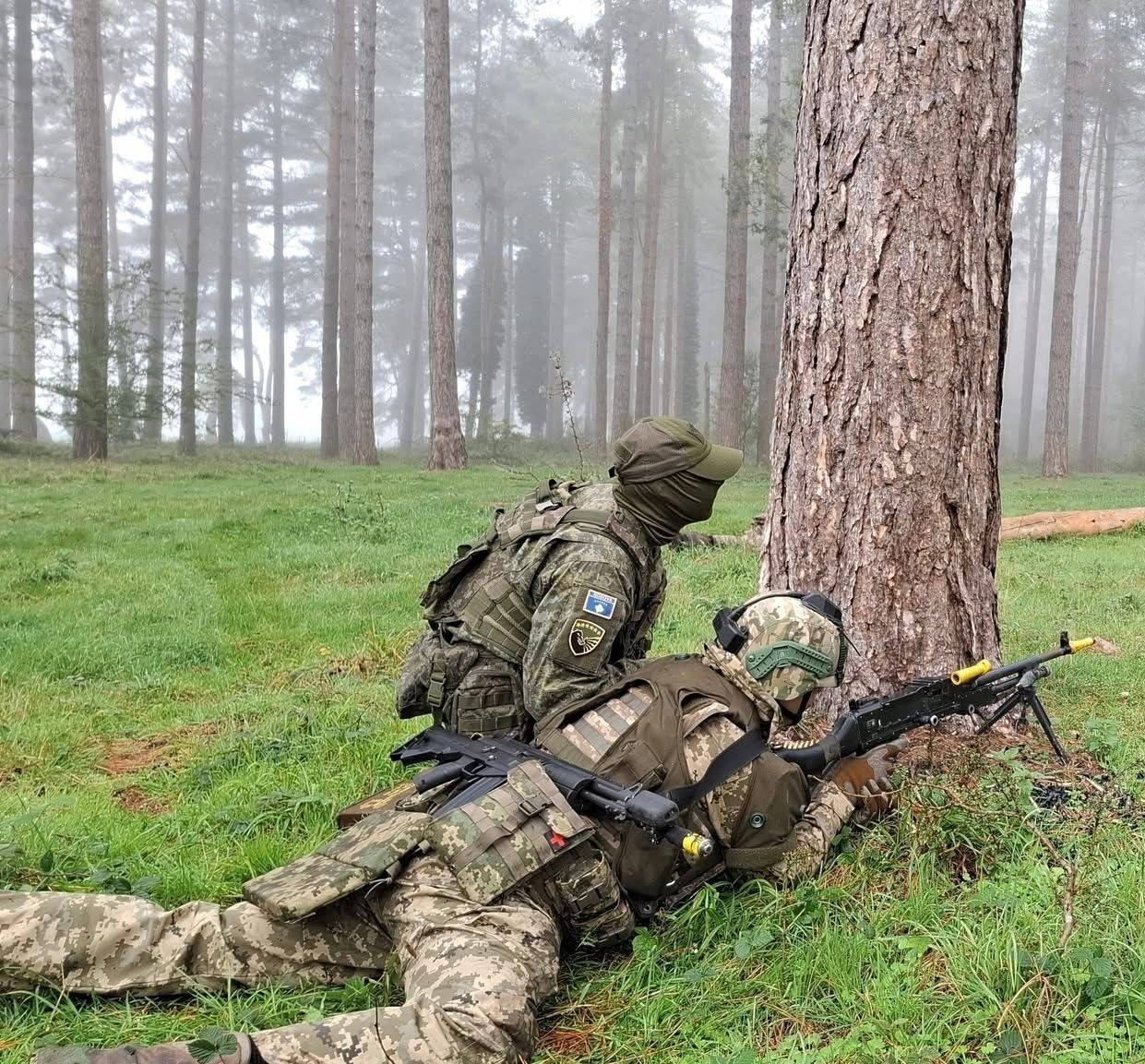
Kosovo's soldiers are training Ukraine's army. That is not a footnote.
by Artan Rugova | 3 April 2026
There is a detail in the operational record of Operation Interflex that has received less attention than it warrants. Among the nations currently training Ukrainian soldiers on British soil, one stands out not for the size of its contingent but for what its presence means constitutionally, diplomatically, and historically. Kosovo is on that list. It has been since January 2024.
On the 18th of that month, Kosovo's Ministry of Defence announced that 26 instructors from the Kosovo Security Force would deploy to the United Kingdom to join the multinational training program for Ukrainian Armed Forces personnel. The announcement was received with polite acknowledgment in Western capitals and near silence in international security commentary. Both reactions missed the point. The deployment is not a symbolic gesture by a small aspiring state. It is one of the clearest available demonstrations of what Kosovo's security transformation has actually produced, and of how Pristina has chosen to position itself in the defining security contest of the post-Cold War era.
What Interflex Is
Operation Interflex is the UK-led multinational program that has, since July 2022, trained more than 56,000 Ukrainian soldiers in basic infantry, leadership, battlefield medicine, and drone tactics. It remains operational through at least the end of 2026, led by the British Army's 11th Security Force Assistance Brigade at multiple sites across the United Kingdom. The program is the institutional successor to Operation Orbital, which ran from 2015 to 2022 on Ukrainian soil itself. Interflex relocated the effort to Britain after Russia's full-scale invasion made in-country training impossible at scale.
The coalition includes, alongside the United Kingdom, thirteen partner nations: Australia, New Zealand, Canada, Denmark, Finland, the Netherlands, Norway, Sweden, Albania, Estonia, Kosovo, Lithuania, and Romania. Kosovo sits in that company between two NATO members, alphabetically and operationally. No asterisk qualifies its participation on recognition grounds. No footnote flags its status as a non-UN-member state. Kosovo trains Ukrainian soldiers. The program proceeds as though this is unremarkable, because operationally it is.
What the numbers behind the program communicate is worth stating plainly. Recent polling conducted among Interflex graduates shows that 90 percent of trainees completing the course since January 2025 report greater confidence in their survivability and lethality at the end of training. These are soldiers returning to a front line that runs more than a thousand kilometers. The instructors who prepare them carry direct operational weight.
The Weight of the Number 26
Twenty-six instructors is a modest figure. Australia sent seventy. The United Kingdom deployed approximately a thousand of its own service personnel to administer the program. By raw count, Kosovo's contingent places toward the bottom of the contributor table.
The count is the wrong metric.
The KSF's budget stood at €50 million in 2018, the year Kosovo's parliament legislated the force's transformation into a conventional army. By 2023 it had reached €203 million, equivalent to 2 percent of GDP. In 2024, the approved KSF budget stood at €138 million, rising toward €208 million in 2025, with Prime Minister Albin Kurti pledging a total allocation of over €1 billion across the next four-year mandate. A force that was legislated into proper military existence in 2018, which is still formally midway through its transformation into the Kosovo Armed Forces, and which operates without UN membership and against the active diplomatic opposition of Serbia, Russia, and China, deployed instructors to train a frontline army within six years of its own institutional birth.
The relevant comparison is not Australia. It is the baseline from which Kosovo started.
The KSF's transformation follows a ten-year plan initiated in 2018, with regiment-by-regiment capability validation running through 2025. The Third Regiment's validation under Defender Europe 25 closes the second phase of that transition. The Interflex deployment did not wait for the process to conclude. Kosovo sent instructors while its own army was still being assembled. That decision reflects a strategic judgment by Pristina: that contributing to European security in a visible, operational role is itself part of the state-building project, not something that follows it.
The Statehood Argument in Operational Form
Kosovo's path to international recognition has always run through demonstrated institutional competence. The argument has never been purely legal. It has been behavioral: that Kosovo functions as a state, protects its citizens, upholds the rule of law, and contributes to the international order it is asking to join. For most of the post-independence period, that argument has been made in civilian terms, through customs administration, judiciary reform, visa liberalization benchmarks, and EU integration scorecards.
Interflex adds a security dimension that those frameworks cannot supply.
When the UK Ministry of Defence publicly welcomed Kosovo's accession to the coalition, it placed Kosovo in a sentence with Romania and Estonia, two NATO members, as nations standing united for freedom and resilience. That framing is not diplomatic courtesy. It places Kosovo within a collective security formation on terms that make no distinction between members and aspirants. The sentence does not raise the recognition question. It proceeds as though Kosovo's presence speaks for itself, because operationally it does.
There is a further dimension. Following Russia's full-scale invasion of Ukraine, Kosovo's Assembly passed a resolution urging the government to launch a formal NATO membership bid. The bid remains blocked by the Alliance's consensus requirement and by the five EU member states that do not recognize Kosovo's independence, a category that includes Spain, Greece, Slovakia, Romania, and Cyprus. But NATO membership is a political question with a political timeline. Interflex is an operational question with an operational answer. Kosovo answered it.
A Pattern, Not an Episode
The Interflex contribution does not stand alone. In February 2026, at the Board of Peace summit in Riyadh, Kosovo pledged to send troops to the International Stabilization Force in Gaza, joining a coalition that includes Albania, Indonesia, Kazakhstan, and Morocco. The KSF has participated in both Defender-Europe 21 and Defender-Europe 23, the large US-led exercises in which Kosovo served simultaneously as participant and host, using the occasions to validate its command and infantry regiments against NATO standards. Javelin anti-tank missiles acquired through US Congressional approval, Bayraktar drones from Turkey, Black Hawk helicopters agreed with the US State Department in January 2025, a domestic ammunition factory under construction in partnership with Turkey's MKE, trilateral defense cooperation agreements with Albania and Croatia: each element belongs to the same accumulation.
The deadline for full transformation into the Kosovo Armed Forces under the 2018 legislation is 2028. That is less than two years away. The political obstacles to NATO membership have not moved. But the operational argument for why Kosovo belongs inside the Alliance rather than adjacent to it has been building steadily and concretely, and Interflex is one of its most legible data points.
The Significance That Goes Unremarked
International coverage of Interflex rarely pauses on Kosovo's role. The program's scale, measured in tens of thousands of Ukrainian trainees and hundreds of British instructors, naturally dominates the frame. Smaller contributors function as coalition backdrop rather than individual subjects of analysis. That compression is understandable. It is also consequential, because it obscures what the Kosovo deployment actually represents.
A state that holds no UN seat, faces active recognition denial from two permanent Security Council members, and is still assembling its own armed forces has been training another country's military on the soil of a NATO member state, as part of a multinational coalition under British command, since early 2024. Kosovo's instructors in the forests of northern England are not making a gesture. They are doing the work, on terms set by one of the most operationally serious military training programs Europe has run since the end of the Cold War.
For Kosovo, the instructor role is itself an argument. It does not require a speech at the United Nations. It requires showing up, and Kosovo has.