Brussels congratulated a transition. Moscow recognised the policy that survived it.
by Fatos Kabashi | 28 October 2026
On the night Serbia voted out Aleksandar Vučić, two congratulations arrived in Belgrade from opposite directions. They cannot both be right.
The first came from Brussels, on 25 October, election night. Ursula von der Leyen and António Costa wrote that they stood ready to support reforms on the rule of law, media freedom, the fight against corruption and strong institutions, and to work together on Serbia’s European future. Marta Kos sent a written statement: a new chapter can begin, the EU’s door is open, and the values the students marched for are the values at the heart of the Union. On 26 October Friedrich Merz added his own post about Serbia’s European path.
The second came from Moscow, from a man called Konstantin Malofeyev. He is not a minister. He is the Orthodox oligarch who paid for the first Russian proxy commanders in Donbas in 2014, who was sanctioned by the EU and the United States for it, who was tied to the 2016 coup attempt in Montenegro, and who owns Tsargrad, the channel that has been telling Serbs for a decade that Kosovo is Serbia. On his Telegram channel, 1.33 million subscribers, he wrote that the Serbian people had delivered “a historic verdict on Vučić’s regime” ("исторический приговор режиму Вучича"). Vučić, he said, had spent years manoeuvring between the West and Russia while surrendering Serbia’s national interests to Brussels and Washington. The Student List, he said, has nothing in common with the pro-Western liberal agenda. In its ranks are genuine Serbian patriots and loyal friends of Russia, for whom Orthodox brotherhood is dearer than any handouts from the Eurofunds. He closed: “Congratulations, brothers! Kosovo is Serbia, Crimea is Russia!” ("С победой, братушки! Косово – это Сербия, Крым – это Россия!").
So which one read the programme?
The list answered on 26 October. Its representative, Bakić, went not to Brussels but to RT Balkan. The new government, he said, will not join EU sanctions on Russia. “We respect Russia both as a great power and as our historical partner and protector. There will be no changes in that.” No recognition of Kosovo. The programme itself, as Radio Free Europe noted on election night, was about domestic questions; the campaign, in RFE’s own headline, was almost without the European Union.
That is Malofeyev’s reading, word for word. It is not the Commission’s.
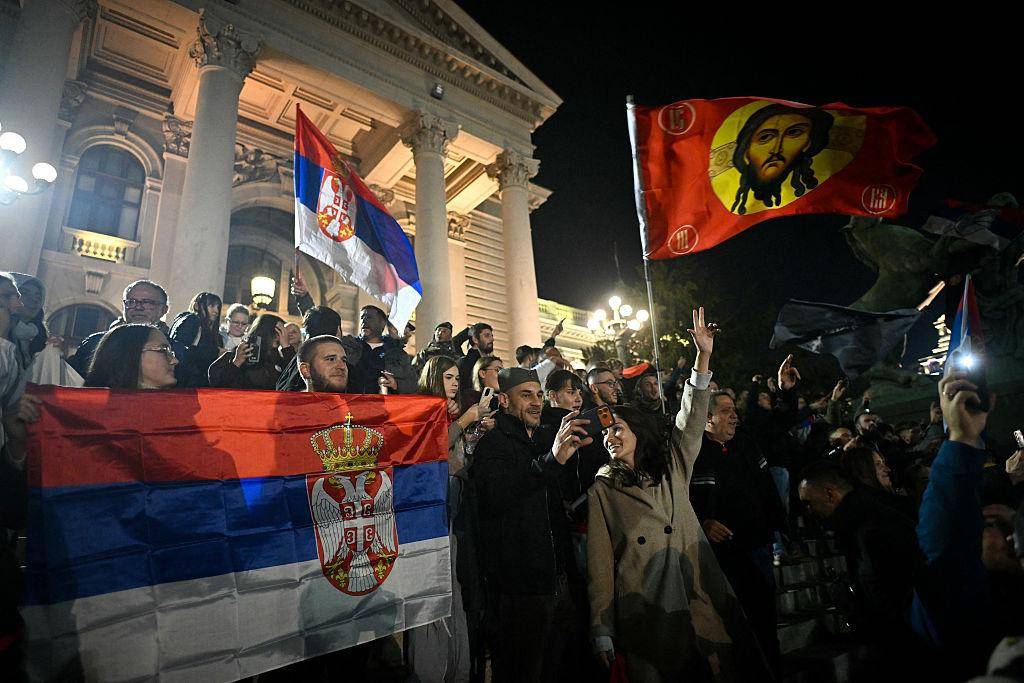
On election night in Belgrade the flags were Serbian. The icons were Orthodox. Young men carried wooden crosses through the capital as the symbol of their victory. There was no EU flag. A national, Christian, conservative movement had beaten Vučić from the patriotic right, on honesty, after a station roof fell on sixteen people in Novi Sad. It did not beat him because he was too close to Moscow. It beat him because he was a thief.
Western analysts who know Serbia said the same, with no Albanian in the room. Dietmar Pichler, the Austrian propaganda analyst who runs Inved, asked why exactly Putin was supposed to have lost twice in one night, and answered that the list’s foreign policy does not differ from Vučić’s, that there is no change on Kosovo or NATO, and that anti-Westernism and pro-Russian feeling are Serbia’s political culture, not Vučić’s invention. Jasmin Mujanović, who has written two books on the region and never a kind word about Vučić, warned the EU against “wish-casting a reformist government that did not/may not exist”. Walk first, he said, then talk.
Malofeyev is a partisan, and his reading can be tested. He has watched this movement for a year and Serbian nationalism for thirty. He funds its friends. Set his paragraph beside Bakić’s interview and the footage from the Republic Square and every sentence holds. Set the Commission’s paragraph beside the same evidence and it does not touch it.
We congratulated a democratic transition, the Brussels reader will say. We did not endorse a foreign policy. True, on 25 October. But the Commission knows the conditions it wrote: Chapter 35, alignment with EU foreign policy, Cluster 3 held back over sanctions on Russia. On 26 October the list said on camera that it will not align. On 27 October the Commission had still not said a word. Von der Leyen’s post does not mention Russia. Kos’s statement does not mention Kosovo. Merz’s post, written with the Bakić interview already on air, mentions neither. Not one of the three has contradicted a single sentence Bakić spoke. And the first voice asking for the reward was Serbian: Vladimir Međak, once chief lawyer of Serbia’s accession team, now of the European Movement, asked within a day for Clusters 2 and 3 to be opened as soon as the government is formed. He asked with “historical partner and protector” already on air. Brussels has not agreed. Brussels has not answered either.
Moscow quoted the list. Brussels quoted itself.
For twelve years Brussels filed Serbia’s refusal on Kosovo and its refusal on sanctions under one name, and told itself the problem was the man. The man is gone. The voters removed him in a free election, in historic numbers, with 52 percent. And they kept the refusals. Serbia’s foreign policy now has what it never had under Vučić: a democratic mandate. That is not a Serbian problem for Europe to manage. It is a European problem Europe can no longer explain away.