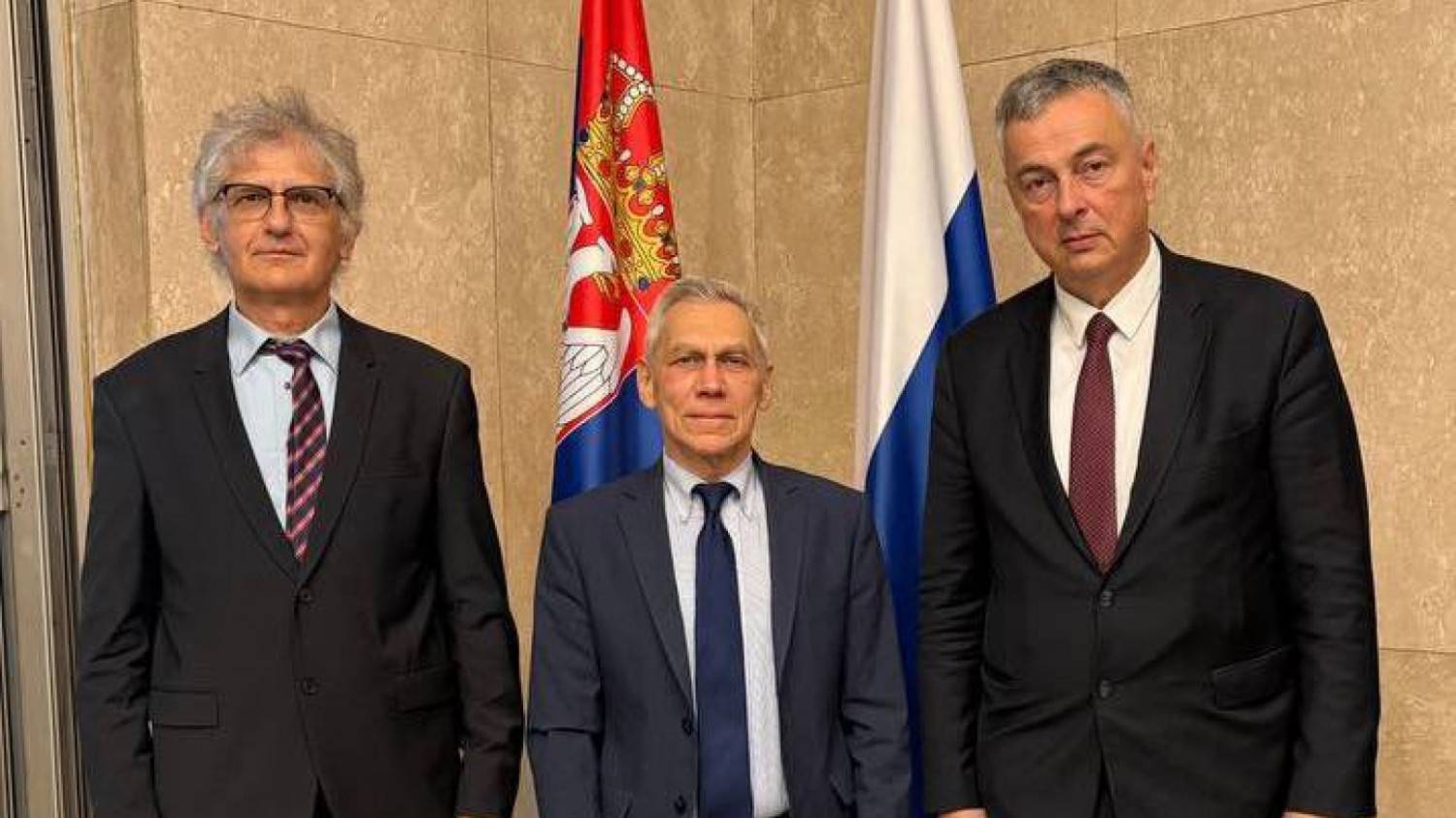
Marta Kos asked the Student List for change. Since the election each of its commitments on Russia has been recorded in a Russian outlet, and on Thursday the Russian Embassy wrote the one on Kosovo itself.
By Drizan Shala | 13 November 2026
On Thursday the Russian Embassy in Belgrade announced that Ambassador Alexander Botsan-Kharchenko had received Dejan Šoškić and Miodrag Krmar of the Student List. “The importance of close cooperation on international platforms was stressed and the principled position of the Russian Federation on the Kosovo question was confirmed,” it wrote, on the basis of Serbia’s sovereignty and territorial integrity under Resolution 1244.
The verbs have no subject. Nobody stresses and nobody confirms, so the sentence attributes nothing to the two guests and still leaves both standing inside it. In the embassy’s photograph three men stand before the flags of Serbia and Russia set as a pair, the staging of a meeting between states, five days before the parliament that will give the list any office has sat. By Friday morning the list had published no account of its own.
Beneath its report of the meeting, RT Balkan linked what came before. Radomir Saičić told RIA Novosti that the list does not intend to impose sanctions on Russia. RT’s headline on the list’s position on NIS reads: no nationalisation, Russian energy “extremely important”. Saičić has also said a delegation will travel to Moscow once the government is formed, to discuss the gas contract that expires on 31 December and the American sanctions on NIS. On 11 November Jugoslav Gašić gave RT Balkan an interview on Kosovo, and the same day RT carried Sergei Lavrov on Russia’s commitment to gas agreements with Serbia.
Sanctions were recorded at RIA, NIS and gas at RT, and Kosovo at RT on Wednesday and in an embassy readout on Thursday. An interview is one candidate’s opinion and can be walked back. A diplomatic record of a meeting, published by the host and uncontested by the guest, is a position.
“International platforms” means the Security Council, where Russia’s veto protects Resolution 1244, and the organisations Kosovo is trying to enter. Under the embassy’s words RT reprinted the list’s programme: it will oppose Kosovo’s independence and “will not allow its membership in international organisations”. Seven weeks remain on the gas contract. The men who will negotiate it now have the Kosovo sentence on the table with it.
After the vote Marta Kos wrote that Serbians had given “a strong mandate for change”. On 2 November she received four list representatives in Brussels, and two days later she told the European Parliament’s Foreign Affairs Committee the new government could turn the page, naming “strategic alignment with the European Union” among the subjects raised. Her request is on the record in Brussels. The answers are on the record in Moscow’s outlets, one subject at a time. An American assistant secretary met the list on Thursday evening, and his embassy’s post attributes nothing to it.
A grip is measured by what the held party can no longer do. In eighteen days the Student List has given up sanctions, the ownership of NIS as a bargaining chip, and now its freedom to describe its own Kosovo policy. It can still publish its own account of Thursday. Each day it does not, the embassy’s stands, and the next step will start from there.