Ric Grenell is the American Serbia’s lobbyists report contacting. This week he is the subject of a White House counsel review over a donation that may never have arrived, brought by a man who bought proximity to him and lost his Venezuelan contract to Rubio’s policy anyway. The allegations are unproven. The lesson for Belgrade is not.
By Mark Gojcaj | 15 October 2026
On Friday, 10 October, Alina Habba walked into the Oval Office and told the president that Ric Grenell had taken a multimillion-dollar donation her husband made to the Kennedy Center and that the money never arrived. The president directed the White House counsel to examine the claim. Axios reported it on Tuesday, sourced to four senior administration officials and three people briefed on the dispute. Grenell’s answer, in full: “Absurd. I’ve never asked for one cent to be sent somewhere else pretending it was for the Kennedy Center, and I’ve never received any payment from him at all. Make him give proof to what he is saying, not make these absurd allegations.”
A senior official told Axios these are only allegations and could be a misunderstanding. The counsel has asked Habba’s lawyers for documents and, as of publication, had received none. Nothing in this piece treats the claim as established, and nothing should until the counsel does.
What is established is how the two men came to know each other, and that is the part a Balkan reader needs.
Habba’s husband, Turhan Mildon, is a Turkish businessman with contracts to run state-owned cement plants in Venezuela. In early 2025 those contracts were under threat from the State Department’s pressure campaign against Nicolás Maduro, run by Marco Rubio. Grenell, as the president’s envoy for special missions, was arguing inside the administration for the opposite course: normalisation with Maduro. Mildon and Grenell became friends. Habba told the president that in the spring of 2025 Grenell persuaded Mildon to fold a Kennedy Center donation into a $17.6 million payment for a business deal with an American company. Mildon never checked whether the donation was credited. He assumed it had been, because the Kennedy Center treated him as a major donor, and it was there, in late 2025, that he met Habba. Kennedy Center records show a $270,000 pledge outstanding in his name, which he paid on Tuesday. The woman who ran the center’s finances at the time told Axios there was nothing in her books about six million dollars, and she would have heard.
Rubio’s policy prevailed. On 3 January US forces seized Maduro and flew him to New York to face narcotics charges. In June, Maduro’s successor Delcy Rodríguez revoked one of Mildon’s cement contracts, a step a source told Axios came partly at Washington’s prodding. She then reversed herself, the New York Times reported, after learning Mildon had married Habba, on the assumption that the marriage meant the president’s backing. The contract survived on a misreading of who in Washington decides.
A foreign businessman with interests exposed to American policy bought proximity to an envoy who was arguing against that policy. The envoy lost the argument to the department.
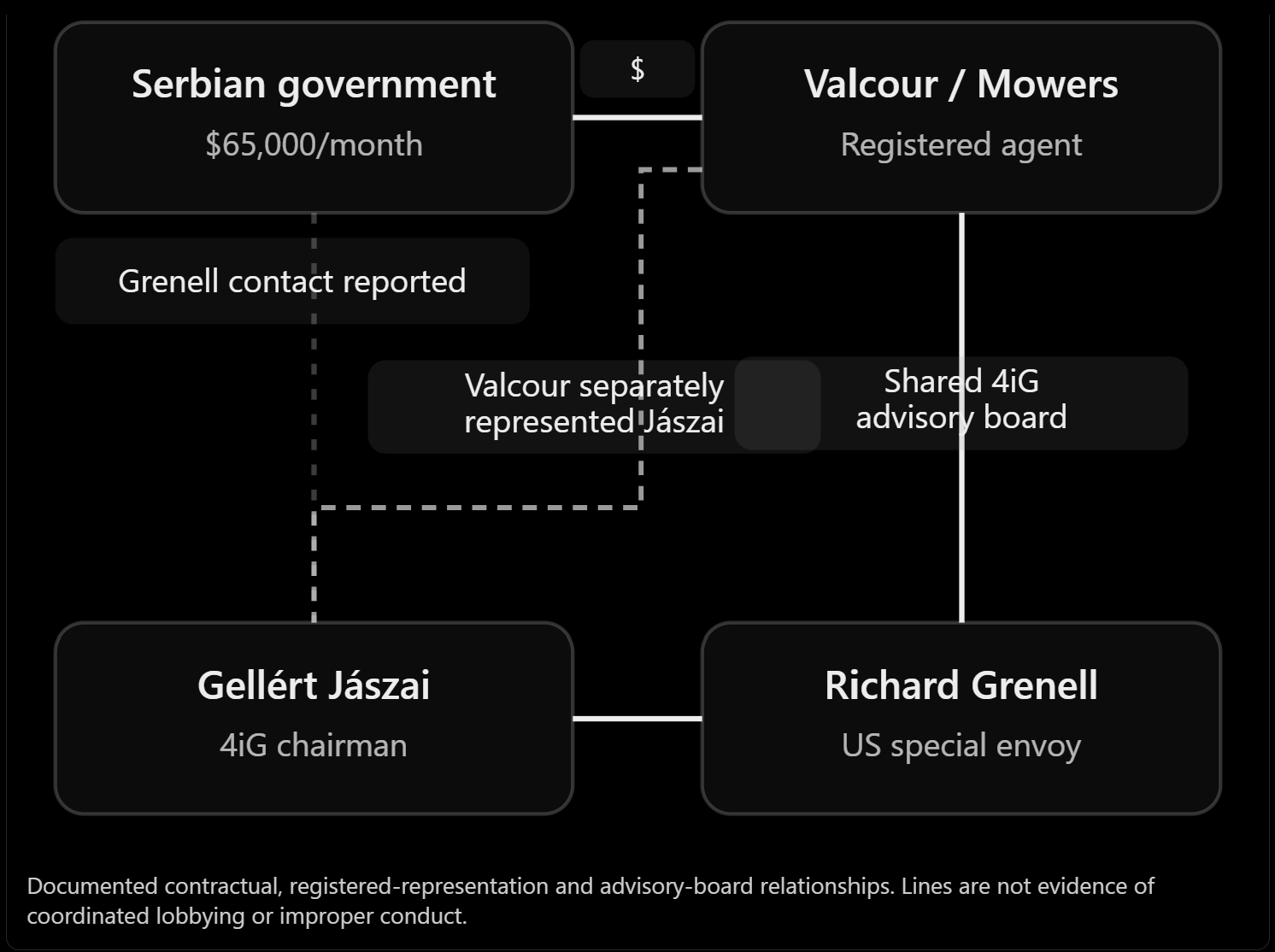
Grenell is the envoy. He is also, since 2019, Belgrade’s American: the special envoy for Serbia and Kosovo who produced the September 2020 Washington Agreement, decorated with the Order of the Serbian Flag in 2023, and, as reported here yesterday, listed by name in the activity reports of Valcour LLC, the firm Serbia pays $65,000 a month in Washington. Valcour’s president sits with him on the advisory board of Hungary’s 4iG. No record shows Grenell paid by Serbia or by its lobbyists, and this piece makes no such claim. The record shows which American Belgrade’s hired representatives report contacting, and it shows what that American’s week has been.
Axios quotes an insider calling this the ultimate MAGA blood feud. Grenell was absent from the Habba–Mildon wedding last month, a $10 million event attended by the president’s circle. Another official: the president does not want to deal with this, but if there is missing money it is a very big problem. The counsel’s review will decide whether there is. It will not decide the thing that matters in Belgrade, which was decided before Habba walked into the Oval Office: on the one policy question where Grenell’s position and Rubio’s collided in public, the department won, and the man who bought proximity to Grenell found out what proximity was worth.
Serbia has made the same purchase. The filings say so. Whether its friend is cleared or not, he is a friend, and the friend is this week the subject of a review by the president’s own lawyer. The institution he lost to is run by the secretary of state to whom Bosnia’s foreign minister addressed a letter on Monday about Republika Srpska’s lobbyists. Belgrade chose its American. October is showing it what that choice buys.
Mark Gojcaj writes from New York, where he analyzes the intersection between American conservatism and the political and security realities of Southeast Europe. He is a regular contributor to The Kosovo Dispatch on transatlantic coverage, focusing on U.S. foreign policy, NATO dynamics, and the Western Balkans.
