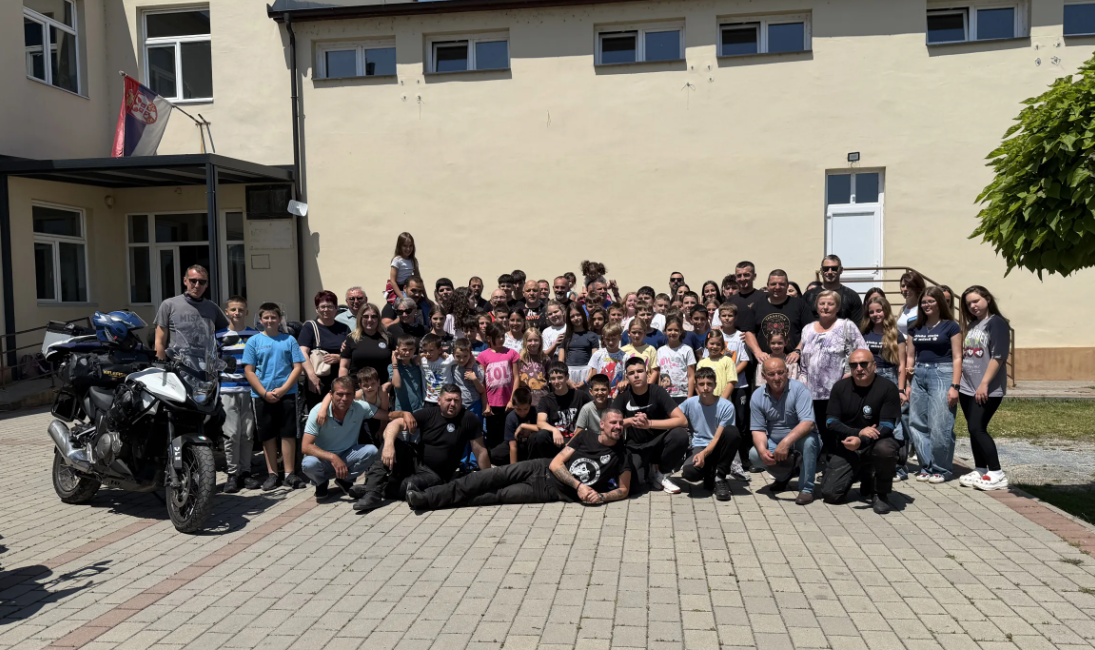
A motorcade from Republika Srpska rode Kosovo end to end last week on identity cards. A Kosovo citizen cannot make the return trip. Washington just gave away the one instrument that could have changed that, and has not explained why.
Kosovo Dispatch | DC Bureau | 03 June 2026
On the first day of June a column of motorcycles from Republika Srpska crossed into Kosovo and rode it the length of the territory. Fifteen riders from five clubs out of Prijedor, Banja Luka and Laktaši spent four days touring more than fifteen monasteries, attending liturgies, sleeping in the shrines, and stopping in Goraždevac to hand out sweets to the schoolchildren and let them photograph the engines. They entered on identity cards. They lingered where they pleased. They left on their own schedule. A citizen of Kosovo cannot make the reverse journey. To enter Bosnia and Herzegovina a Kosovar still needs a visa, issued rarely and grudgingly, if at all.
That asymmetry is not an accident of geography. It is a policy, and it has an author.
The architecture is not in dispute. At the Berlin Process summit of November 2022 the six governments of the Western Balkans signed three mobility agreements, the first of them on freedom of movement using only identity cards. Kosovo ratified it first, in February 2023. Serbia, Montenegro, Albania and North Macedonia all opened their crossings to Kosovo identity holders and were opened to in turn. Today a Kosovar reaches Belgrade, Podgorica, Tirana and Skopje on a card, and their citizens reach Pristina the same way. One government refused, and refused alone.
Trace the refusal and it ends at one address. The Serb member of the tripartite Presidency, Željka Cvijanović, lodged the veto, and the National Assembly of Republika Srpska has kept the agreement from reaching ratification ever since. Faced with that wall, Pristina did not answer in kind. On 1 January 2025 it opened its side unilaterally, admitting holders of Bosnian identity cards regardless of whether the favor was returned. The bikers are the dividend of that decision. So is the silence from the other bank of the Drina.
The June convoy repeated a route the same riders ran a year earlier, and they say so plainly: the tour is now an annual fixture, conceived after that first visit and branded this season as the Orthodox Motorcycle Tour "Kosovo 2026." It belongs to a wider and older traffic. Organized pilgrimages and motor convoys run into Kosovo's Serbian monasteries from Serbia, Montenegro and Republika Srpska on a recurring calendar, cresting each June at Gazimestan and Gračanica on Vidovdan, when biker contingents and official delegations cross into the territory in force. The Heinrich Böll Foundation, surveying Serbian community life in Kosovo this year, recorded the phenomenon without sentiment: these visits carry not only believers but Greater Serbia nationalists with little real connection to the Church, who arrive to commune with the myth and not infrequently turn their fervor on their hosts through chants, songs and threats. That is the genre to which last week's sweets in the Goraždevac schoolyard belong. The traffic is organized, it repeats, and it moves in one direction, into a territory whose own citizens cannot make the journey back.
Here the file becomes a Washington file.
On 29 October 2025 the Treasury's Office of Foreign Assets Control removed Milorad Dodik, along with dozens of his relatives, allies and the companies tied to them, from the Western Balkans sanctions program, forty eight designations struck in a single action. The Department of State explained the move as a response to recent steps by the RS assembly, and said the delisting should help stabilize Bosnia and enable a partnership "based on shared interests, economic potential, and prosperity." Two weeks later the ranking Democrats on the House Foreign Affairs Committee, Gregory Meeks and William Keating, wrote to Secretaries Rubio and Bessent demanding the basis for the decision and warning that it handed secessionist actors in Banja Luka a free hand. The letter is on the record. The answer to it is not.
Set the two facts side by side. Washington held one durable instrument over Banja Luka and chose to spend it. By the Department's own account it asked for the annulment of separatist legislation, and it received a version of that. It did not ask for the single regional deliverable that costs the entity nothing and serves a neighbor's citizens directly: ratification of a mobility agreement that every other government in the region already honors with Kosovo. The leverage is gone. The visa wall stands.
A point of precision, because the Department will reach for it. Dodik no longer holds office. A Bosnian court barred him in the autumn of 2025 and the assembly seated a replacement. This changes the nameplate, not the machine. The veto on movement with Kosovo was never the property of one man. It belongs to the political bloc that still governs the entity, the same bloc whose standing in Washington was just restored. To strike a name from a list while the structure behind it keeps the border shut is a sequence the Department has not been asked to defend. It should be.
Which returns the question to Pristina, and the answer is not as fraught as caution pretends. Kosovo opened its door unilaterally and was met with a closed one. What is granted unilaterally can be withdrawn unilaterally, and Kosovo stands within both its rights and the plain logic of reciprocity if it makes entry on an identity card conditional on the same courtesy being extended to its own citizens. A government that denies Kosovars the right to cross its threshold has no standing to protest when Kosovo declines to extend that right in return. The grievance refutes itself before it is spoken.
The measure can be aimed, and its precision is the point. The Federation never blocked ratification; Republika Srpska did, through the veto its assembly continues to enforce. A response that mirrors the blockade should fall where the blockade is manufactured. Kosovo can keep admitting residents of the Federation on their identity cards and require residents of Republika Srpska to present the passport that Bosnia, at the entity's own insistence, still demands of every Kosovar. Bosnian identity documents record the holder's address; the line is administrable at the crossing, and it is not an ethnic test but a residential one, keyed to the jurisdiction that shut the gate. The convoys from Banja Luka and Laktaši would then encounter, at the Kosovo boundary, the exact condition Banja Luka sets for every traveler from Pristina: arrive with more than a card, or do not arrive.
The rule writes its own expiry, which is the proof that it is reciprocity and not spite. The day Bosnia admits Kosovars on an identity card, Kosovo extends the same to every Bosnian, Federation and Republika Srpska alike. A condition that dissolves the moment the other side reciprocates is not a punishment. It is the price of a closed gate, payable in full by opening it.
And to the readers this is written for, on the Hill and at Foggy Bottom: the step you should require of Banja Luka is small, concrete and entirely consistent with Dayton, which guarantees freedom of movement throughout Bosnia and licenses no entity veto over a neighbor's travelers. You restored a relationship. Name its price. Mobility with Kosovo is the cheapest item on the board and the easiest to verify. Either a Kosovar enters Bosnia on an identity card by a date certain, or the partnership you announced is being paid for in one direction only, exactly as the road across Kosovo now runs.
The bikers are not the scandal. Men are entitled to visit their churches and their kin, and the children of Goraždevac are entitled to an afternoon of engines and sweets. The scandal is the direction of the arrow. A column rolls freely across Kosovo on an identity card while the return lane stays shut, and the capital that could have priced that lane open chose, for reasons it has not given, to ask for everything except the road.
Sources
Convoy details, the participating clubs, the route, the Goraždevac school stop and the "Kosovo 2026" branding, from Radio Goraždevac, carried by KoSSev on 2 June 2026. The wider pattern of organized visits and their conduct toward host communities from the Heinrich Böll Foundation's survey of Serbian community life in Kosovo, February 2026. The sanctions delisting from the U.S. Treasury's Office of Foreign Assets Control, 29 October 2025. The congressional challenge from the letter of Representatives Gregory Meeks and William Keating to Secretaries Rubio and Bessent, 12 November 2025. Berlin Process mobility agreement and Kosovo's unilateral opening of 1 January 2025 as reported across regional outlets at the October 2024 Berlin Process summit and since.
