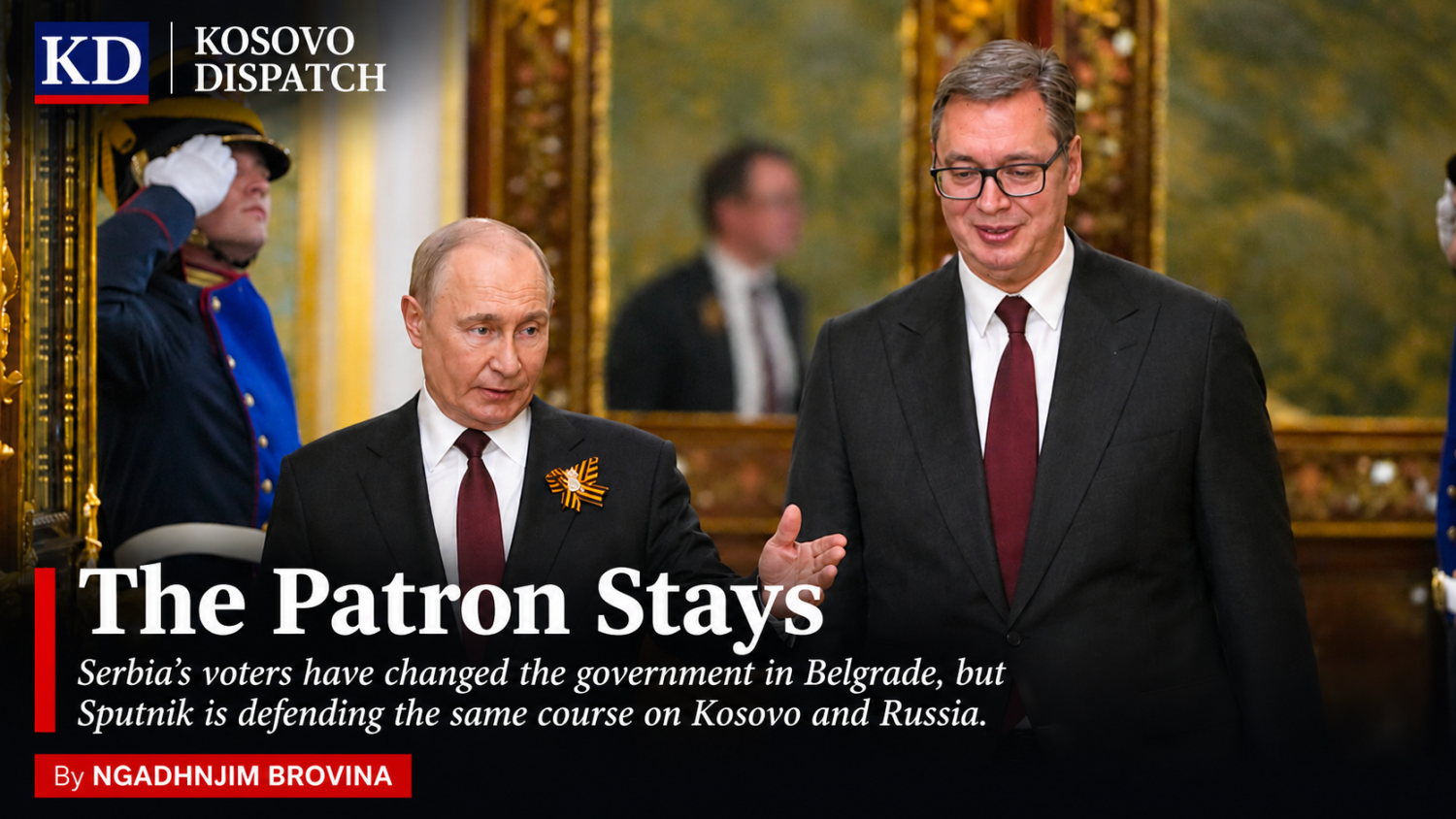
Two weeks after the vote, Sputnik Srbija tells Serbia’s new majority it was right to remove Vučić, and wrong if it touches his Kosovo and Russia policy.
By Ngadhnjim Brovina | 7 November 2026
On Sunday evening, two weeks after Serbia’s parliamentary election, Sputnik Srbija published a commentary agreeing with the Serbian electorate. The Student List’s victory, it says, with its high turnout and broad support, shows the voters’ need “to stabilise the social system at any price”. The outgoing authorities governed by a method that secured an “imposed” political stability while producing “destabilisation of the social system”. The limits of the bearable were crossed long ago. The vote was a referendum on that.
Sputnik even has a good word for Aleksandar Vučić. He understood it on election night, promised there would be no obstruction, and so “contributed to avoiding escalation”.
Then the commentary explains what the voters were not voting about. Serbia’s problem “was not in its foreign policy” but at home. Western commentary, in Sputnik’s telling, wants “the pro-Russian nationalist” gone and “anti-Russian neoliberals” in his place; politics cannot be run on “either/or”. Serbia’s foreign policy was built on “and”, Russia and the West, and that produced “a whole series of good solutions” and softened the effects of Europe’s crises. The new government’s task is to let the discontent out and calm society. Yielding to Western expectations, Sputnik warns, would bring “a new round of social destabilisation with unforeseeable consequences”, the loss of the majority’s legitimacy, and a “phase of potential escalation”.
Destabilisation, in this text, is what Vučić’s rule did to Serbian society and what Serbian society must not do to Vučić’s foreign policy. The stability Sputnik is defending is not Serbia’s.
Sputnik names two expectations. The first is “rapid implementation of an oral agreement of Aleksandar Vučić with German and French diplomats, never considered in our institutions”. The second is alignment with the EU’s foreign and security policy, “that is, sanctions on Russia”, which “a convincing majority” opposes and which would cost Serbia cheap Russian gas.
The agreement Sputnik calls oral exists in writing. The EU published the text of the Agreement on the Path to Normalisation after the Brussels meeting of 27 February 2023, and the text of its implementation annex after Ohrid on 18 March. Both sides accepted them; neither signed. Both are part of the EU accession path of Kosovo and of Serbia. “Oral” is Sputnik’s word for a written text without a signature, and “German and French diplomats” is its name for the European Union, which mediated the talks and published the texts. The commentary then asks how there can be a rule of law if such deals count as obligations “while the resolution of the most important international organisation is ignored”. The resolution is not named. There is only one it can mean, Security Council Resolution 1244 of 1999. A published EU text is a private arrangement; a 1999 resolution is law. That is the hierarchy handed to the new majority before its government has been formed.
The Student List did not need the help. Its foreign-policy programme, published after the vote, opposes Kosovo’s independence and its membership in international organisations, cites the Serbian Constitution and Resolution 1244 for the position, and promises a review of the agreements negotiated under Vučić. Its candidate Jugoslav Gašić told Radio KIM on 30 October that the list “will never recognise Kosovo”. Its pre-election programme on foreign policy committed Serbia to no sanctions on Russia. The resolution Sputnik declines to name is the one the list cites. What Sputnik supplies is the alibi: change course and you destabilise the country you were elected to calm.
The commentary then says where the pressure will come from. “For a part of Western strategists, complete destabilisation in Serbia, political and social, is the solution.” No strategist is named, no document cited; the sentence is an allegation and the commentary offers nothing to support it. From “those circles”, it continues, Serbia will be pressed to “respect international obligations” and “align its foreign policy”. It also predicts that the new majority “will not be very stable”, because saying what you are for, unlike what you are against, “brings discord and deconstruction”. The warning and the forecast arrive in the same text.
This publication has written about Srpska Lista: it can change its leader, not its patron in Belgrade. Sputnik Srbija is the Serbian service of a Russian state outlet. On Sunday it told Serbia’s new majority the same thing, one floor up. Change the government. Keep the patron. And the proof of loyalty it asks for first is the one the patron has least use for in itself: Kosovo.
Sputnik’s own closing question is whether Serbia “can change its foreign policy at all”, rather than how much. The article answers it. Serbia’s voters removed a government. Sputnik has told them who they did not remove. The patron stays.