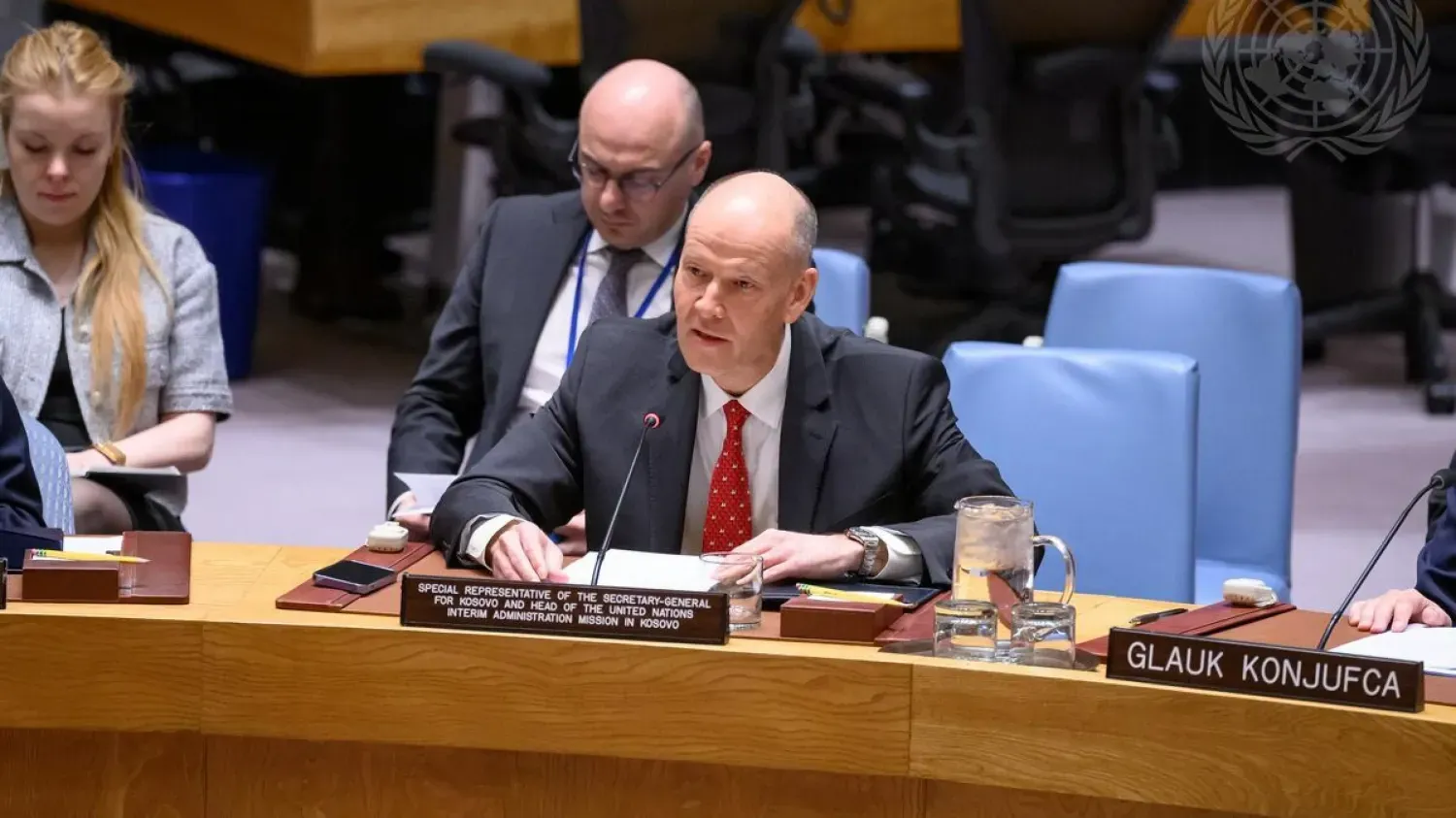
Vasily Nebenzya opened by thanking the mission for its report and closed by calling Kosovo a regime of institutional terror. Twelve other speakers read the same document and saw an oversized mission with no peacekeepers.
Ngadhnjim Brovina | 21 October 2026
Yesterday this publication set the Secretary-General’s nine Observations against the forty-six paragraphs that precede them and found the mission failing its own standards on every page. Monday evening in New York was that text in use.
Three speakers described a Kosovo in which Serbs stay indoors, leave, or answer to the police. Two called it terror. The third had written the report they were reading from.
Nebenzya gave the verdict. Everything the “ultranationalist Kosovo regime” does, he told the Council, “can be described as institutional terror, which is in fact aimed at cleansing the province of its Serb population”. He had numbers: more than 800 ethnically motivated attacks in five years, more than 250 Serbs arrested on invented charges. He had a demand: UNMIK’s budget, staffing and meeting schedule, preserved in full. And he had a courtesy, at the top of his speech: thanks to the mission for its report, by name.
Marko Đurić painted the picture. The north of Kosovo is “a police protectorate”. A street is quiet because a family stays indoors; a town is quiet because the young have left; a community can vanish “without a single dramatic event”. Behind the picture came the list Belgrade has carried for two years: closures of Serbia-run institutions, demolitions, police conduct, the judges and prosecutors, the Association, the Specialist Chambers amendments, Vidovdan, the Church. He too wanted UNMIK kept.
Peter Due read the report. He did not say terror. He said tensions had increased, that demolitions and evictions raised questions of property rights and due process, that there were allegations of ill-treatment by Kosovo police and the Inspectorate had opened investigations, that Serbia-run schools and clinics and the Church face challenges, that symbols and language of non-majority communities are restricted, that Kosovo Serb judges and prosecutors are not reintegrated, that policing at Gazimestan on 28 June raised concerns. All of it “reinforces the perception of insecurity and unequal treatment among Kosovo Serbs”.
The same items, in the same order. And the same items absent from both: Banjska, and the man Kosovo names as its organiser standing at a rally of the Serbian president; a Serbian deputy prime minister promising the Serbian flag over Prizren; the honours Serbia paid at the funeral of Ratko Mladić. Belgrade’s Kosovo office produces a grievance agenda every six months. So does UNMIK. The agendas match.
In the report Serbia announces, urges, distances, rejects; Kosovo demolishes, arrests, closes, fines. Strip the adjectives from the Serbian government’s case file, add “allegations” and “perceptions”, and the result is a document whose author will not say terror and whose reader in Moscow does not need him to. Belgrade supplies the items. UNMIK supplies the neutrality. Russia supplies the word.
The Kosovo Police, Due told the Council, handled the demonstrations after the Specialist Chambers verdict professionally and protected the right to assemble. His complaint was that the police informed other international organisations and not the United Nations. The police called everyone with a job to do. Due then listed what the mission still does: Interpol liaison, document certification, Kosovo’s access to UN forums. A mission reduced to that still writes the report, and the report is what Nebenzya held up as proof of ethnic cleansing.
Twelve speakers did not see terror. Tammy Bruce said Washington’s position is unchanged: the mission has outlived its purpose and should close. “We must stop pretending that Kosovo in 2026 is the same as Kosovo in 1999.” What remains is “an oversized peacekeeping mission with no peacekeepers”, and the Council can keep UNMIK or responsibly manage the United Nations, not both. Britain asked for a strategic review of a 27-year-old mandate. France criticised the Specialist Chambers amendments and said nothing about terror. The EU spoke of normalisation and said nothing about terror. Denmark, Liberia, Somalia: nothing. China alone joined Russia in defending the mission, coupling it to Serbia’s territorial integrity. Greece, in the chair, recorded its attachment to 1244.
Glauk Konjufca called the report biased, one-sided and built on Serbian propaganda, with incidents labelled inter-ethnic on no evidence: “Such incidents exist only in Serbian reports.” He asked the Secretary-General to reconsider his endorsement of UNMIK’s reporting, and reminded the room what terror in Kosovo has looked like: twelve thousand unarmed Albanians killed by the state Đurić represents, absent from Đurić’s speech.
The terror has an address. Compiled in Belgrade, typed in Pristina by a UN mission, read out in New York by a Russian ambassador. When the chamber emptied it left with the people who brought it in.