Serbia’s election winners spent their first weekend in Kosovo with the Church and nobody else, and went home calling the country a constituent part of Serbia.
By Artan Rugova | 11 November 2026
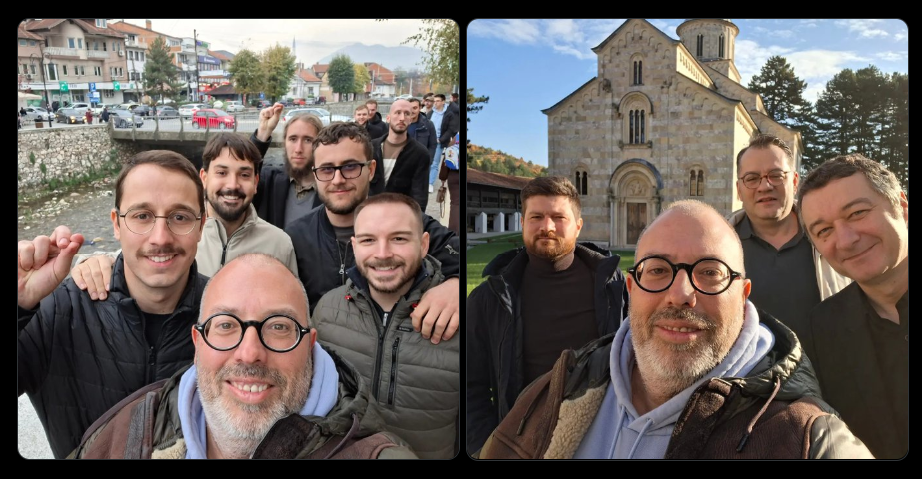
On Sunday 8 November, the feast of St Demetrius, some two dozen people stood for a photograph in front of the Deçan monastery (Visoki Dečani), a monk among them. Six were candidates of the Student List, which had won Serbia’s election two weeks earlier; the rest were students of the movement that produced it. It was their first trip to Kosovo since the win. They had come from the Graçanica monastery (Gračanica), where Metropolitan Teodosije received them, and they went on to Prizren. They met the Church and nobody else. Radio Free Europe asked the movement whether any meeting with Kosovo Serb politicians was planned and received no answer.
The Eparchy of Raška-Prizren wrote that the guests pledged to devote themselves, “through future work and activity in the institutions” (kroz budući rad i delovanje u institucijama), to “the protection of the Serbian people, its rights and Orthodox holy sites” (zaštite srpskog naroda, njegovih prava i pravoslavnih svetinja), and that those holy sites were “inseparable from the survival of the Serbian people in these areas” (neodvojivi od opstanka srpskog naroda na ovim prostorima). Deçan added that the delegation had stressed “institutional support, legal and professional assistance” for Serbs in Kosovo once the list takes office. Feđa Dimović, one of the six, wrote on Facebook that Kosovo is “a constituent part of Serbia” and “a pillar of our spiritual and cultural identity”, and that the delegation was returning “with the strength we will need to liberate our country from the claws of organised crime”.
Miodrag Vlahović read all this on Tuesday morning. He was the first foreign minister of independent Montenegro and its ambassador in Washington and at the Holy See, and he was born in Gjakova. He answered with two lines he attributes to Tin Ujević, about a road walked for a long time and the late discovery that the road was a circle, and then with one word: Žalosno. Sad.
He is right. During the campaign the student movement wrote that “Kosovo is Serbia” would not be a slogan for awkward political moments but its “basic political and moral principle” (osnovno političko i moralno načelo). Its Memorandum on Kosovo rests the matter on the Serbian Constitution. The Serb National Council of Kosovo endorsed the list on the strength of that memorandum and called Vučić the man who sold the Serbs out. The Green-Left Front, which backs the list, made its support conditional and named the memorandum as the position it would go on criticising.
In five texts from the weekend, the Eparchy’s, the monastery’s, the students’ own post, Dimović’s and a supporter account’s caption, the word Kosovo appears only inside “Kosovo and Metohija”. No institution of the Republic appears, no law, no official, no city. A million and a half Albanians do not appear at all. In its campaign statement the movement’s name for the Government of Kosovo was “the provisional authorities in Pristina” (privremene vlasti u Prištini). The only people in Kosovo the weekend’s texts know are “the people who live in Kosovo and Metohija”, and those are Serbs.
The country that does not exist checked their documents at its border. Kosovo’s foreign ministry told Gazeta Express on Tuesday that it had received no request for an official visit and issued no approval, because the visitors hold no office yet and entered “in the capacity of ordinary citizens” (në cilësinë e qytetarëve të zakonshëm), under the ordinary rules for Serbian citizens entering the Republic. The same reply notes that official visits by representatives of Serbia’s institutions are requested through Kosovo’s Liaison Office in Belgrade and decided by procedure. Dimović and the others will be members of parliament within weeks. The first official request from this government will carry the names of people who used a private trip to declare Kosovo part of Serbia, and Pristina will have to answer it.
In Prizren the same men took a selfie on the Lumbardhi (Bistrica) embankment in the old town, a fist in the air, no escort in frame, and posted it, a day after the Metropolitan briefed them on security and survival.
On 7 November Jugoslav Gašić, the list’s candidate from North Mitrovica, repeated that there would be no cooperation with Srpska Lista and blamed it for the deterioration of the Serbs’ position in Kosovo. Srpska Lista, after the election, said it took note of the result and hoped institutional cooperation would continue. The new list cuts the SNS branch and goes to the Church instead. The frame it carries through the door is the branch’s frame.
Albin Kurti spoke about the same government on the same Tuesday, from Paris: it should recognise the reality of the twenty-first century, Kosovo independent and recognised by more than 120 states; normalisation begins with Milan Radoičić handed over for Banjska; and Serbia should drop its campaign against Kosovo’s international recognition, including its use of Russia’s veto. On the first item the list has answered with the Constitution. On Radoičić and on the campaign against recognition it has said nothing. The incoming government of Serbia spoke about Kosovo from Deçan; the government of Kosovo spoke about Serbia from Paris; neither addressed the other.
Vučić accepted the Brussels text of February 2023 and its Ohrid annex and then did not implement them. The list that replaced him has not said it is bound by either. Its first act in Kosovo after winning was to visit three church sites, promise the Church the support of Belgrade’s institutions and go home calling the country a constituent part of Serbia. Serbia has a new government. Kosovo has the same neighbour, holding the same claim, with the 2023 commitments still unacknowledged.