NATO said Kosovo was stable on Thursday. On Friday Serbia’s chief of staff told the new KFOR commander who the threat was. Eight commanders have heard that briefing. What changes is how Belgrade talks about them afterwards.
Fatos Kabashi | 18 October 2026
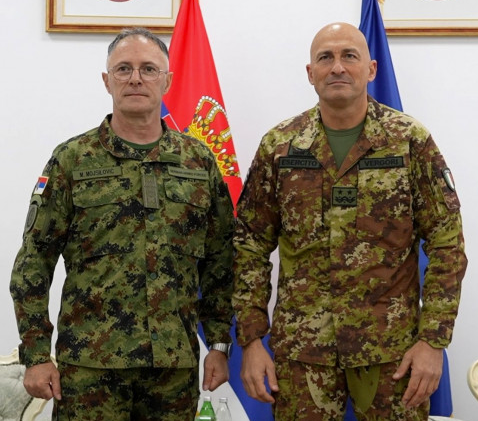
On 15 October NATO published its assessment of Kosovo: the security situation “has remained generally stable and has continued to improve”, the basis for the Council’s decision to bring KFOR down toward 3,000–3,500 troops. On 16 October General Milan Mojsilović, Chief of the General Staff of the Serbian Armed Forces, received Major General Roberto Vergori in Belgrade, forty-eight hours into his command, and told him the situation in “Kosovo and Metohija” was sensitive, that Serbs did not feel safe, and that their basic rights and freedoms were threatened. He said the Serbian Armed Forces regard KFOR as “the only legitimate armed formation” there, and asked the Italian general to implement the mandate “consistently and impartially” and to secure freedom of movement “above all for Serbs”. The Serbian Ministry of Defence published this. The two texts can both be true. Where they part is on who constitutes the threat, which institutions in Kosovo are legitimate, and whose protection comes first.
KFOR published its own account the same evening. It spoke of constructive dialogue, professional cooperation and timely coordination with the Serbian Armed Forces, and restated the mandate: security for everyone living in Kosovo, impartially. It adopted none of Belgrade’s claims. One side used the meeting to enter allegations and a priority list into the record. The other used it to confirm a channel.
Vergori is the eighth commander to receive the briefing since 2019: D’Addario, Risi, Federici, Kajári, Ristuccia, Ulutaş, Barduani, now Vergori. The “only legitimate” formula is in every readout since Risi. Ristuccia, in October 2022, was told KFOR was “obliged to react first” to any breach of security, which is not its role in a system where Kosovo Police is first responder, and heard Belgrade’s concern that KFOR contributors were helping build the Kosovo Security Force. Ulutaş, in March 2026, was told that turning the “so-called” KSF into an army violates Resolution 1244. Barduani in October 2024 and Vergori in October 2026 got the same two demands, impartiality and Serbs first. The military liaison itself is legitimate and prevents incidents. But an assessment that retains the same premises through Banjska, the bridge, Deçan and a Council-approved drawdown is a position, filed under each new commander’s photograph so that his conduct can be measured against it.
On 14 June 2023 Mojsilović briefed Ristuccia, during the tensions in the north, that the Serbs were the endangered community. On 24 September around thirty heavily armed Serb gunmen attacked Kosovo Police at Banjska and killed Sergeant Afrim Bunjaku. On 29 September the White House described an unprecedented Serbian deployment of artillery, tanks and mechanised infantry along the border with Kosovo and asked for its withdrawal. Nothing on the record ties the briefing to either event, or shows that KFOR believed it. The sequence belongs beside every Serbian threat assessment delivered since.
The nationality campaign does not run through the General Staff. On 2 October Mojsilović thanked the departing Ulutaş for his professionalism and cooperation, and in the same meeting repeated the briefing. The sorting by flag is done above and beside him. In August, after Ulutaş answered “no problem” on the bridge handover, Vučić called that liaison meeting “probably the worst one yet” and said it explained “why you did everything you did back in 1999”. On 14 October Garić, of Serbia’s media regulator, called an Italian commander good news for Serbs because Italian soldiers held the bridge and the monasteries, and said the Turk had followed Ankara’s policy. The channel delivers one briefing to every commander. The political level then assigns a nationality to each outcome. The audience that reading points to is the Serbian community in the north, which is being told its safety depends on the passport at Film City.
Vergori’s protection is the record KFOR keeps of its own meetings, and the discipline the Council expects of him: to separate information supplied by Serbia’s armed forces from the policy of the state they serve. On seven years of published evidence, Belgrade has delivered the two in the same paragraph. KFOR, on 16 October, declined to copy it out.