In 1997 Aleksandar Vučić wrote that Serbia would wait for the world’s policeman to leave before taking back its land. On 7 October Aleksandar Vulin told B92 the waiting may be over.
Ngadhnjim Brovina | 14 October 2026
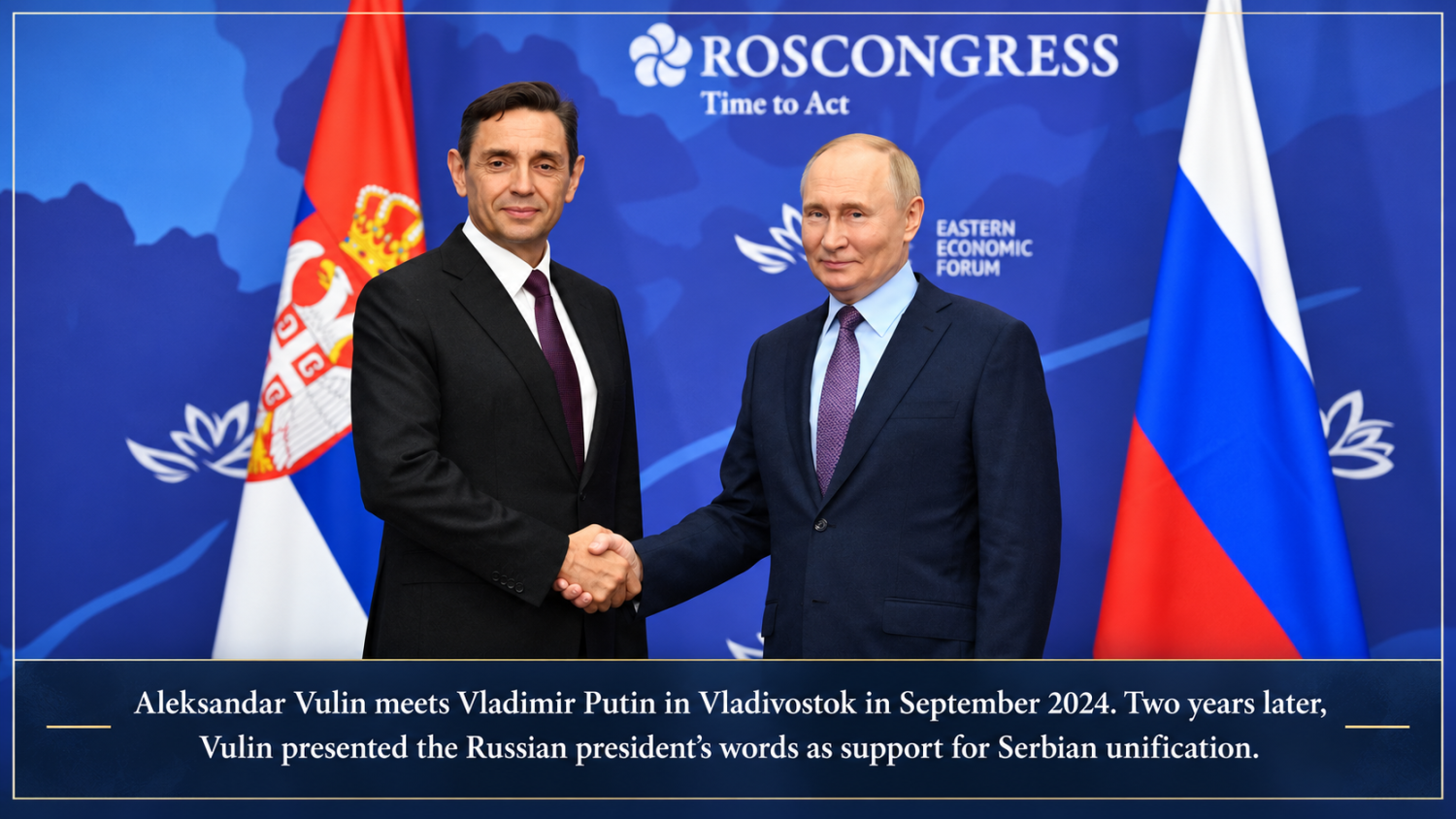
Three men spoke about Serbia’s future in the space of a month. On 8 September, the day after Ratko Mladić was buried with military honours in Belgrade, Aleksandar Vučić told RTS that the applause at the graveside hinted at something he wanted to prevent, and then named it: “I do not want any second half here.” On 1 October Vladimir Putin told the Valdai forum that the Serbs are a divided nation in Europe, “divided by force”, that this is unjust, and that he hopes Vučić becomes prime minister. On 7 October Aleksandar Vulin, Vučić’s companion since the Radical years, his former defence minister, police minister, intelligence chief and deputy prime minister, sat in the B92 studio and finished the sentence Putin had left open: “The world is changing. What until yesterday was unimaginable, that the Serbs should unite, is now very much imaginable. It is up to us, this generation of politicians, to turn President Putin’s support into reality.”
A second half requires a first, and Serbia’s leadership has never disputed which match it means. In September 1997 Vučić explained to his party’s magazine that there was for now a world policeman, the United States, and that against a policeman one does not move; that balances of power pass; that France waited fifty years for Alsace and Lorraine and “we too will be patient in order to regain our land”; that when the balance shifts Serbia shows its teeth, politically first and militarily if necessary; and that until then “we will remind people every day that these territories are our centuries-old land”. The reminding has been done. The text had one open clause, the condition, and Vulin’s “the world is changing” is that clause read out loud on national television by a man who, two days earlier, had opened his party rally with a minute’s silence for Mladić and promised to lead his voters “in that great charge for the Serbian world”.
What Belgrade sees changing is not hard to list, and it does not need to be true to be acted on. Washington is courting Belgrade, with a deputy assistant secretary telling Congress that America wants to become Serbia’s “partner of choice” and Secretary of State Marco Rubio promising a deeper strategic partnership; NATO announced in June a calibrated reduction of KFOR, reversible if conditions worsen, and the mission’s future is now openly argued down in American policy journals. Europe has watched Serbia buy near-hypersonic Chinese missiles with ranges that cover every neighbour, Israeli PULS launchers with 300-kilometre munitions, a billion-dollar electronic-warfare and command layer, Rafales, and, by Kosovo’s defence ministry count, station three of its four combined-arms brigades along the southern line, and has answered with enlargement clusters and ambassadorial statements. Belgrade’s own explanation, that it is responding to defence cooperation between Albania, Croatia and Kosovo, does not account for strike systems that none of the three fields or threatens. Croatia’s defence minister Ivan Anušić said in November 2024 that twenty years of EU policy had been “a complete failure”, a “pink policy” in which everyone is well-meaning and nobody wants to talk about weapons, and asked the question Brussels will not: what is Serbia arming for. He has since answered it himself, warning that Belgrade’s rhetoric treats the 1990s as a first half with another to come, and that its claims run to Kosovo and to the old line from Karlovac to Karlobag. Croatia is in NATO and the EU. When its defence minister says a neighbour is arming for a return match, the problem has left the Belgrade-Pristina file.
The man who wrote the 1997 doctrine rejects its last chapter in exactly the words that confirm its vocabulary. “I do not want any second half” is not what a man says about a match he does not recognise. The rejection is addressed to Brussels; the capability is addressed to the day the policeman leaves; and the interpretation, the part Vučić cannot voice while he wants EU money and American indulgence, is left to Vulin, whom Belgrade can disown on any given Thursday and whose voters it has asked for on 25 October. Vulin told B92 the government dropped him from the list “under EU pressure” and in the next breath endorsed that list. Brussels gets a cleaner ballot. Vučić gets the nationalist vote. The policy keeps its spokesman.
The restraint Belgrade sells to the West is a price, not a conviction, and the price is set by the two capitals Vulin says are changing. States buy reach for deterrence and for prestige; procurement of this scale, aimed south, bought by a government that keeps the 1990s claims alive in its constitution and its media, and now explained on television by a former intelligence chief as the road to unification, leaves the defensive account very little to stand on. What Putin added on 1 October was that the account is not settled and that Moscow will reciprocate Serbia’s cooperation; what Vulin added on 7 October was that Moscow’s words are a mandate, and that the whistle for the second half is a question for this generation. The only people still treating that as the private opinion of an embarrassing friend are the ones whose weakness it is counting on.
Ngadhnjim Brovina is a political scientist at the University for Business and Technology in Pristina, where his research addresses party systems, democratic consolidation, and transnational party organisation in postcommunist Europe.
