Sputnik's Serbian staff spent an hour explaining that a German journalist is the problem. Russia's own intelligence service filed the answer to his question fourteen months ago. Sputnik carried it.
By Artan Rugova | 14 August 2026
On Thursday evening the Serbian-language service of Russia's state broadcaster devoted sixty minutes of its program "Od četvrtka do četvrtka" to Michael Martens. The guest, the former China correspondent Milorad Denda, opened by declaring the subject beneath comment: what Martens asked Ukraine's president in Belgrade on 8 August was a "svinjarija", filth, not worth a word. The hour then supplied the words. Martens, listeners learned, is a "vojnik", a soldier, in a "specijalna operacija" run above all from Berlin to separate Belgrade from Moscow. The interview his newspaper published with the former American ambassador Christopher Hill on the eve of the visit was proof of coordination. Southeast Europe "treba disciplinovati": it needs disciplining. Had Denda asked such a question as a correspondent in China, he added approvingly, he would have been expelled.
The hour was the third strike on the same man in four days. Maria Zakharova opened on 9 August, on her Telegram channel, with the word "propagandist" prefixed by a color and a tour of the man's grandfather's Wehrmacht service, a detail she did not have to investigate, since Martens disclosed it himself in 2024 to explain why he stays silent on Israel. Russia's embassy in Belgrade followed on the 10th, telling RIA Novosti that the question was "a call to unlawful actions and a direct threat to Russians," noting that Russian, Serbian, and German law all provide criminal liability for such conduct. Then state radio, at program length, on the 13th. Four days, three organs, one German journalist. For the head of state who issued the invitation and stood at the other podium, the same apparatus produced, in the same four days, nothing.
So let us examine the soldier they found. Martens asked: "Can you tell us Europeans what can we concretely do to help you to kill more Russians?" He corrected himself at once, "more Russian soldiers, of course," and moved to a question about military cooperation. His newspaper has said it regrets the formulation, calling it ambiguously worded, and the regret is warranted; the question could have been put better. Martens himself has conceded nothing of the substance, writing afterward that there is nothing scandalous in asking Ukraine's president how Europe can help Ukraine kill more Russians. On the substance he is right. Ukraine is defending itself against an invasion, wars are fought with lethal ammunition, and ammunition kills the soldiers who invade. Asking how Europe helps Ukraine fight and asking how Europe helps kill invading soldiers is one question asked twice.
Here the file turns, because the question has already been answered, in public, by the government now hunting the man who asked it. On 29 May 2025 Russia's Foreign Intelligence Service published a statement on its own website under the title "The Serbian Defense Industry Is Trying to Shoot Russia in the Back." Serbian defense firms, it said, "continue to supply ammunition to Kiev, in violation of the 'neutrality' declared by Belgrade," through fake end-user certificates and intermediaries in Poland, the Czech Republic, Bulgaria, and African states: some hundred thousand rocket and howitzer shells and a million small-arms rounds, from a list of companies that names Yugoimport, Krušik, Sloboda, and Prvi Partizan. The SVR did not leave the purpose to inference. "Their only obvious purpose," the statement reads, "is to kill and maim Russian servicemen and civilians." The record beneath the accusation was already documented: roughly €800 million of Serbian ammunition reaching Ukraine through third countries since 2022, per the Financial Times, and confirmed by Serbia's president himself. "Yes, we do export our ammunition," Aleksandar Vučić said; what buyers do with it is their business. Fourteen months before a German journalist asked in Belgrade how Europe helps kill Russian soldiers, Russian intelligence announced that Belgrade already does. And Sputnik knows this, in the most literal sense available: its own news service carried the SVR statement on 29 May 2025. The answer to Thursday's forbidden question sits in Thursday's broadcaster's archive.
Belgrade will reply that the matter was settled: a working group with Moscow was announced, and on 23 June 2025 Serbia's president declared all military exports halted. The reply deserves its hearing, and it fails on the record. An Israeli cargo plane landed at Belgrade airport on 23 June, hours after the announcement, and departed the next day for Israel's Nevatim military airbase. By year's end, Serbia's own statistics would put arms exports to its other wartime client at a record €114 million, and flight logs count seventeen more ammunition flights in the first months of 2026. On the eve of the visit, Hill was still describing, in the very interview Denda cites as evidence of conspiracy, how Washington helped Ukraine obtain Serbian ammunition. To make the plot against Serbia work, the hour vouched for the warehouse.
Which leaves the hour's actual cargo, delivered near its end: Moscow, listeners were assured, "razume politički kontekst." Russia understands, the visit had to happen, nothing strategic has changed. That assurance was manufactured in Serbian, by Serbian staff, for Serbian listeners, and it now stands opposite a Russian government document that calls the same conduct a shot in Russia's back, while Russian television tries the word traitor and Aleksandar Dugin tells his Radio Sputnik audience that Serbia's president "has spat in our face."
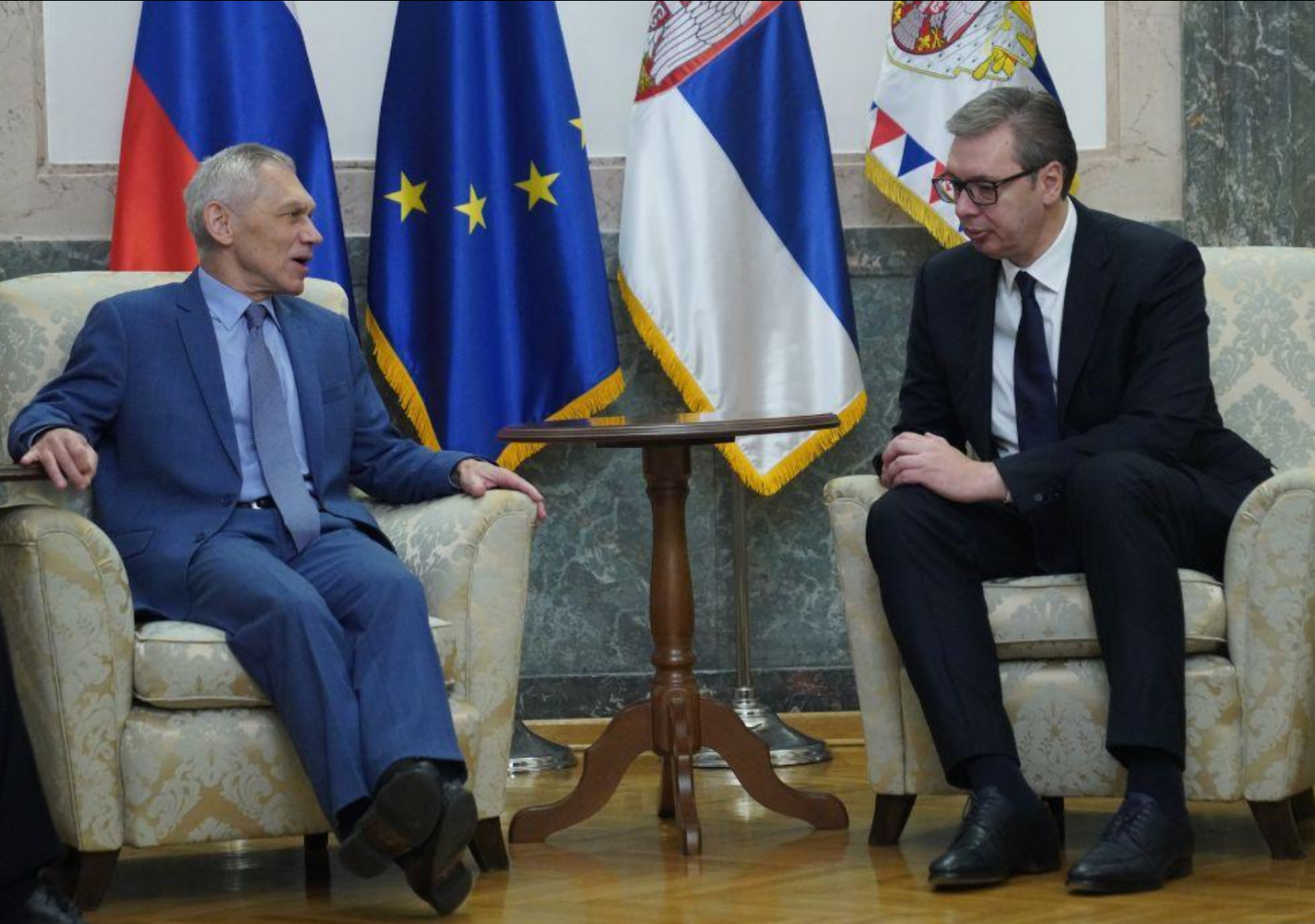
Aleksandar Bocan-Harčenko has served as Russia's ambassador in Belgrade since 2019, and no other ambassador in the city sees Serbia's president as often. Moscow now has one document on file and one explanation offered in its name. The document, from its intelligence service, says Serbian ammunition exists to kill and maim Russian soldiers. The explanation, from a broadcaster's Serbian staff, says Russia understands. We ask the ambassador which speaks for Moscow. The program found sixty minutes for the man who asked about the killing. Our question is about the supplying, and it is shorter.
Artan Rugova is a Kosovo-based commentator for The Kosovo Dispatch, where he writes on political and institutional developments in Kosovo. He has also been involved in sports administration and public life, including engagement with national sports structures in Kosovo. Earlier in his career, he was the publisher of The Kosovo Times, an English-language news journal based in Prishtina that covered Kosovo and regional affairs for an international audience.
