Europe congratulated Serbia’s new majority on the rule of law without mentioning the condition its programme already rejects. The record says it should have known better, and the programme says it did.
By Ardit Rada | 27 October 2026
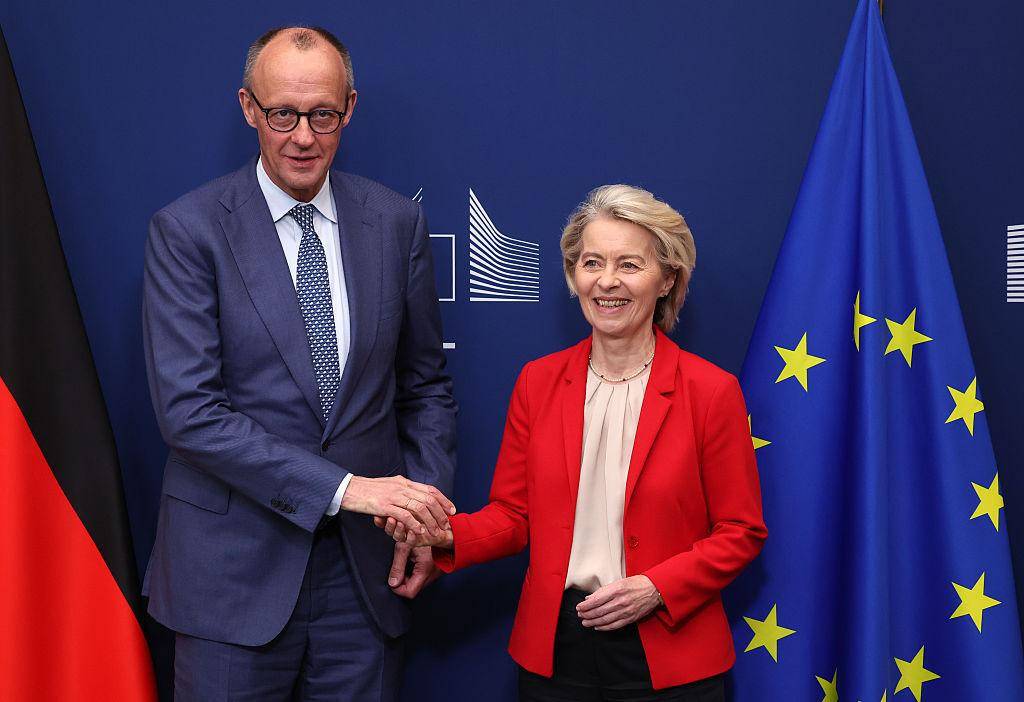
On Monday the German Chancellor’s account congratulated the Student List on a clear victory in the Serbian election, praised its demands for the rule of law, the fight against corruption and fundamental freedoms, and promised active support for Serbia’s European path. Ursula von der Leyen and Marta Kos had posted to the same effect on Sunday night. Across the three messages the words Kosovo, Russia and sanctions do not appear.
That would be a small omission if the list had not already spoken. Its programme rejects the normalisation agreements with Pristina. Its spokesman told RT Balkan after the result that there would be no sanctions on Russia and no change of course. Those are declared positions. Beyond them there is a signal, the first call of the night going to Moscow, as this publication reported on Monday, and a silence, on Ratko Mladić, whose state funeral in September drew a formal German response and from the list not a word. Brussels and Berlin were not being asked to guess what a new government might do. They were congratulating a movement whose file was already open on the desk, and they praised the pages it had written well while passing over the ones that read like Vučić.
Why trust it at face value? A Belgrade analyst, Nik Stanković, gave the short version on election night: Milošević came to power on an anti-corruption campaign, so did the coalition that removed him in 2000, so did Vučić in 2012, and whoever thinks it is different this time is a twenty-year-old student. Serbian reformers need not be frauds for that to hold. A promise to clean the state has never, in Serbia, been a promise to change the state’s position on Kosovo, and Europe has mistaken the first for the second every time it was offered. The removal of Milošević in October 2000 was real; the Council lifted the oil embargo and the flight ban within nine days, Jacques Chirac received Koštunica at Biarritz as the embodiment of Yugoslav democracy, and the man Europe welcomed had, three days earlier, told French television that independence for Kosovo was impossible. In May 2012 Van Rompuy and Barroso congratulated Nikolić on the clear signal voters had sent for Europe; the statement went out before the polls closed, Nikolić denied the Srebrenica genocide a fortnight later, and the government that followed was led by Milošević’s former spokesman with Vučić in charge of the fight against corruption. In 2013 Dačić initialled the Brussels Agreement, a genuine document that Europe praised for the courage of its signatories and rewarded with accession talks inside ten weeks. In 2017 Juncker and Tusk congratulated President Vučić with the sentence that stable institutions, the rule of law and the fight against corruption were crucial. Four years later Angela Merkel, leaving office, called him a man who keeps his word. A revolution, a signature, a congratulation, and in each case a limited achievement read in Brussels as a turn the country had not made.
Why was nobody reminded of Kosovo this time? The condition has been on the record for fourteen years. In June 2012 Barroso told Nikolić, in public, that normalisation with Kosovo was an absolutely central condition for the next step. Nikolić went home and told Serbian television he had been assured Brussels would never ask for recognition, and Brussels let that stand, but the condition had at least been spoken. It was then written down: Chapter 35 of the negotiating framework of December 2013 ties the pace of Serbia’s accession to its relations with Pristina, and Kaja Kallas repeated in New York last month that the Ohrid agreement is binding. The Commission has restated it in every enlargement report since. What is new in October 2026 is that the condition was left out of the one message where it was needed, by the Commission President, by the Chancellor of the member state that pressed hardest for the framework’s wording, and by the Commissioner whose portfolio is enlargement and whose post was therefore the natural place for the sentence. It was not forgotten. It was not invoked.
The cost of that choice falls on Pristina first. For twelve years Kosovo’s argument in every European capital was that the agreements went unimplemented because an autocrat chose not to implement them. A democratically elected majority that refuses the same agreements removes that argument and replaces it with something harder to answer: Vučić’s refusal was a leader’s decision, the list’s will be presented as the decision of a free electorate, and the legitimacy Europe is celebrating this week will be the legitimacy cited against the condition Europe wrote. Pressure that used to point at Belgrade’s system will start pointing at Pristina’s patience. That shift began on Sunday night, in three posts that did not mention it.
The list is free to campaign against normalisation and Serbian voters are free to reward it. What the European side owed was one sentence, in the same message that praised the rule of law, stating what that choice costs under the Union’s own rules. Merz, von der Leyen and Kos each had the programme, the RT Balkan interview and the silence on Mladić in front of them before they wrote. Five governments since 2000, each praised for what it had done at home, a condition on Kosovo stated repeatedly and enforced never, and now a congratulation sent to a movement that had already filed its answer. Berlin and Brussels did not fail to predict the Student List. They declined to read it.