On 23 September 1998 the Security Council warned of a humanitarian catastrophe in Kosovo. On 23 September 2026 Serbia's president told the General Assembly it never happened. Albania counted the people who arrived.
by Ardit Rada, Tirana | 24 September 2026
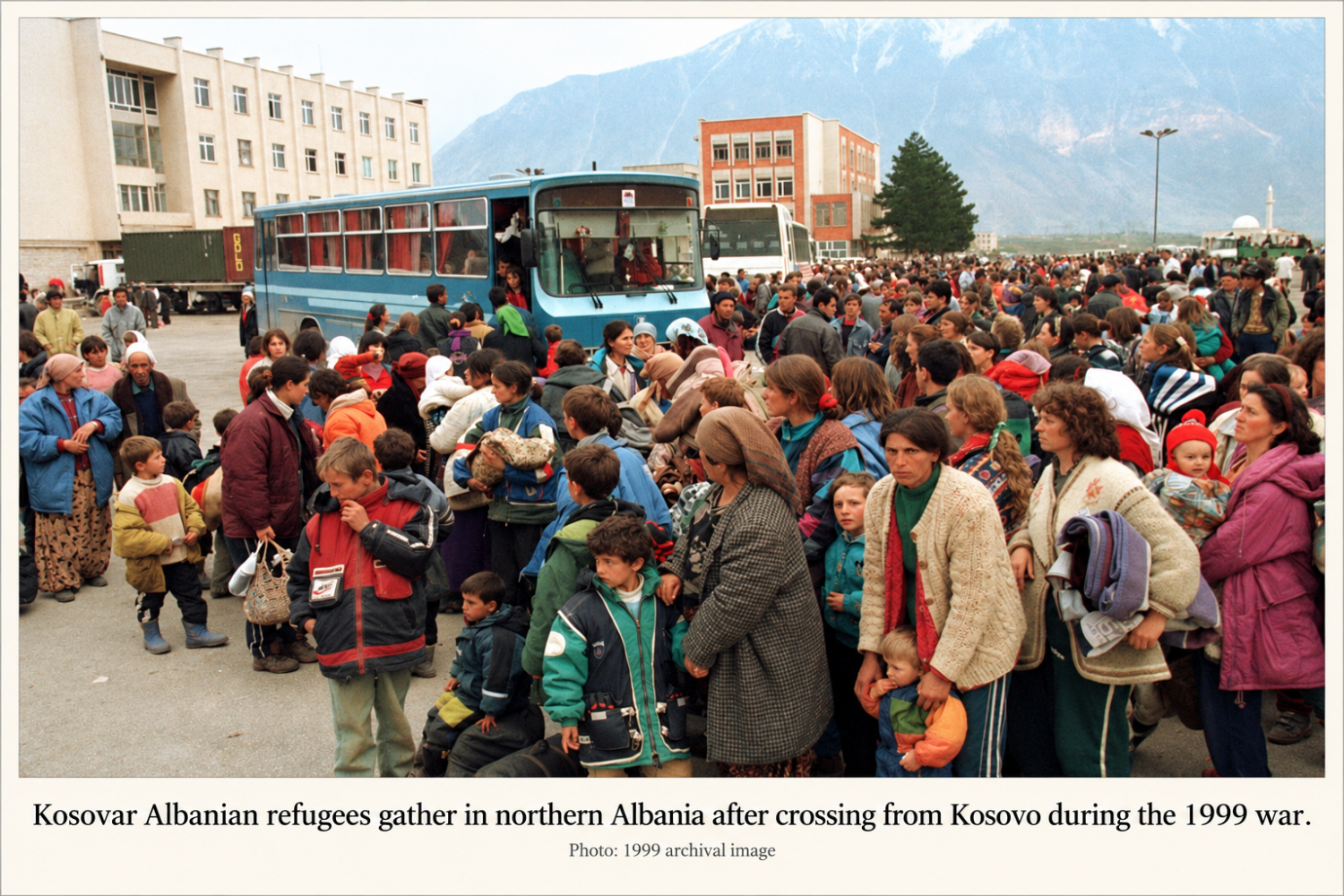
On 1 April 1999 the buses stopped several kilometres short of the Morina crossing, and the people on them were made to walk the rest of the way into Albania. UNHCR staff counted 20,900 arrivals at Morina that day, most of them women, children and the elderly. Further south, at Qafë Prushit, two women and two children died on arrival, apparently of exhaustion and exposure. By 10 June the agency's count for Albania stood at 444,200, out of 780,700 refugees and displaced people across the region.
On 23 September 2026 Aleksandar Vučić stood at the rostrum of the General Assembly and explained why NATO had bombed his country. They said, he told the delegates, that they had attacked a sovereign state to prevent a potential humanitarian disaster. "The humanitarian disaster did not occur," he said, "and I have still not managed to hear or see where a similar example has occurred anywhere in the world."
The date has its own entry in the UN's files. On 23 September 1998, twenty-eight years earlier to the day, the Security Council adopted Resolution 1199. The Council declared itself alarmed at "the impending humanitarian catastrophe" in Kosovo and demanded that Belgrade take immediate steps to avert it. Vučić invoked the Charter and Resolution 1244 repeatedly in his speech. He did not mention 1199.
The Hague later heard his argument in another form. A Serbian defence witness told the Tribunal that the columns heading for Albania were fleeing NATO bombs. The judges noted that not one Kosovo Albanian witness said so. They also noted that Belgrade, bombed harder than anywhere, did not empty. The Tribunal found an organised campaign of expulsion by Yugoslav army and Serbian police forces, and convicted a Yugoslav deputy prime minister, two army generals and a police general for it. Many of those who crossed at Morina arrived without identity papers, because the papers had been taken from them on the road.
Anyone in northern Albania who was old enough in 1999 heard from the people coming over the mountains why they had come. Nobody in Kukës needed a court to explain it. The court was needed for Belgrade.
Belgrade's own soil holds the rest. In 2001, after Milošević fell, the remains of 744 people were dug out of the grounds of the special police anti-terrorist centre at Batajnica, on the edge of the Serbian capital. They had been killed in Kosovo and driven north so they would not be found. The grave still lies inside the police compound, and a visit requires police permission.
Some of the dead at Batajnica came from one family in Suva Reka. The Berishas were killed on 26 March 1999, two days into the bombing. In 2009 a Belgrade war crimes court convicted four Serbian policemen for the massacre and called it the worst single killing of civilians in the war. The victims included fourteen children, two babies, a pregnant woman and a woman of one hundred.
In 1999 Vučić was Serbia's minister of information. The catastrophe that did not happen is recorded in a Security Council resolution, in the judgments of The Hague, in the register of a Belgrade court and under a police compound on the edge of his own capital.
On 7 September the Serbian state buried Ratko Mladić, convicted of genocide at Srebrenica, with military honours. Europe told Vučić twice what it thought of that, and twice let him leave with a photograph. The enlargement commissioner cancelled her visit to Belgrade. In New York the EU's foreign policy chief raised Mladić with him the day before he spoke, according to Vučić himself. Emmanuel Macron received him at the Élysée. Ursula von der Leyen gave him a handshake her office later called an accident, and he posted it.
The funeral had been built from parts that could each be defended on its own terms, and no official needed to call Mladić a hero. In New York the head of state spoke for himself. Sixteen days after the convicted Bosnian Serb general was buried with honours, he denied the Kosovo record from the rostrum of the organisation whose Council had warned of the catastrophe.
Albania was there. The country took in some 465,000 people that spring, two years after the 1997 pyramid-scheme collapse and the unrest that followed. Nobody knows the exact number, because nobody issued them papers. Families in Kukës, Shkodër, Tirana and Durrës opened their homes to strangers. Albania is now completing its accession negotiations with the Union that Serbia says it still wants to join. Von der Leyen is due in Tirana on 30 September.
A candidate country's president has told the United Nations that the catastrophe which sent close to half a million people into Albania never took place. Brussels will decide whether that sentence costs Belgrade anything. In Albania the answer was given in 1999, on a mountain road below Morina, by people who walked the last kilometres because the buses would not take them further.
Ardit Rada is Tirana-based journalist covering politics, governance, and institutional developments. Focused on the intersection of domestic political dynamics and Albania’s European trajectory.