Serbia wrote Kosovo into its Constitution while the territory’s status was being negotiated and its Albanian majority had no vote. Twenty years on, Belgrade still presents the document as the reason it cannot accept Kosovo. It binds Serbia. It has never bound anyone else.
By Albatros Rexhaj | 30 October 2026
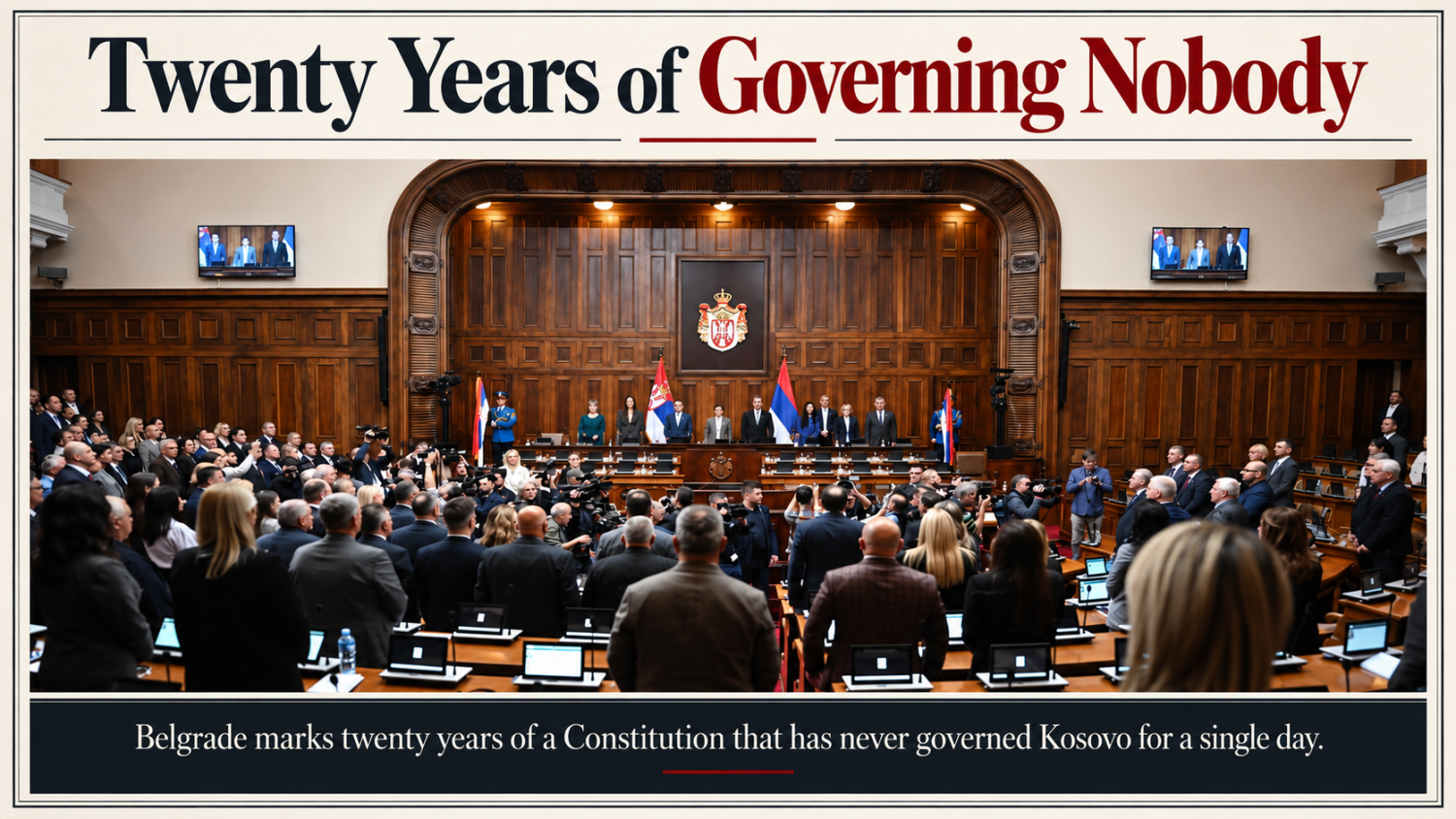
On Thursday Belgrade celebrated twenty years of a Constitution that has not governed Kosovo for a single day. The vice-president of the Venice Commission came to the Serbian Assembly to mark the occasion, with a judge of the European Court of Human Rights and the president of Italy’s Constitutional Court beside him. There were speeches about maturity, rule of law and national identity. Nobody in the hall appeared troubled that the document’s most cherished clause, the one its hosts kept returning to, has never produced one Serbian judge, policeman or tax officer in the territory it claims.
Eirik Holmøyvik told the hall that most constitutions die young and that this one had, in Tanjug’s rendering, matured and become firmly grounded. Slobodanka Perić, dean of the Serbian law faculty that calls itself the University of Pristina and sits in North Mitrovica, read the preamble as written: the province is an integral part of Serbia’s territory, and every state organ is obliged to represent and protect Serbia’s state interests there. “Kosovo and Metohija”, she said, is the core of Serbian national identity and not merely a geographical and political notion. The president of the Constitutional Court, Vladan Petrov, conceded that the text protects Kosovo on one side and faces Europe on the other, and called the contradiction apparent. It is the document.
Every word Perić read describes duties of Serbian officials. A constitution tells a state what its own organs must do. It does not reach across a border and tell another people where they live. Serbia may oblige itself to regard Kosovo as Serbian. It cannot oblige Kosovo to be Serbian. Otherwise every territorial dispute on earth would be settled by whichever parliament printed the largest map.
When it wrote that preamble, Serbia held nothing in Kosovo. Since 10 June 1999 it had governed nothing there. Its parallel schools and clinics in the enclaves ran on Belgrade’s money; the territory was administered by UNMIK and held by KFOR. Resolution 1244 had called for a political process to determine Kosovo’s future status, and in February 2006 that process opened in Vienna under Martti Ahtisaari, with Serbia at the table. The Contact Group had already written that the outcome must be acceptable to the people of Kosovo and that there would be no return to the situation before 1999.
Seven months into that negotiation, Serbia wrote the ending into its Constitution. The Kosovo paragraph went into the preamble by government conclusion on 29 September 2006. The Assembly adopted the whole text the next day, unanimously, 242 of 250, at a special session, with no public draft and no debate. President Tadić admitted unease at the speed. The referendum ran over two days because the Milošević-era rule demanded a majority of all registered voters and one day would not deliver it. Final count: 6,639,385 registered, 3,521,724 Yes, 53.04 percent of the electorate. Cleared by three points.
Those 6.6 million did not include the Albanians of Kosovo. They had been off Serbian rolls since 1990. Serbia counted them into the territory and left them off the roll in the same month, then announced a constitutional settlement of both. Serbia wanted their land, not their opinion. The vote was held in Serbia, celebrated in Serbia, and the ninety percent of Kosovo whose future it claimed to decide were expected to accept a decision in which they had no voice. Had they been on the roll, the fifty-percent line would have been out of reach. Their absence is what made the Constitution possible. Imagine Pristina doing the same to Serbia and ask how Belgrade would describe it.
Then Serbia told the mediator its hands were tied. Ahtisaari’s proposal came in February 2007 and Belgrade rejected it by pointing at the preamble it had written five months earlier. Kosovo declared independence on 17 February 2008.
Then the Court spoke. On 22 July 2010 the International Court of Justice found that Resolution 1244 had created an interim regime for Kosovo and had left its final status open; the text spoke of Yugoslavia’s territorial integrity in its preamble and annex and settled nothing in its operative paragraphs. The declaration of independence, the Court held, violated neither general international law, nor the resolution, nor the Constitutional Framework. Serbia had asked the question. Serbia had written the preamble as if the answer were already given. The world’s highest court said it was not. A document that claims as settled what the Security Council left open, and what the Court found open, settles nothing anywhere except inside Serbia. Nor could a unanimous Serbian vote have changed that. Had every voter in Serbia said yes, the Constitution would have exactly the force in Kosovo it has today: none.
The Venice Commission knows all this. In March 2007 it examined this very text and found the adoption at an irregular session, without public debate, wanting; Belgrade had promulgated the Constitution four months earlier regardless. Nineteen years later its vice-president stood in the same Assembly and spoke of maturity. He should have brought his Commission’s opinion.
The Constitution has served one purpose outside Serbia. For twenty years Belgrade has carried it to Brussels as the reason it cannot accept Kosovo, and negotiators have flown to Pristina with another request for flexibility. A restriction Serbia placed on its own officials has been handled as a limit on what Kosovo may ask.
If Serbia wants the preamble changed, Article 203 tells it how: another referendum. If it does not want it changed, that is Serbia’s choice. Either way the problem lives in Belgrade, and Pristina owes nothing for it.
Serbia can keep its Constitution exactly as it is. It can keep Kosovo in the preamble, in the presidential oath, in the schoolbooks and on every map in every ministry corridor in Belgrade, for another twenty years or another hundred. The Republic of Kosovo will not acquire a single Serbian institution because of it. The document tells Belgrade what Belgrade must do. It tells Kosovo nothing.