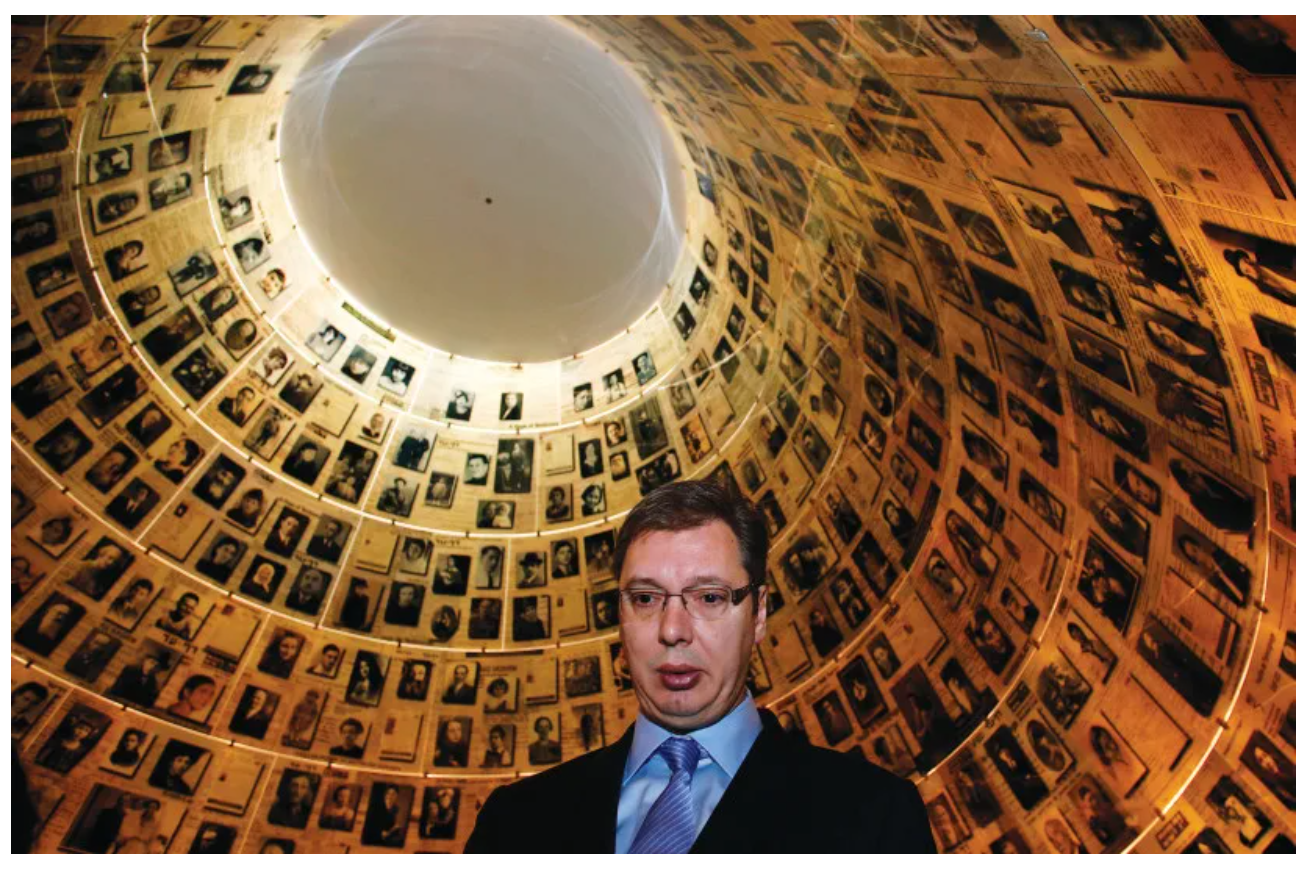
Belgrade invokes the Holocaust to defend historical truth, but still treats the crimes of the 1990s as a matter of interpretation.
by Mark Gojcaj | 28 January 2026
Serbian President Aleksandar Vučić marked International Holocaust Remembrance Day with a familiar message: a call to fight historical revisionism and the distortion of the Holocaust, and a pledge that such crimes must “never happen again.”
“We must fight against historical revisionism and the distortion of the Holocaust,” Vučić wrote on January 27. “Never again.”
The statement, issued via the official presidential account and echoed by senior Serbian officials, follows a well-established script. For more than a decade, Belgrade has marked the day with near-identical language, backed by institutional gestures — from participation in the International Holocaust Remembrance Alliance (IHRA) to memorial projects in Belgrade and restitution commitments.
There is nothing new in this.
What matters is where this moral clarity ends.
In Serbia’s official narrative, the Holocaust is an absolute crime — beyond debate, beyond context, beyond relativization. In the same political discourse, the wars of the 1990s are still described as “complex conflicts,” “tragic events,” or “misunderstandings of history.”
Auschwitz is certainty.
Srebrenica is semantics.
Kosovo is geopolitics.
This is not just denial. It is hierarchized memory.
Vučić has called Srebrenica a crime. Serbian courts have convicted individual perpetrators. Yet political language remains carefully engineered to avoid naming a system, a policy, or institutional responsibility. Guilt is individualized. History is blurred. Moral judgment is postponed.
That asymmetry has not faded with time. In July 2025, on the 30th anniversary of the Srebrenica genocide, Vučić issued condolences via social media but did not attend official commemorations. Serbia also opposed the UN resolution establishing an international remembrance day for Srebrenica — arguing it would deepen divisions.
More recently, Vučić has gone further in the Kosovo context, publicly rejecting claims of Serbian state crimes during the 1998–99 war and portraying documented atrocities as fabrications or wartime propaganda. In doing so, he has shifted from calibrated ambiguity to open narrative defense — disputing not only interpretations, but the legitimacy of established evidence.
At the same time, Holocaust remembrance remains unambiguous and ceremonial.
Why?
Because it is safe history:
• It is internationally settled.
• It carries diplomatic reward.
• It costs nothing domestically.
Honoring Holocaust victims does not threaten Serbia’s national narrative. Confronting the crimes of the Yugoslav wars still does.
Serbia was the central state in the Yugoslav wars, with the strongest institutional continuity. Its language about history therefore carries regional weight.
So when Vučić warns against revisionism, the real question is not whether he is right about the Holocaust.
The question is whether the rule he invokes applies beyond it.
If distortion is dangerous, it is dangerous when mass graves are turned into footnotes.
If memory must protect future generations, it must include the wars they inherited.
If “never again” is a principle, it cannot stop at 1945.
Until that line is crossed, Serbia’s remembrance will remain sincere in one register and strategic in another.
Not false.
But incomplete.
And in the Balkans, incomplete memory is never neutral.
Read also: Vučić’s Intermission Doctrine
