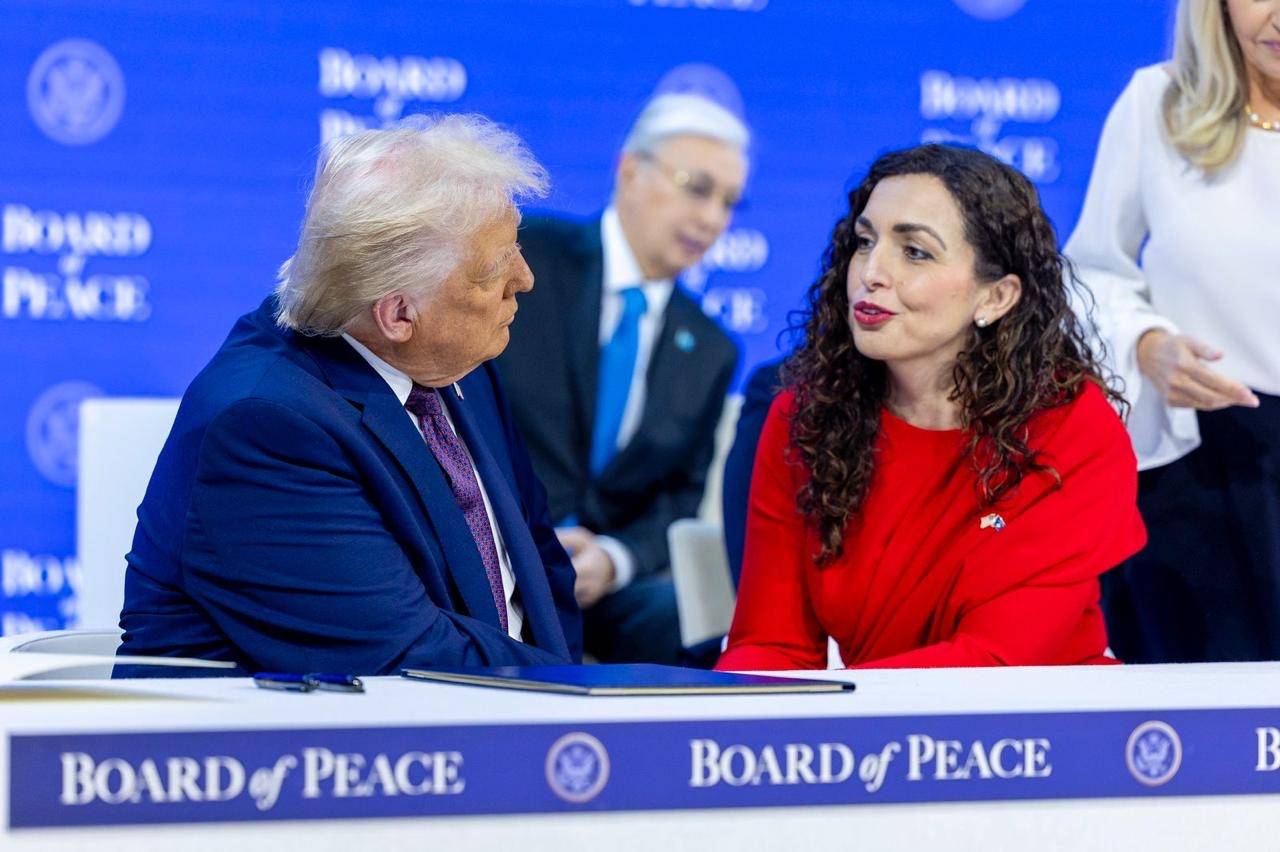
The Serbian president told a German newspaper he was disappointed Vjosa Osmani sat in a U.S.-convened diplomatic process. He never explained why that was his call to make.
by Mark Gojcaj | 9 March 2026
Aleksandar Vučić gave a polished interview to Germany's Süddeutsche Zeitung last week. He spoke of energy pipelines, EU accession, Serbian sovereignty, the burdens of navigating between East and West. He was fluent, measured, statesmanlike.
He was also, if you read carefully, making a claim so extraordinary that it appears to have passed without the scrutiny it deserves.
Here it is, stripped of its diplomatic upholstery.
Vučić told a major Western newspaper that he was disappointed the Trump administration had allowed Kosovo's president, Vjosa Osmani, to participate in its Peace Committee. Her presence, he suggested, was unexpected — something the administration should not have permitted.
"This is not what we would have expected," he said.
The obvious question — the one that should have followed immediately — is simple: expected by whom, and on what basis?
The United States recognized Kosovo as an independent state in 2008. That recognition has not been rescinded, reconsidered, or qualified by any subsequent American administration. The Peace Committee is a process convened by Washington, on American terms, with an American guest list.
Vjosa Osmani sits at that table for a straightforward reason: she is the president of a state the United States recognizes, participating in a process the United States organized.
What, precisely, is Vučić's theory?
That Washington should have excluded the head of state of a country it has recognized for seventeen years from a diplomatic process it convened in its own house? That Belgrade holds some form of veto — formal or informal — over who Prishtina sends to American-hosted talks?
Vučić never says. Saying it plainly would expose how untenable the position is. So instead he registers disappointment, lets the implication drift, and moves on to the next topic.
It is a technique he has refined over many years.
The same logic governs his use of the phrase "Kurti regime."
The term appears not once but twice in the interview — deliberately — in a newspaper read across European capitals. "Regime" is not a translation accident. In the political vocabulary of the Western Balkans it carries a specific charge: it frames a democratically elected government as illegitimate, something other than a normal state exercising normal sovereign authority.
Vučić knows this.
He chose the word anyway, knowing it would travel — knowing it would land in Berlin and Brussels without the context that makes its tendentiousness visible.
He also invoked unspecified provocations against "all Serbs living in Kosovo," a rhetorical move he has deployed so often it has become routine.
The power of such claims lies in their vagueness. Vague accusations in high-circulation Western media serve a function: they create the atmosphere of grievance without the burden of proof. By the time a reader reaches for context, the interview has already moved on and the narrative frame has been established.
None of this is surprising.
What is worth marking is the timing and the venue — and the venue matters more than it might appear.
Vučić is operating under pressure on several fronts: sustained domestic protests, the dispute surrounding sanctions on Serbia's oil sector, and an EU accession process that continues to demand democratic reforms his government has repeatedly resisted.
The Süddeutsche Zeitung interview is therefore not merely an interview. It is a Western outreach exercise with a specific target. Germany is the European Union's anchor power and a country whose support is indispensable to any Balkan accession trajectory. It is also a country where skepticism toward Kosovo — its independence, its institutions, its international standing — has at times found a more sympathetic hearing than in Washington. Vučić knows his audience. Reassure European readers. Signal dissatisfaction to Washington. And reframe Kosovo not as a sovereign state asserting its place in regional diplomacy, but as a source of instability that tests Serbian patience and complicates European order.
The strategy is coherent. It is also, when examined directly, audacious in a way that deserves to be named.
Audacious, because it requires Western interlocutors to forget that Kosovo's presence in international forums is not a favor Belgrade can grant or withdraw.
Audacious, because it asks Washington to treat Serbian disappointment as a relevant factor in deciding who sits at American diplomatic tables.
Audacious, because it frames the simple act of a recognized state sending its president to a diplomatic process as a provocation that requires explanation.
Kosovo does not owe Belgrade an explanation for Vjosa Osmani's presence in Washington.
The United States does not owe Belgrade an apology for convening a process that includes the government of a state it recognizes.
And Aleksandar Vučić does not get to register disappointment about outcomes he was never entitled to shape — not in a German newspaper, and not anywhere else.
He knows the difference between a grievance and a claim.
So do we.
About the Author
Mark Gojcaj writes from New York, where he examines the intersection of American conservatism and Southeast European political and security realities. He is a regular contributor to The Kosovo Dispatch’s transatlantic coverage, with a focus on U.S. foreign policy, NATO dynamics, and the Western Balkans.
