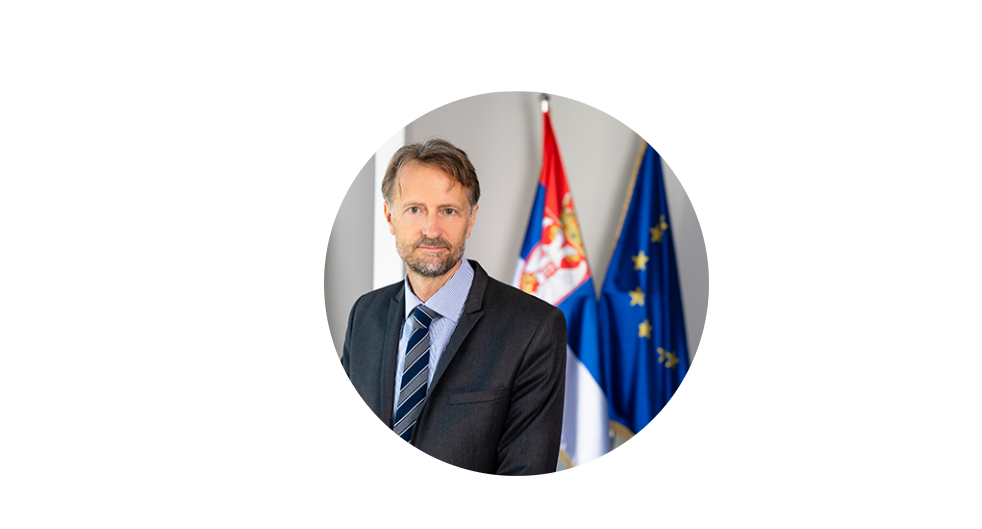
At a moment when Serbia’s European trajectory appears stalled—and public support for EU membership is at its lowest point since accession talks began—the EU’s language toward Belgrade has become more cautious, more procedural, and more revealing in its silences.
In this wide-ranging interview, Andreas von Beckerath, Head of the EU Delegation to Serbia, speaks with unusual openness about polarization in Serbian society, media capture, disinformation, reform fatigue, and the limits of dialogue. He acknowledges frustration among pro-European citizens, defends the credibility of the accession process, and outlines Brussels’ expectations on the rule of law, elections, and media freedom.
What stands out, however, is not only what is said—but what is not. Kosovo is never mentioned. Not as context. Not as constraint. Not as a political reality shaping Serbia’s European path.
That omission is not incidental. It reflects the current contours of EU engagement with Serbia: firm on values, cautious on accountability, and carefully calibrated to avoid confrontation.
The interview below is republished in full as a strategic reading—a document that helps explain how Brussels now speaks to Belgrade, and what that language tells the region about the limits of European leverage.
First published in Nedeljnik ’s New Year double issue (Nos. 728–729), 25 December 2025.
Support for the European Union in Serbia is probably at its lowest level since negotiations began. Why do you think that is? How much responsibility does the European Union bear for this?
I think that support is shaped by several factors, but two in particular stand out: the length of Serbia’s accession process and insufficient understanding of what EU membership would mean in practice for the country and its citizens.
I fully understand why many people feel tired of the pace of Serbia’s European path. Serbia has been formally involved in the accession process for almost two decades, and such a long timeframe inevitably affects public trust and expectations. At the same time, it is striking that the latest Eurobarometer data show stronger support for EU enlargement within the European Union itself than in Serbia.
For example, in my home country, Sweden, around 80% of citizens support Serbia’s membership in the EU. Of course, I would like to see the same level of support here in Serbia.
The European Union must take its share of responsibility. Together with colleagues, I am making every effort to reach citizens across Serbia and to clearly explain what EU membership means in practice—for their everyday lives. What the EU offers is, in my view, extraordinary in terms of opportunities, rights, and protections it brings to citizens.
However, conveying this message is not easy in a highly polarized media environment. In the five months since I assumed my duties as EU Ambassador to Serbia, I have witnessed several clear disinformation campaigns against the European Union, as well as daily manipulation and distorted portrayals directed at the EU and its Member States in Serbia’s mainstream media.
In this, Serbian authorities—who continuously emphasize that EU membership is Serbia’s strategic goal—should have a special role. As should the media. Both have a responsibility to provide citizens with factual, objective information about what the European Union offers and what it stands for.
I am more than ready to engage in debate with citizens who are still not convinced about Serbia’s path toward the EU, but this discussion must be based on facts and evidence, expressed in a manner befitting such a debate. When disagreements are presented openly, responsibly, and with mutual respect, societies become stronger: trust grows, better decisions are made, and citizens feel they have a real stake in shaping their country’s future. I am convinced that fostering such a culture of constructive, fact-based discussion would be of great benefit to Serbia and to its future in the EU.
Support has been declining over time even within that part of Serbian society that is oriented toward Europe and committed to European values. Many feel betrayed by the often lukewarm reactions from Brussels and Strasbourg to everything happening in Serbia, especially when it comes to freedom of assembly. Still, recently we have seen somewhat faster reactions, even from the EU Delegation in Belgrade. Is that an indication that something is changing with your arrival?
I take very seriously the fact that many pro-European citizens of Serbia feel that the European Union has let them down, and I will do everything I can to show that their trust is justified. What you may have noticed does not reflect a change in policy, nor is it tied to any individual approach. It is rather a response to developments on the ground and to the slowing pace of reforms, as identified in the latest Annual Report of the European Commission.
I would remind you that I represent the 27 EU Member States in Serbia, and the EU as a whole in Serbia, and my interventions reflect positions agreed and coordinated at the EU level. Speaking out in such moments is therefore not criticism for criticism’s sake. It is part of our responsibility to be transparent—both to give recognition where it is due, and to clearly point out areas where greater progress is needed and how it can be achieved.
In that sense, the aim of the EU’s messages is to support Serbia in its progress, not to discourage it. If we look carefully at the reforms the European Union is requesting—such as strengthening the rule of law, ensuring an independent judiciary and autonomous prosecution service, improving the electoral framework, protecting media freedom, and creating an enabling environment for civil society—they very much align with what many citizens in Serbia are demanding. Supporting Serbia in advancing these priority areas has been, and remains, at the core of our engagement with Serbia.
That is why I firmly believe that the EU accession process can and should serve as a framework for bringing together different actors. That means the authorities and the governing coalition, the opposition, and—crucially—civil society. The accession process must be a whole-of-society effort. Without broad ownership, reforms cannot be sustainable or credible.
Serbia’s President Aleksandar Vučić personally decided, as he said, that official Belgrade would not send a delegation to the EU–Western Balkans Summit. How do you comment on that? And how do you assess the messages sent to the Western Balkans at that summit?
I think it was a pity that Serbia did not participate in the EU–Western Balkans Summit. If there are challenges or doubts, they should be addressed through dialogue. After all, the EU enlargement process is built on open and constructive dialogue.
The recent summit once again reaffirmed our determination to enlarge the Union, and Serbia—together with the Western Balkans—is firmly seen as a future member of the Union. This commitment has been consistently confirmed over the past year by the highest EU officials who have visited Serbia. The summit’s message was therefore strong and consistent: the EU is determined to continue supporting the Western Balkans in becoming part of the EU, and enlargement remains a priority for the Union.
Participation in such events is important precisely because it enables countries to engage directly, voice concerns, and contribute to shaping the path forward.
Do you fear that Serbia will miss this opportunity as well to catch the train of European integration? What must happen for things to change?
As long as I am here, I will do everything in my power to ensure that Serbia does not miss that train. There is real momentum for enlargement—we clearly see it in neighboring countries such as Montenegro and Albania, which are moving decisively toward EU membership.
That is why EU Member States have already begun preparing internally for an expanded Union—in institutional, financial, and political terms. The opportunity is real. But it now depends on Serbia whether it will use it.
So, what must change? The greatest obstacle I see today is the deep political and social polarization in Serbia, which is intensified by a confrontational tone in public discourse. That benefits no one. If Serbia wants to move forward, space must be created for genuine dialogue on the reforms the country urgently needs—above all on the rule of law, but also on electoral reforms, where there is clearly a shared interest.
These reforms can succeed only when all key actors—the government, the opposition, and civil society—are included and committed. I am fully aware of the frustration many citizens feel and I understand how difficult dialogue can seem in the current circumstances. But there is no alternative. And here the authorities bear a special responsibility—that is the burden that comes with being in power.
Leadership means lowering the temperature, extending a hand, and creating conditions for inclusive dialogue. These are reforms that would benefit all citizens of Serbia and bring the country closer to where it belongs—in the European Union.
How “jealous” are you of EU ambassadors in Podgorica and Tirana? What is the main difference between what Montenegro and Albania are doing in the EU accession process, and what Serbia is doing—or not doing?
I truly meant what I said at the beginning. I wanted to be the EU Ambassador to Serbia, and there truly is no other place I would rather be than Belgrade.
When it comes to the accession process in the Western Balkans, the principle is clear: the implementation of reforms and concrete results accelerate accession. Montenegro and Albania, for example, achieved tangible results over the past year, which resulted in their rapid progress toward EU membership.
Accession is always based on merit and results. Montenegro and Albania show that progress can be achieved when political will and the implementation of reforms are aligned. I hope their example will motivate other candidate countries to intensify efforts and advance faster.
As we speak, Serbia faces an acute energy crisis. NIS remains under U.S. sanctions, the refinery has stopped, and the issue of Russian gas is open. How do you think this situation can be resolved? How much can the EU help Serbia?
What we have seen in recent years is that Russia is an unreliable energy partner. Energy is repeatedly used as a political instrument of pressure, and Serbia is not immune to that. The current situation around NIS illustrates precisely why dependence on a single supplier carries serious risks.
The European Union offers a fundamentally different approach. Our goal is not dependence, but resilience. We support Serbia in diversifying both gas sources and supply routes, in order to strengthen energy security and reduce political vulnerability for the benefit of Serbian citizens.
Specifically, the EU has already provided more than one billion euros in financial assistance to Serbia’s energy sector. This includes EU grants for the Serbia–Bulgaria gas interconnector, which is of crucial importance under current circumstances.
It has opened Serbia’s gas market to gas sources that are not from Russia, including liquefied natural gas, and created the infrastructure needed for reliable, diversified supply. We are also financing technical preparations for a new gas interconnector with North Macedonia, further strengthening regional energy security.
In addition to infrastructure, Serbia—together with other Western Balkan partners—has been invited to participate in the EU’s joint platform for the procurement of energy sources, covering gas, liquefied natural gas, and in the future, hydrogen.
This mechanism improves supply security and strengthens negotiating power in a volatile global market. At the same time, energy security is not only about imports. The EU strongly supports Serbia’s investments in renewable energy, the rehabilitation of existing hydropower plants, and energy efficiency, which is often overlooked but is one of the fastest and most cost-effective ways to reduce pressure on the energy system.
So, when we look at how the current crisis can be resolved, the direction is clear: diversification, interconnection, renewable energy, and efficiency. These are all areas in which the European Union is already providing tangible support.
On the one hand, there is a model based on dependence and political influence. On the other, there is a partnership based on investments, reliability, and long-term stability.
I am fully aware of the frustration many citizens feel and I understand how difficult dialogue may seem in the current circumstances. But there is no alternative. And here the authorities bear a special responsibility—that is the burden that comes with being in power. Leadership means lowering the temperature, extending a hand, and creating conditions for inclusive dialogue.
The European Union itself is under pressure—from allies, especially those in Washington, but also from within. How do you view the EU’s response to the U.S. National Security Strategy and to the latest developments in Ukraine?
The current geopolitical context makes one thing clear: the European Union must be confident, united, and strategically mature. The U.S. National Security Strategy reminds us that we must increasingly take responsibility for our own security and strategic choices.
But these debates also highlight something fundamental: EU enlargement is more important than ever. Enlargement represents a strategic investment in peace, security, and Europe’s long-term prosperity. A stronger, larger, and more cohesive European Union is better equipped to defend its interests, protect its values, and shape global developments.
At the same time, while the U.S. strategy rightly notes that Europe’s share of global GDP is declining, the same trend also applies to the United States. In a world of continental-scale powers, Europe’s strength lies precisely in deeper integration and enlargement—in pooling sovereignty, not fragmenting it.
Recent European Council conclusions on Ukraine demonstrate this strategic clarity. The European Union has responded decisively and in unity to Russian aggression, providing Ukraine with unprecedented political, military, financial, and humanitarian support. This support is about defending the principles on which European security is built: sovereignty, territorial integrity, and the rejection of force as a tool of policy.
That brings me to the bigger picture. The European Union has remained the essence of freedom in today’s world—a unique political project that stands as a global beacon of democracy, human rights, and the rule of law. Twenty-seven countries have voluntarily chosen to cooperate on the basis of shared values, and ten more are knocking at our door, eager to join. That is, in itself, powerful proof of the EU’s quality and credibility.
Yes, the EU is home to intense political debates, including voices that challenge the European project from within. But that is not a sign of decline. It is a sign of a living democracy. In the EU, disagreement is expressed through free elections, open debate, and independent media, not through repression or fear. The EU does not silence dissent; it keeps it within the framework of democratic rules and the rule of law. Defending democracy is demanding and sometimes uncomfortable, but that commitment is precisely what makes the EU resilient. And that is why, even in a turbulent world, the European Union remains a global reference point, and why so many countries continue to choose it as their future.
When you handed the European Commission’s Annual Report to the President of Serbia, he said he disagreed with many of the assessments. A few days earlier, he called your fellow diplomats, as well as Members of the European Parliament, derogatory names. He often uses such words against journalists and political opponents as well. What did you tell him after presenting the report? How do you view that style of politics?
Derogatory and insulting language—whether directed at journalists, political opponents, civil society, or international partners—is unacceptable and has no place in a country that aspires to join the European Union. Free and independent media are not an obstacle to democracy; they are its foundation. These attacks must stop. There truly is no alternative to creating conditions for constructive and meaningful dialogue. That was also the message I conveyed after presenting the report.
I fully understand how difficult it is, in the current climate, to create space for dialogue. But as I have already said, that is precisely where an important responsibility lies for those in power. The President, like all leaders, bears a special responsibility to lower the tone, extend a hand, and create conditions for respectful engagement on reforms that would benefit all citizens of Serbia. But other actors also have a responsibility to soften rhetoric in order to create space for dialogue.
When it comes to freedom of expression and the media, the last few days have been particularly concerning. We have witnessed verbal attacks and threats directed at independent journalists and media outlets. The European Commission’s Annual Report already assessed that there has been backsliding in the area of freedom of expression, and what we have seen recently, unfortunately, confirms that assessment.
In the end, the choice is clear. Progress toward the European Union requires dialogue, restraint, and respect—not polarization and intimidation. The EU is ready to support Serbia on this path, but political leadership must align with these principles in both words and deeds.
You often speak about progress Serbia needs to make, especially regarding media and electoral laws. Sometimes it seems the EU—perhaps you personally—accepts form rather than substance, given that over the past decade the authorities have shown no real willingness to implement the substance of reforms or to ensure fair electoral conditions. Why do you think it would be different now, and that the composition of the REM council—criticized by all relevant professional associations—would improve the media situation in Serbia?
Allow me to disagree with the assessment that the European Union is interested only in form, not substance. On the contrary, our engagement in Serbia has consistently focused on the quality, credibility, and real impact of reforms. The enlargement process is certainly not just ticking boxes. That is reflected in our extensive consultations with a wide range of stakeholders, in the detailed comments we provide on draft laws—including recent reforms related to the media and electoral framework—and in our clear expectations regarding alignment with the EU acquis.
Crucially, our focus does not stop at the adoption of laws. Implementation is equally important, and that was also emphasized during the recent visit of the President of the European Commission. Laws on paper deliver trust, fairness, or democratic standards only if they are applied consistently and in good faith.
The situation regarding REM illustrates precisely why substance and dialogue matter. Serbia is currently left without a functional REM Council after the resignation of several elected members who cited irregularities in the election process. We regret this development, particularly given the backsliding we have seen in freedom of expression over the past year. A fully functional, independent, and credible REM Council is necessary to improve the media environment and ensure fair electoral conditions.
Looking ahead, the most important issue is how the process will continue. The EU calls for the REM Council to be constituted in a transparent and inclusive manner, in line with the legal framework and the Reform Agenda, and with meaningful participation by all relevant actors.
This issue cannot be resolved through formal procedures alone. Restoring genuine dialogue across the entire political spectrum and within society, and ensuring an enabling environment in which all voices can be heard, is the only sustainable way forward—not only for media reform, but also for rebuilding trust more broadly.
Did you follow the recent local elections in three smaller towns in Serbia? How did that “festival of democracy,” Serbian-style, look to you?
We closely followed the recent local elections. We made it clear that the competent authorities must prioritize investigations into all allegations of irregularities and violent incidents, including those directed against election observers. Such investigations, together with full implementation of the remaining ODIHR recommendations, are necessary to rebuild trust in the electoral process. Citizens must have confidence that elections are truly free and fair. Addressing these incidents from the recent local elections would be an important step toward strengthening that trust and the credibility of Serbia’s electoral system.
How does “Ćaciland” look to you? Have you ever raised that issue with any Serbian officials?
Questions regarding the legality of any settlement and the maintenance of public order fall under the responsibility of national authorities. Nonetheless, it would be difficult not to view this situation as a reflection of the deep divisions and polarization currently present in Serbian society. As I have said many times, these divisions are a cause for concern, because they hinder dialogue and risk further undermining trust between different parts of society.
That is why we have consistently called for de-escalation and restraint—both in actions and in rhetoric. Any decision or initiative that helps overcome divisions, reduce confrontation, and create space for dialogue is welcome, and that applies to all stakeholders.
Ultimately, progress requires decisions that bring people closer together, not push them further apart.
Senior representatives of the authorities rarely have kind words for the European Union, while loudly praising other foreign partners. And as for pro-government tabloids and national-frequency television stations, which are also under direct influence of the authorities—open pro-Russian propaganda is already in play. How much does that bother you? How can one fight against it? Does the EU have an answer?
Indeed, disinformation and information manipulation represent a major challenge in today’s Serbia. The EU has repeatedly emphasized the importance of the authorities taking responsibility to curb disinformation and stop anti-EU rhetoric, as clearly stated in the European Commission’s Annual Report. It is particularly worrying that many influential media outlets amplify false narratives and misleading information. For a country that has declared EU membership to be its strategic goal, this undermines public trust, distorts the debate on reforms, and complicates the path toward European integration.
Addressing this challenge is not easy and requires action on multiple fronts. First and foremost, it entails ensuring freedom of expression, as noted in the Commission’s Annual Report. Authorities, the media, and civil society all have a role in creating a media environment that is open, credible, and responsible. The European Union is ready to support Serbia in this effort, but ultimately progress depends on political will and commitment to upholding these standards.
Fighting disinformation is not about silencing criticism. It is about protecting the public space for honest, informed debate, which is essential for democracy and for Serbia’s European path.
You met with representatives of civil society organizations, local activists (you visited Novi Sad and Novi Pazar), as well as with the media. After those conversations, how does Serbia and its future look to you? How does Serbian society look to you now, about half a year after your arrival?
Indeed, I had the opportunity to visit Novi Sad, Novi Pazar, and Niš, and I was genuinely impressed by the quality, competence, and integrity of Serbian civil society. Civil society is an enormous resource for Serbia. With such a dynamic and engaged community, I am convinced that Serbia has every potential to flourish.
The European Union regards many members of Serbian civil society as valuable partners. That is why we were concerned by recent accusations in some mainstream media and by certain officials directed against members of civil society, claiming that they are undermining Serbia’s EU accession process. The Annual Report stressed the importance of creating an enabling space for civil society and the media; what we have seen in recent weeks has been the opposite.
It is important to emphasize that when civil society criticizes certain aspects of the reform process, that is not sabotage—it is a way to ensure quality, transparency, and credibility of the accession process. The authorities have a special responsibility to cultivate an environment in which civil society can contribute openly and constructively. Portraying evidence-based criticism as obstruction, as we have seen in recent statements and in some mainstream media, risks undermining the credibility of the accession process itself.
After meeting representatives of civil society organizations, local activists, and members of the media, my overall impression of Serbian society is positive. There is energy, expertise, and a strong commitment to progress, even amid challenges. Five months after my arrival, I am convinced that Serbia has every potential to advance on its European path—provided that dialogue, inclusion, and fact-based politics continue to guide the reform process.
EDITORIAL NOTE
Why This Interview Matters — and Why It Is Incomplete
This interview is a textbook example of how the European Union currently speaks to Serbia.
The emphasis is on:
- dialogue over confrontation,
- reforms without enforcement timelines,
- media freedom without naming responsible actors,
- polarization as a societal problem rather than a governance choice.
From a Brussels perspective, the language is coherent and internally consistent. From a Kosovo perspective, it is revealingly incomplete.
Kosovo is absent — not because it is irrelevant, but because naming it would require political clarity rather than procedural vocabulary. The interview reflects an EU posture that seeks to keep Serbia anchored to the accession process while avoiding points of rupture, even when those points define regional stability.
For Kosovo, this matters for three reasons:
- Serbia’s EU trajectory directly affects Kosovo’s security environment, yet Kosovo remains excluded from how that trajectory is publicly narrated.
- The EU’s credibility in the region is shaped not only by values language, but by what it is willing to name.
- Silence has strategic weight. In diplomacy, what is omitted often signals more than what is said.
This interview should therefore be read not as reassurance, but as a diagnostic text — one that shows both the EU’s intentions and its current constraints.
