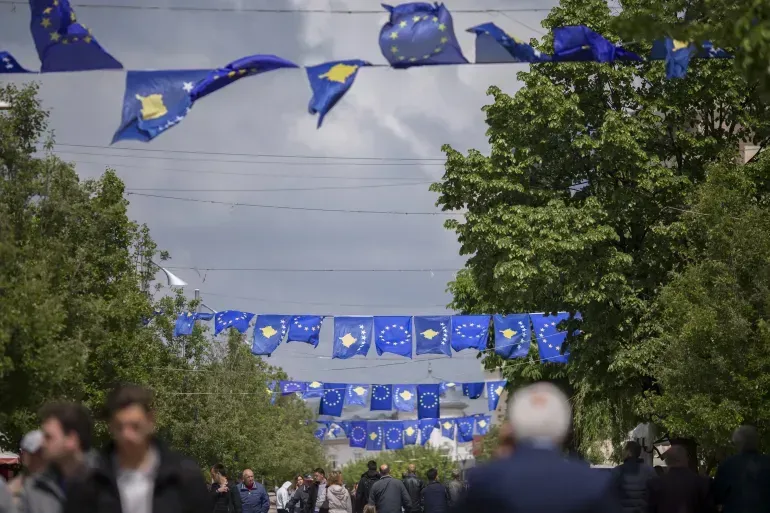
Serbia must normalise relations with Kosovo to finish its EU negotiations. Kosovo must do the same to have its application read.
The Editorial Board | 1 October 2026
Sit down with any ambassador in Pristina or any diplomat in Brussels and you will hear the same sentence before the coffee is finished. If Kosovo wants to join the European Union, it needs to do this, and then that. Reform the courts. Pass the laws. And always, at the end, normalise relations with Serbia.
It is a sentence about a process that does not exist.
Kosovo applied for membership on 15 December 2022. On Wednesday its chief negotiator, Jeton Zulfaj, told a panel in Pristina that the application has not moved a single step since. The Council has never asked the Commission for an opinion on it. No questionnaire has arrived. Kosovo has no candidate status, no screening and no chapters. What the ambassadors call Kosovo's European integration is a list of demands attached to an unopened envelope.
Brussels has put the condition in writing. In February 2025 Kaja Kallas and the enlargement commissioner, Marta Kos, declared normalisation with Serbia "the only way for Kosovo to achieve progress on its European path." The next paragraph of the same statement recalled that Kosovo applied in 2022 and that the Commission will write its Opinion when the Council asks. They repeated the formula after the December elections. The next step on Kosovo's path is that request, and by the Union's own sentence it waits on normalisation.
Serbia was made a candidate in 2012 and opened negotiations in 2014. For Belgrade the Council's formula is that normalisation advances in parallel with the negotiations and, with the rule of law, sets their pace. Twelve years on, Serbia has 22 of its 35 chapters open and Ohrid unsigned. Belgrade owes normalisation to finish. Kosovo owes it to start.
Any student knows how this works. Two students face the same hardest exam, and it can only be passed together. One must pass it before he graduates. The other must pass it before the university agrees to read his enrolment form. The first is already inside and keeps his seat whether he turns up or not. The second waits at the gate for a partner who has every reason never to show up.
Normalisation takes two. Serbia can keep Kosovo outside without lifting a finger. It only has to go on refusing, and Brussels does the blocking for it. Article 5 of Ohrid forbids Serbia to block Kosovo's road to the EU. The Union has spared it the trouble.
The EU brokered that agreement, wrote it into both countries' paths, and last week Kallas called it binding. It obliges Serbia to treat Kosovo as a state without recognising it. What exactly is Belgrade being asked to do, if the Union will not even open the application of the country it tells Belgrade to treat as a sovereign equal? Serbia's reading is that Kosovo is something less than a state, and a file that may not be opened is that reading in practice. The EU will treat Kosovo as a state on the day Serbia starts. The guarantor has made its own compliance depend on the party it is supposed to hold to the deal.
Every Kosovar is entitled to ask why the government should bother with the rest. Kosovo is fully aligned with EU foreign policy, sanctions on Russia included. Serbia refuses them, and Serbia is the candidate. If the only item that counts is the one Belgrade controls, every other reform Pristina passes is homework for a class it is not enrolled in.
The way out costs the Union one letter. Send the application to the Commission. Put the dialogue in a chapter, as was done for Serbia, which is what Zulfaj proposed on Wednesday. Let Kosovo fail the examination if it deserves to fail. The five member states that do not recognise Kosovo can still say no at the end, as the treaties allow.
So spare Kosovo the next lecture on its European path. The application lies where it was left in December 2022. Until it is sent, let the ambassadors say when the Union intends to begin.
