Brussels asks Kosovo to normalise relations with a government whose Interior Minister campaigns on returning to Prizren. Kosovo’s future cannot wait for him to change his mind.
the Editorial Board | 13 October 2026
Ivica Dačić has made his voters a promise. The Serbian flag will fly over Prizren again. By the accounts of his Belgrade rally carried in Tirana, he added that it need not happen tomorrow, since Serbia once waited four and a half centuries. He is asking for a four-year mandate.
It would be a joke if the man telling it were a clown. He is Serbia’s Interior Minister and deputy prime minister, and he commands its police. When Michael Roth, Germany’s former Europe minister, condemned the promise, Dačić mimicked him from the stage of the Belgrade Arena on Sunday, how dare Dačić say that, and answered: “Well, I dare!” He dares, he told the crowd, because that is what his party thinks.
This is the partner. For thirteen years Brussels has told Kosovo that its future runs through normalisation with Serbia: its EU application, its seat in international bodies, its place in Europe. Normalise, and the doors open. Kosovo has stood at those doors since 2013.
With whom were we normalising? Dačić initialled the first agreement himself, as prime minister. Last year he called it a fraud on state television, and explained a day later that he meant the way it had been carried out. Aleksandar Vučić, then president, accepted the second agreement at Ohrid in 2023 and refused to sign it. His prime minister, Ana Brnabić, put the refusal in a letter to the EU. She is Serbia’s acting president today. That agreement obliges both sides to refrain from the threat of force, and obliges Serbia not to block Kosovo’s way into international organisations. On Sunday the Interior Minister promised Prizren and ten or twenty more withdrawn recognitions in one speech.
Brussels will say it is an election. Then let Brussels explain why, in a country it is preparing for membership, the conquest of a neighbour’s city is what wins elections. And let it explain Monday. The Enlargement Commissioner found the word “unacceptable” for a law passed in Kosovo’s parliament. For the minister and his flag, in the published accounts, she found no word at all.
A country cannot build a future while it feels permanently under threat. It cannot plan while every Serbian exercise might be a rehearsal, every election in Washington a question about whether America will still answer the phone, every review of KFOR a rumour of abandonment. A generation in Kosovo has grown up inside that question. They were told the answer was patience and dialogue. They have been patient for thirteen years, and the other side’s answer came on Sunday, with a crowd cheering it.
Why should our future wait for them?
Serbia is not waiting idly. It is buying combat aircraft, rocket artillery and drones at a pace Croatia’s prime minister calls a shopping mania. Vučić, who resigned the presidency last month to run for prime minister, counsels patience while the world changes. Europe knows what to do with a neighbour like that. It is spending hundreds of billions to be ready by 2030 because a man in Moscow said what he wanted and Europe finally believed him. Dačić has said what he wants. We believe him.
So the next thirteen years should go into defence. KFOR stands between Kosovo and the worst, and we are grateful for it. But a country whose safety is decided entirely in other capitals has to ask what it will do on the day those capitals decide differently.
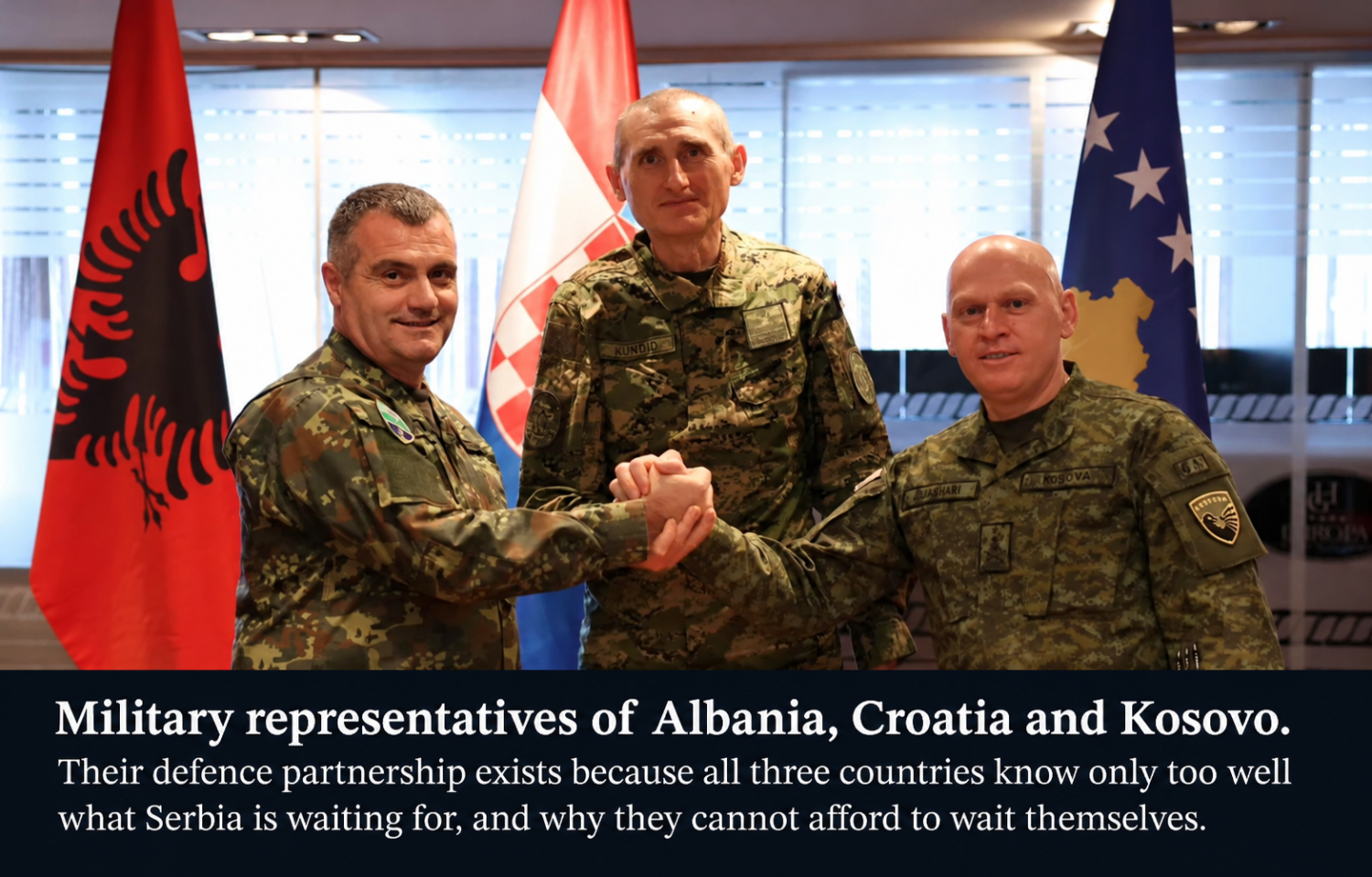
Kosovo and Albania have to answer that together, and here the reproach is to ourselves. While a Serbian minister campaigns on Prizren, Tirana and Prishtina have run their relationship like two fraternal Koreas. That ends now or it ends too late. Albania is in NATO. Kosovo has the most to lose. What they lack is a common plan: joint defence planning between the two forces, common procurement, ammunition and drones made at home, air defence, and exercises that assume the worst day. The declaration Albania, Croatia and Kosovo signed in Tirana in March 2025 is a beginning. It needs budgets and deadlines.
Brussels can help or it can watch. A Kosovo able to defend itself, tied to a NATO member next door, adds to Europe’s security. Brussels should make room for it in Europe’s defence plans. A Kosovo kept in the corridor of a process its partner mocks from a campaign stage is a standing invitation.
The utopia was that talking could persuade Serbia to stop treating our existence as temporary. If a government in Belgrade ever does, we will be glad to meet it.
Dačić says Serbia can wait. Let it wait. Kosovo and Albania have an invasion to make impossible.
