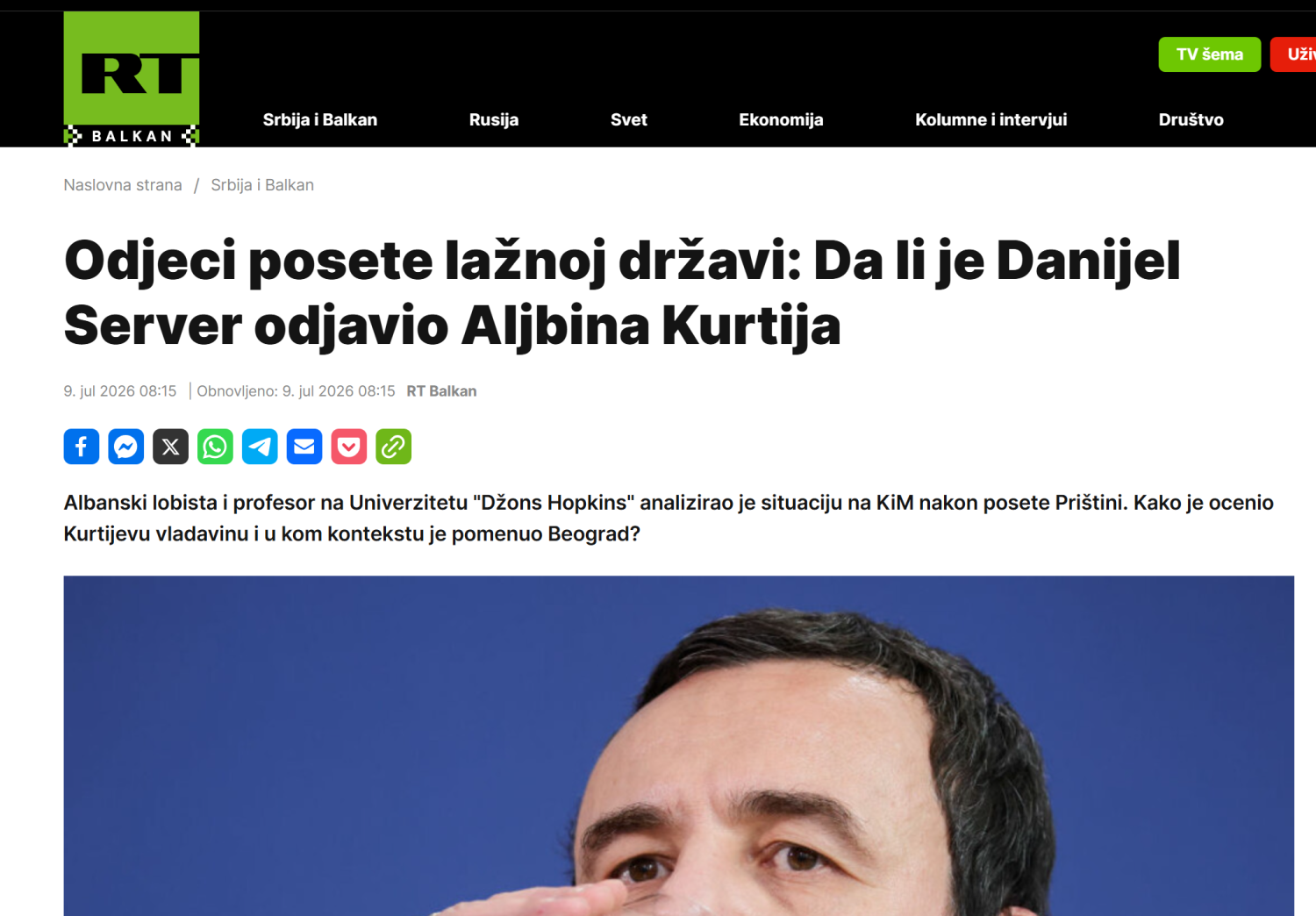
The source, the rewrite, and the rebuttal. A line-by-line comparison of how Daniel Serwer's observations on Kosovo became something he says he never wrote.
By Klea Ukaj | 12 July 2026
Daniel Serwer, Professor and Senior Fellow at the Foreign Policy Institute of the Johns Hopkins School of Advanced International Studies, spent the last week of June in Kosovo on a speaking tour marking America's 250th anniversary. On July 5 he published his impressions under the headline "Improved, but not as good as could be." Four days later, RT Balkan told its Serbian language readers what he had found, under a headline of its own: "Echoes of the Visit to the Fake State: Has Daniel Serwer Written Off Albin Kurti?"
Serwer's answer, given on the record to Kosovo Dispatch, is that RT reported a piece he did not write. "The state and democracy in Pristina are real," he told us. "Otherwise RT wouldn't be writing fake news stories about it."
The two documents exist side by side. One is the source. The other claims to report it. What follows is a comparison of the record, because in this case, unusually, the complete record is available: the original text, the RT rendering, and the author's itemized response.
What the source says
Serwer's piece is not flattering to everyone. It notes three elections in sixteen months without producing a president or a fully mandated government. It records the opposition's perception of Prime Minister Albin Kurti as "high-handed and even anti-American or authoritarian in his handling of some issues." It criticizes increases in pensions and social payments delivered ahead of elections as vote buying that degrades democracy. It questions the government's reasoning on American liquefied natural gas.
It also records the following, in roughly equal measure: a relatively prosperous economy, improved rankings on rule of law indices including a corruption perception score well above Serbia's, enormous construction activity fueled by diaspora investment, modernized commerce and services, rare interethnic crime, free circulation of Serbs as reported by American military forces deployed in the country, and a conclusion projecting NATO membership readiness for the Kosovo Security Force in 2028 with European Union membership to follow.
That is the document RT Balkan set out to translate for its readers.
Seven alterations to the record
The headline asserts what the source never says. RT's headline announces a visit to "the fake state" and asks whether Serwer has "written off" Kurti. Neither claim appears in the source in any form. Serwer's assessment of the state is in his own headline: improved, but not as good as could be. His assessment of Kurti is a documented account of an opposition perception, followed by an economic record described as relatively prosperous. "Yes, I noted the political crisis (how could I miss that?) but I never said I was disappointed and didn't refer to a 'fake' state," Serwer told us.
The attribution is laundered. The source is explicit that the view of Kurti as "high-handed," "anti-American," or "authoritarian" belongs to the opposition. RT reports that "Serwer also stated that Kurti is perceived as" these things. The retelling removes the grammatical owner of the opinion: what belonged to Kosovo's opposition becomes Serwer's own assessment. RT then adds a third term, "strongman," which appears nowhere in the source at all.
A proposal is inserted. RT reports that Serwer "recalled Kurti's proposal to amend the constitution so that the president would be elected directly by the people." The source contains no such recollection. It mentions the constitution once, in a different context: the opposition's fear that Kurti wants to change it. The direct election proposal is RT's addition, attributed to Serwer to give it the authority of his byline. Serwer confirmed to Kosovo Dispatch that RT "attributes to me a reference to a specific constitutional proposal that I did not mention."
A logic is inverted. Serwer's vote buying passage makes a specific argument: the recipients of the payments delivered ahead of elections were mostly at the lower end of the socioeconomic scale, and vote buying degrades democracy even so. RT renders this as a conditional in which the poverty of the recipients becomes the proof of the vote buying. Serwer criticizes the government's conduct, not the poverty of the pensioners. The criticism survives the translation. The reasoning does not.
The omissions are systematic, and they are not what they first appear. RT cut the economy, the corruption perception ranking above Serbia's, the construction boom, the interethnic calm sourced to the American military, and the entire concluding trajectory toward NATO in 2028 and the EU thereafter. An obvious reading is that RT removed everything favorable to Kosovo. But RT also cut the passage most genuinely critical of Kurti's judgment, the analysis of his decision to pass on American LNG imports, a section that has generated real friction with Washington. If RT's editorial target were the prime minister, that passage serves the purpose. It was cut anyway, because it treats Kosovo's energy policy as what it is: a real state making real decisions among real tradeoffs. The omissions do not track for or against any actor in Kosovo's politics. They track the state's normality. Whatever depicts Kosovo functioning as a country is removed, whatever can be bent toward dysfunction is kept.
The delegitimization is typographic. In the RT text, the words institutions, president, constitution, and democracy appear in quotation marks, and the state appears as "the so-called state." No argument is offered for any of these designations. The scare quote does the work the reporting cannot, an assertion of unreality applied at the level of punctuation and repeated until it reads as description.
The author is discredited before he is read. RT introduces Serwer as "the prominent Albanian lobbyist," a characterization he states is "simply untrue" and which he notes RT has asserted repeatedly. The function of the label is not descriptive. It is prophylactic. A reader told in the first sentence that the author is paid arrives at every subsequent sentence already inoculated. RT then makes the mechanism explicit in its own voice, writing that Serwer "is paid to behave as though he does not" know that Kosovo's democracy is an abstraction. The claim requires no evidence because the label has already supplied it.
Serwer's actual position, in his words to Kosovo Dispatch: "Because of the history of Serbian oppression, I am a defender of Kosovo independence, statehood, and democracy. You won't read that sentence in RT."
Why the record matters
Serwer has a platform, a byline of three decades, and the standing to answer back within four days. Most subjects of this method have none of those things. The techniques documented here, the fabricated headline, the laundered attribution, the invented statement, the inverted logic, the systematic omission, the typographic delegitimization, the discrediting of the author in advance, are the same techniques applied daily to municipal officials, prosecutors, witnesses, and ordinary institutions that will never publish an itemized rebuttal. What this episode provides is the rare case in which the full chain of custody survives: source text, distorted rendering, and the author's contemporaneous accounting of the difference.
The comparison requires no interpretation. The two documents convict each other.
Klea Ukaj writes on transatlantic affairs from Michigian.
