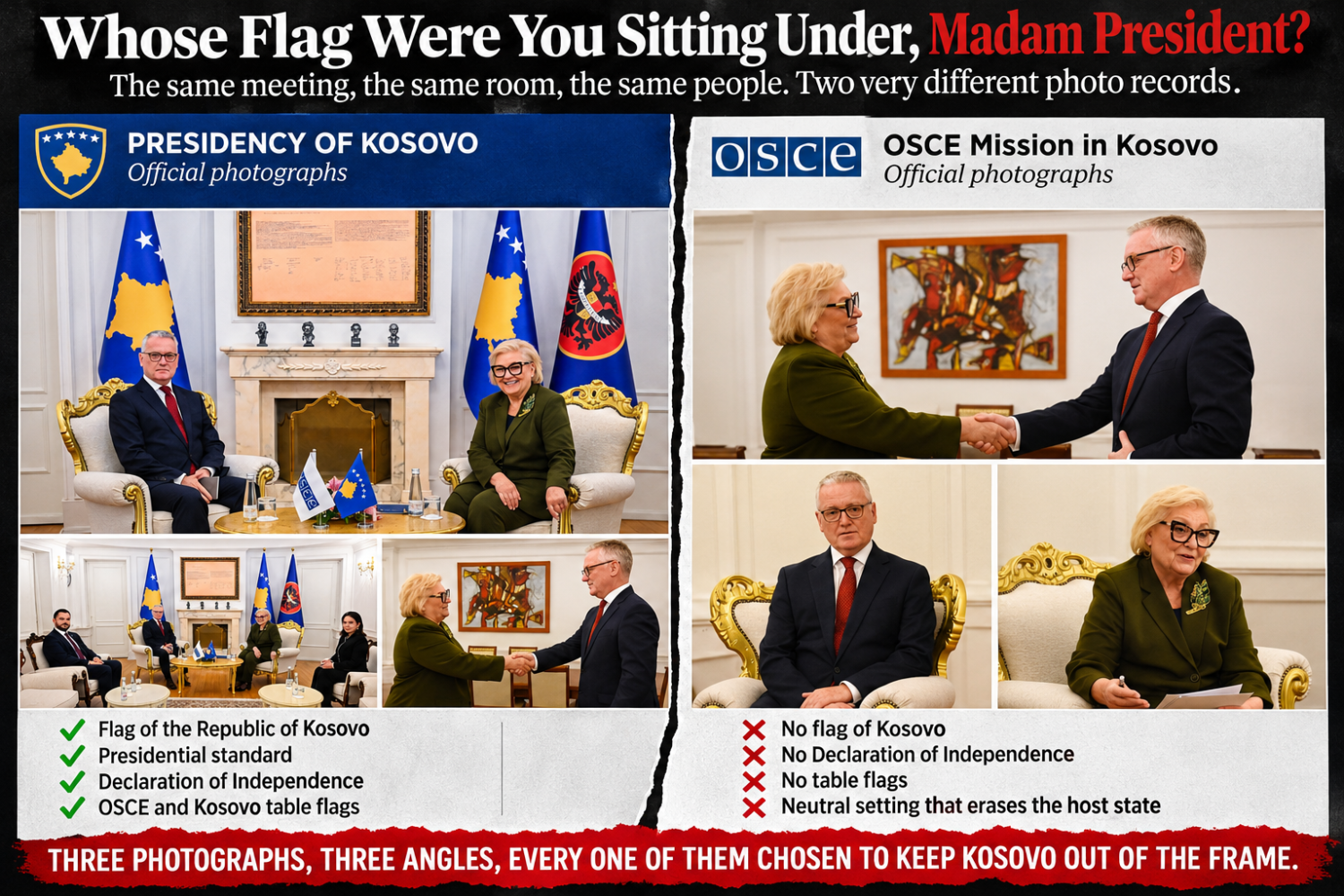
The OSCE mission photographed the Presidency of Kosovo with no Kosovo in it. The President thanked it for its support.
Editorial Board | 3 November 2026
Look at the two sets of photographs from Monday’s meeting between President Justina Shiroka Pula and the head of the OSCE Mission in Kosovo, Gerard McGurk.
The Presidency published three. In them the President sits beneath the framed Declaration of Independence, between the flags of the Republic and the presidential standard, with a small Kosovo flag and a small OSCE flag side by side on the table. In the handshake photograph the flag of Kosovo stands at her shoulder.
The mission published three of its own, of the same meeting, in the same room, at the same moments. There is a handshake in front of an abstract painting. There is McGurk in a gilded armchair against a white wall. There is the President with papers in her hand against the same wall. There is no flag. There is no Declaration. There are no table flags, though they stood half a metre from his knee. The mission’s photographer went into the Presidency of Kosovo and came out with pictures in which Kosovo does not exist.
The mission calls this status neutrality. It is a deliberate insult. Three photographs, three angles, every one of them chosen to keep the state out of the frame, in the state’s own house, with the state’s own President in the chair. Belgrade’s platform understood it at once; it reported the meeting the same afternoon and found one piece of news in it, that Kosovo’s symbols were visible in the Presidency’s pictures, with Serbia’s complaint to Vienna attached. The mission and the Serbian government agree on what should not be seen in Kosovo.
This country is almost two decades old. It has a Constitution, an army, elected institutions and a flag that flies over all of them. The organisation that cannot photograph that flag spent five years unable to agree on its own budget, 57 states vetoing one another over sums smaller than Pristina’s annual road works, and runs today on less money than it had in 2021. It is in no position to tell Kosovo what it is. A mission that has a problem with Kosovo’s flag has a problem with Kosovo, and the answer is simple: pack your things and go. Nobody here will miss a mission that behaves as if it were still 1999.
This publication has kept the account of the OSCE under McGurk and will not repeat it here. He adopted Belgrade’s sentences on almost everything. He described stones thrown by children at a bus that did not stop in the vocabulary of a security crisis. Each time, the words he used were Belgrade’s words first. A mission that says what Belgrade’s Office for Kosovo says, a week later and on better letterhead, has become its mouthpiece. That is the sentiment in Pristina, and it is earned.
The mission was not built for this. When the OSCE came to Kosovo in 1999 it ran Pillar III of UNMIK, institution-building: it organised the first elections, trained the first police, set up the first media regulator, because there was no state to do it. There is a state now. For democratic governance, elections, rule of law and public administration, Kosovo works with the European Union, which it has applied to join, whose Stabilisation and Association Agreement it has implemented for a decade and whose standards its laws are written to. The EU does not need the OSCE to tell it how Kosovo’s institutions are doing. Neither does Kosovo. What is left is an organisation that decides by consensus of 57 states, two of which are Russia and Serbia, keeping a mission in a country it cannot name, doing work that country is already doing with someone else. That mission has no purpose in Kosovo any more. Its only remaining function is the one Belgrade uses it for.
And the President of the Republic received him, smiled for his photographer, and had her office thank the mission for “strengthening democratic institutions, the rule of law and the protection of fundamental rights and freedoms”. She was elected to symbolise the unity of the people and the sovereignty of the state. On her first courtesy call from this mission she gave it the one thing no Kosovo official should give it: cover. The office she holds has no power to pardon a mission on the nation’s behalf, and she used four sentences to do exactly that. If McGurk came to hear her priorities, as his post says, the first one should have been that the mission is a guest of the Republic of Kosovo and will conduct itself as one. Her office published a testimonial instead.
She is not alone, which is the problem. Since McGurk arrived, ministers, the Assembly, mayors and the police have received him, posed with him and thanked him, and he has walked out of every one of those buildings with Belgrade’s vocabulary intact and a photograph with no flag in it. Each meeting tells the mission that nothing it says or does costs anything in Pristina. Each readout that praises “cooperation” is read in Belgrade as proof that Kosovo’s institutions will swallow whatever is served to them. Officials who do this are being used, and they have been told so in public more than once.
A mission with a problem about Kosovo’s existence is not welcome, and the Presidency, the Government, the Assembly and every other institution of the Republic should stop receiving it, stop thanking it and stop lending it the pictures it then cuts the state out of. This is Kosovo’s house. The guest list is Kosovo’s to write.
The OSCE Chairperson-in-Office, Ignazio Cassis, arrives this week, the man who in March got his organisation a budget after five years of none. He will be received in the same room. The flags will be there. The Presidency’s readout afterwards will show whether it has understood what its own photographs already said, and whose flag the President was sitting under.