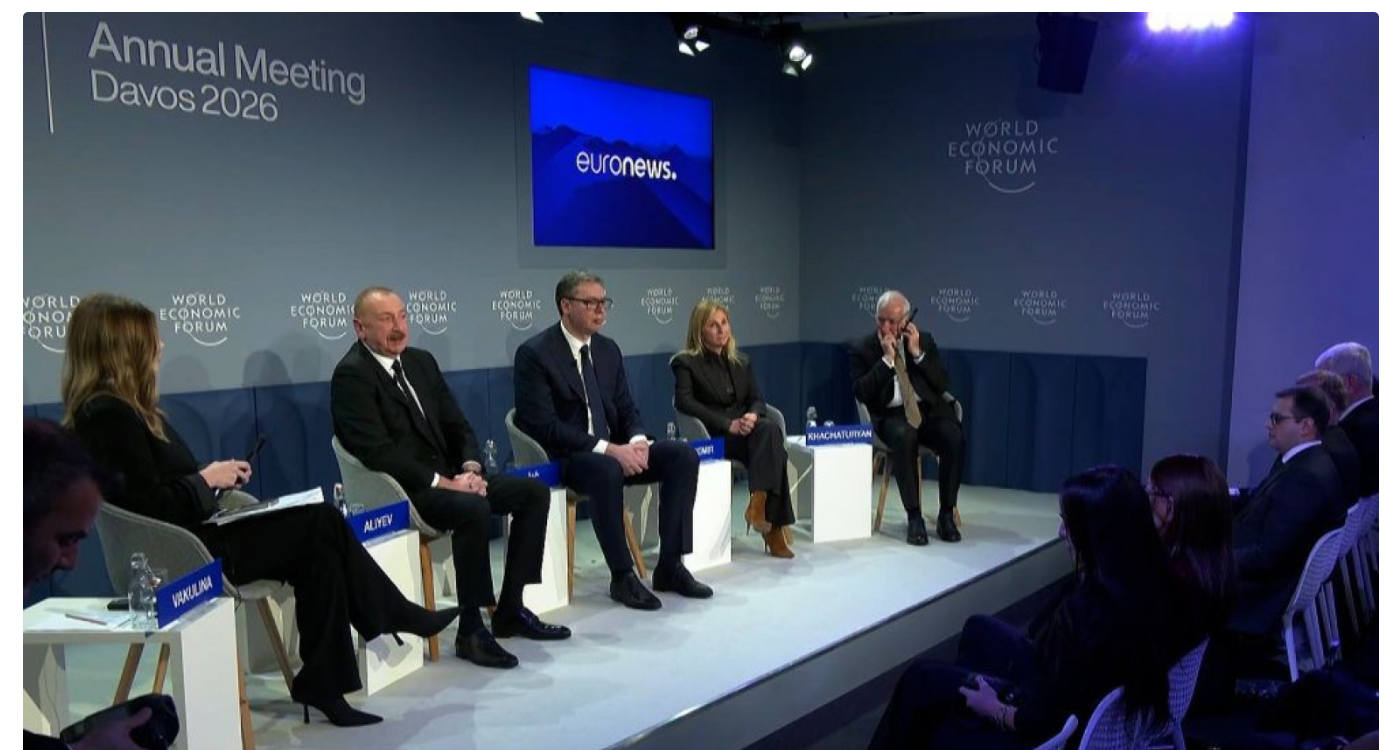
In the same panel where Azerbaijan and Armenia described how a 30-year conflict ended through restored territorial integrity and follow-on diplomacy, Serbia’s president recycled an old grievance as a diagnosis of global disorder. The contradiction was hard to miss — especially as Aleksandar Vučić warned of a “lawless world” heading in a “crazy direction,” with repeated assertions that “this year is worse than the last, and the next will be worse still,” while his co-panelists spoke about choosing resolution over perpetual war.
Kosovo Dispatch | 20 January 2026
At the World Economic Forum in Davos, President Vučić once again argued that today’s instability began with Kosovo — that "Pandora’s box" was opened when Western states recognized Kosovo’s independence, allegedly inventing a humanitarian catastrophe to justify it.
The claim is familiar. What matters in 2026 is where and how it was deployed — and how poorly it withstands the evidence presented on the very stage where Vučić made it.
"Pandora’s box" is causal inversion — exposed by the panel itself
Vučić framed global politics as entering a phase without rules, dismissing multilateralism as hollow and international law as ineffective. Yet the Davos panel he joined offered a direct counter-example.
Azerbaijani President Ilham Aliyev described how three decades of ignored UN Security Council resolutions ended not in endless escalation, but in a Trump-brokered peace process after Azerbaijan restored control over internationally recognized territory — and then deliberately stopped. Armenian President Vahan Khachaturyan reinforced the point: leaders chose resolution over indefinite conflict, accepting reality to prevent permanent war.
This live counter-example directly undercuts Vučić’s causal claim.
If Kosovo truly "opened" an era of endless instability, the Caucasus — following post-2023 enforcement and the 2025 U.S.-mediated deal — should exemplify it. Instead, it models how addressing frozen status questions decisively, followed by diplomacy, can end disorder rather than spread it.
Kosovo did not inaugurate global lawlessness. It emerged from a situation where sovereignty had already collapsed.
Kosovo remains legally distinct — and the ICJ firewall still holds
For great-power audiences, the decisive issue is not rhetoric but legal architecture.
Kosovo followed a narrow remedial secession trajectory: systematic repression, mass displacement, exhaustion of internal remedies, prolonged UN administration, and internationally mediated final-status talks under the Ahtisaari framework.
In 2010, the International Court of Justice confirmed that Kosovo’s declaration of independence violated no rule of general international law. Crucially, the Court avoided creating a general right of secession, preserving a strict distinction between Kosovo and coercive territorial revisionism.
That distinction has endured for sixteen years.
No major court or UN body has retroactively reframed Kosovo as the trigger for global revisionism. Attempts to do so — from Moscow or Belgrade — remain rhetorical, not jurisprudential. Russia’s Crimea annexation and similar cases fail every test Kosovo passed.
Vučić’s equivalence does not defend international law; it blurs distinctions the ICJ deliberately protected.
Multilateralism is not "dead" — it is selectively weaponized
Vučić declares multilateralism obsolete while practicing instrumental legalism.
Serbia rigidly invokes UNSCR 1244 when blocking Kosovo, yet delays or undermines agreements it has signed when implementation becomes politically costly. This pattern resurfaced in early January 2026, when Serbia’s National Security Council labeled Kosovo’s NATO-partnered security development a violation of international law and a regional threat.
The framing ignores key facts: Kosovo’s procurements are defensive, transparent, capped, and partner-coordinated, aligned with NATO and U.S. assurances through 2028. Kosovo officials have repeatedly emphasized that the KSF remains non-threatening to any state and fully transparent in procurement with Western partners — in sharp contrast to Belgrade’s portrayal. At the same time, Serbia deepens parallel military ties eastward with Russia and China and westward for leverage.
This is not principled realism. It is selective norm shopping.
"Sovereignty versus empires" masks Serbia’s 2026 vulnerabilities
Vučić presented a binary choice: submission to new empires or fierce defense of sovereignty. Serbia, he insisted, would choose the latter.
The domestic reality in 2026 is more constrained.
Serbia is facing:
- intensified student-led anti-corruption protests, ongoing since late 2024 and drawing thousands again in Novi Sad on January 17, 2026, where demonstrators chanting “thieves” pledged concrete demands — including bans on corrupt officials and wealth investigations — and announced further rallies, including in Belgrade;
- a stalled EU accession path driven by persistent rule-of-law backsliding;
- economic dependence on Western markets and foreign investment;
- diminishing returns from hedging between Russia, China, and the West.
Meanwhile, expectations of preferential treatment from a second Trump administration have not materialized. Washington’s posture remains pragmatic: stability, normalization, and mutual recognition — not indulgence of indefinite ambiguity.
In this context, performative sovereignty does not insulate Serbia from pressure. It delays normalization, at mounting political and economic cost.
The Caucasus analogy flatters Serbia — but exposes the contradiction
Vučić aligned Serbia with Azerbaijan and Armenia as fellow "small nations" defending sovereignty.
The analogy collapses under scrutiny.
Azerbaijan restored control over territory already recognized as its own, then moved toward peace. Armenia accepted painful realities to avoid endless war. Serbia, by contrast, seeks recognition of its grievances while refusing recognition of Kosovo’s reality — indefinitely.
The Caucasus lesson celebrated at Davos was not grievance cultivation, but resolution through acceptance of facts.
The Washington subtext is the real message — and the real risk
Vučić’s remarks about Donald Trump and Ursula von der Leyen were not casual pessimism. They were strategic signaling — a wager on transatlantic divergence and an implicit claim that norms are contingent on power.
Great powers tolerate realism. They are less patient with actors who suggest law only matters when enforced by strength — unless they are prepared to live by that rule themselves.
Bottom line for Davos audiences
Vučić’s Davos intervention repackages old grievances as global wisdom. But 2026 realities undermine it: the Caucasus peace deal shows resolution can follow enforcement, the ICJ firewall around Kosovo remains intact, selective multilateralism is increasingly transparent, and small-state hedging — amid domestic unrest and pragmatic U.S. continuity — is yielding diminishing returns.
Kosovo did not open Pandora’s box.
It emerged from one — after sovereignty failed, atrocities occurred, and international administration exhausted every alternative.
Upholding that distinction is not Balkan noise. It is a test of whether the remnants of the rules-based order Vučić claims to mourn still mean anything at all — and whether great powers will reward resolution or indefinite grievance in a region that could otherwise become a low-cost stability win.
