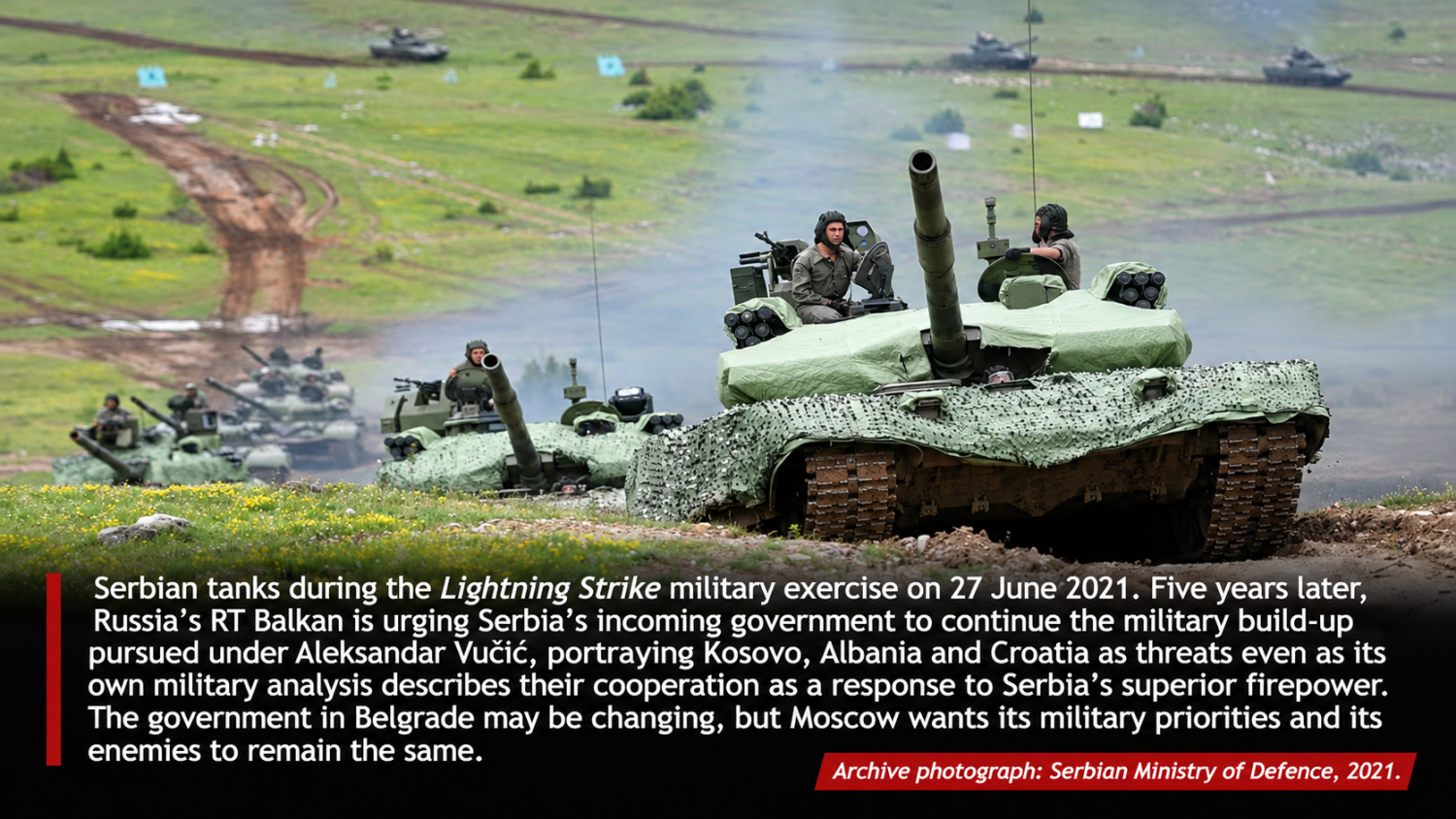
RT Balkan set out to show that Kosovo, Croatia and Albania are arming against Serbia. Its own analyst described three countries defending themselves from Serbia. Then it told Serbia’s incoming government to carry on as Vučić did.
By Drizan Shala | 11 November 2026
On 10 November RT Balkan published an inventory of the Kosovo Security Force. Under its vocabulary it is competent staff work: Bayraktar TB2s in service, Skydagger FPV drones delivered in the thousands, Turkish OMTAS anti-armour missiles, Javelins due in 2027, 105 mm mobile howitzers under a three-year contract, an ammunition plant with Turkey’s MKE near Gjakova, 224.2 million euros for defence in 2027. Every item comes from Kosovo’s own announcements. The headline calls it the rapid arming of a “fake state”.
The analysis belongs to Andrej Mlakar, the military commentator RT quotes throughout. Kosovo, he explains, is following “the Croatian recipe”: the answer to Serbian tanks is anti-armour missiles, bought in a number “proportional to the number of operational tanks in the Serbian Armed Forces”. The drones are there to “parry” the Serbian army.
A force that counts its missiles against another army’s tanks is preparing to be attacked by those tanks. Nothing on RT’s list can take ground or hold it. Kosovo has neither tanks nor combat aircraft, and the article itself notes that air defence missiles and long-range artillery are still missing.
The armies of Albania, Croatia and Kosovo are adopting identical equipment, Mlakar says, and training together at Slunj on the lessons of Ukraine, with Croatia becoming a training centre for the armies around Serbia. RT calls this the “Tripartite Pact”, the Serbian name for the Axis treaty of 1940. Its own text mentions no joint command, no strike force and no plan for an inch of Serbian territory. An outlet with every reason to find an offensive design looked for one and printed anti-tank missiles and a training range.
Serbia’s defence budget has grown from about 1.5 billion euros in 2021 to more than two billion, the largest in the Western Balkans. It has bought Chinese air defence, signed for twelve Rafales, budgeted the return of conscription and ordered attack-drone units. It fields roughly 240 main battle tanks against Croatia’s 55 and Kosovo’s none. In September 2023 an armed Serb formation attacked Kosovo police at Banjska, and within days Washington publicly called on Serbia to pull back the tanks and artillery it had massed on the boundary. Serbia’s constitution claims Kosovo. No document in Zagreb, Tirana or Pristina claims a metre of Serbia.
None of the three can balance that alone. Serbia sits in the middle and can concentrate against one neighbour at a time. Croatia and Kosovo share no border and cannot send each other a battalion overland. Common equipment, common training and the declaration on defence cooperation signed in March 2025 are what is left to them. The arrangement exists to make Serbia’s advantage unusable, and Moscow’s outlet has now explained this in Serbian to a Serbian audience.
RT ends with a question: what should “the future government in Serbia, the future defence minister” pay attention to? Mlakar answers: counter-drone training for every soldier, air defence in every unit from company to brigade, modernised armour, conscription, and long-range missile systems “including those with a reach of up to 400 km”.
The budget, the conscription, the drones and the armour on that list are Vučić’s. So is the enemy. In the last week of his campaign he warned of a military alliance of Zagreb, Tirana and Pristina, as this publication reported. Serbian voters removed him on 25 October. Sixteen days later RT handed his threat assessment to the people who defeated him.
The missile is new. Kosovo is about a hundred kilometres across. From Serbian soil, 400 km covers Pristina, Tirana and Zagreb together. Tirana and Zagreb are NATO capitals. Zagreb is the capital of a member state of the Union that Serbia is a candidate to join.
On 4 November Marta Kos told the European Parliament that Serbia’s new government has an opportunity to “turn the page”. Brussels has congratulated the Student List, received it and credited it with a break with the past. RT is financed by the Russian state and has been banned from broadcasting in the Union since 2022. From Belgrade it is dictating to a minister who has not yet been named that Serbia’s militarisation continues and that its neighbours remain the reason for it.
On 7 November the Student List’s plan for the army was presented on RTS: five per cent of GDP, rocket artillery reaching 300 kilometres, and a spending target justified by “the armies in our surroundings”. The list has not disowned a figure. RT has now named the surroundings and raised the range.
Serbia changed its government. Moscow has told the new one to keep Vučić’s army and Vučić’s enemies, and nothing the Student List has said about defence suggests it will refuse. Zagreb, Tirana and Pristina have read the same article. What they are building together is the answer to it, and RT itself has described that answer as a defence.