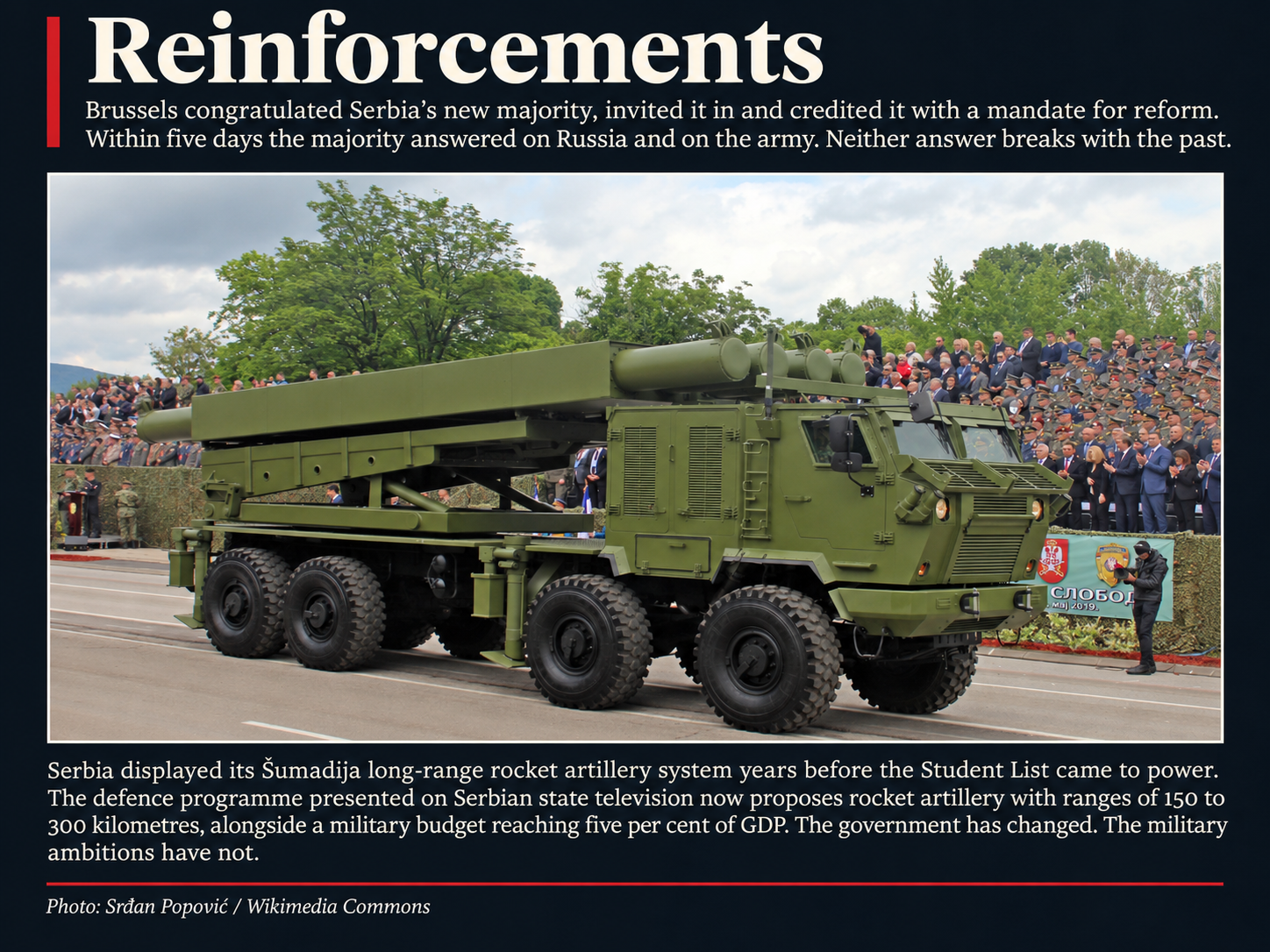
Brussels congratulated Serbia’s new majority, invited it in and credited it with a mandate for reform. Within five days of the invitation the majority answered on Russia and on the army. Neither answer breaks with the past.
By Drizan Shala | 8 November 2026
The Student List was received before it was read. Ursula von der Leyen and Marta Kos congratulated it on election night. Friedrich Merz followed from Berlin. On Monday Kos received four of its representatives in Brussels, at her invitation, while the Commission was finishing its annual report on Serbia. On Wednesday the report appeared and credited the new majority with “a strong mandate for reforms”; Kos told the European Parliament the same afternoon that the protesters wanted what the Union wanted, good neighbourly relations and strategic alignment among them.
On Thursday Mirjana Nikolić, ninetieth on the list, told AFP that opposition to sanctions on Russia was written into the programme, as this publication reported. At eight on Saturday evening Luka Ponorac, a former officer of the Serbian Armed Forces, went on RTS, which introduced him as the list’s representative, and presented its plan for the army for the first time. By Sunday morning the plan existed in English, as a graphic under the Students Win logo, posted by Dunav Intel, the account that has spent the autumn posting imagery of Albanian military sites. The caption read: Stronger Armed Forces. A Safer Serbia.
The number Ponorac gave is five per cent of GDP, up from the current 2.8, by way of three, because five is what is “set for the armies in our surroundings, wider and narrower” (opredeljeni za vojske koje su iz našeg okruženja, šireg i užeg). That is NATO’s figure, agreed at The Hague last year for 2035 by states that spend it inside an alliance, for collective defence, against Russia, and only 3.5 of it on the armed forces themselves; Ponorac’s five is all for the defence system. Six of Serbia’s eight neighbours are such states. Serbia takes their number without their alliance and without their adversary; Russia, in the programme’s words, is a traditional partnership to be preserved. Soldiers get a raise of 20 to 30 per cent and modernisation continues. The procurement priorities, in the order he gave them: rocket artillery with a range of 150 to 300 kilometres; a layered air-defence dome; a network-centric command system; air surveillance and early warning; drones. All of it, he said, depends on the finances the new government finds, and all of it was written by the most expert people in Serbia who deal with these questions.
The list’s published programme already contains part of this. Its defence chapter promises higher spending for capital projects and new capabilities, a layered air-defence dome over the whole territory linked to a network-centric system in three range bands, the longest 170 to 300 kilometres, and a larger role for the Military Technical Institute and the defence industry. The number five is not in that text, and neither is rocket artillery. Ponorac added both on air, as prescribed by the programme, he said. Slobodan Georgiev, a Belgrade editor, wrote on X on Sunday afternoon that Ponorac has no connection to the list. By Sunday night the plan was on every front page in Serbia and in English abroad, and the list had not corrected a word of it.
Defence planners read capabilities, because intentions belong to governments and governments change while the inventory stays. Serbia changed its government on 25 October and kept its list. Four of the five items on it are what a small state outside any alliance buys in order to be expensive to enter, and nobody in Pristina or Zagreb has grounds to object to Serbian air defence. From Serbian territory, 300 kilometres reaches Pristina, Skopje, Sarajevo, Podgorica, Sofia and Budapest, Tirana from the Preševo valley at under 200, and Zagreb from Srem. Six of those capitals sit under Article 5, and a rocket fired at any of them is a war with the alliance. The two that do not are Sarajevo and Pristina. A capital within range negotiates differently from one that is not, whatever the subject. Zagreb has been warning about exactly this range class for a year, as this publication reported in October. Ponorac named a range and no system, and the range is enough.
Serbia’s military neutrality was declared by the National Assembly in December 2007, in the resolution on the protection of sovereignty, territorial integrity and constitutional order, two months before Kosovo declared independence and in the text that rejected it in advance. Neutrality and the claim on Kosovo were born in one document. The Student List rests its policy on the two pillars that document named, the Constitution and Resolution 1244. Its founder, Radomir Saičić, has called Kosovo temporarily occupied territory on RTS. Its first name, Ilija Srdanović, has confirmed that the agreements reached in Brussels will be examined for conformity with the Constitution, and the programme adds prosecution for the men who concluded them. All of it predates Vučić. The posture was in the building before him, and a movement that set out to clean the building found it there.
Vučić traded with what he had built: he accepted the Agreement on the Path to Normalisation and its Ohrid annex, let Serbian ammunition reach Ukraine through intermediaries, and kept the army for television. A government that treats those agreements as suspect cannot hold the position with the force that accepted them, and an industry that loses the Ukrainian route needs a domestic customer at twice the budget. The plan brings the security services “back within legal frameworks” (da se vrati u zakonske okvire) and examines their officers; it pays the army more and hands it the list intact. The revolution has reached the police, the prosecutors and the broadcaster. It stops at the barracks gate.
The report that credited the mandate says political choices on security and defence directly shape the speed of accession, raises questions about Serbia’s strategic orientation, and notes that Serbia receives nothing under the European Peace Facility while EUR 1.586 billion is indicatively available to it under the Reform and Growth Facility. Dunav Intel’s graphic was made for the reader of that report, and it is faithful to Ponorac in every figure. Nothing needed adding.
The same programme promises free textbooks, cheaper medicines and fairer wages. Ponorac’s caveat about the finances says which promise was made for which room.
On 28 October this publication wrote that Kosovo believes the new majority and is preparing, and that rested on a silence; the programme had a defence chapter and no number, and nobody on the list had named a weapon. The number and the weapon came on Saturday, on the public broadcaster, and nobody on the list has taken them back. The capitals that congratulated Serbia’s new majority were congratulating a change of government. The budget goes up, the agreements go under review, the services are purged and the army is kept, with the same claim behind it that the Assembly wrote into law in 2007. Nothing in that breaks with the past. It is the past, reinforced.