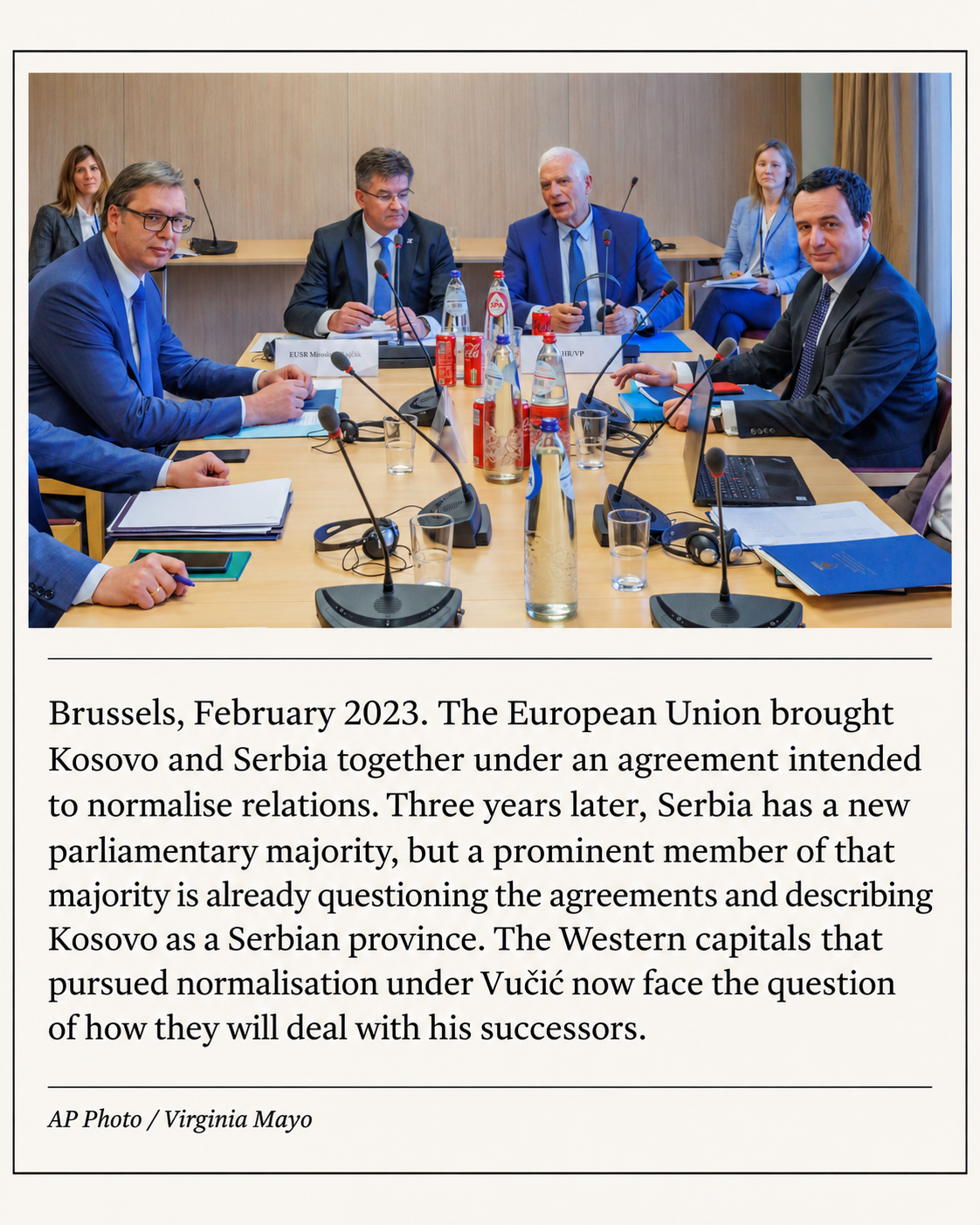
The capitals that want normalisation congratulated a movement whose man for Kosovo speaks of a province, provisional authorities and deputies to be controlled from Belgrade. They appeased Vučić and got nothing. They now have to decide whether to do it again.
The Editorial Board | 12 November 2026
On the night of 25 October, Brussels and Berlin congratulated the Student List and spoke of a new chapter for Serbia. The policy of those capitals towards Kosovo and Serbia is normalisation, set down in the Brussels text of February 2023 and its Ohrid annex, which both countries carry on their European path. Within three weeks, a member of the movement they congratulated had described Kosovo as Serbian territory and set out how Belgrade will exercise authority inside it.
Jugoslav Gašić is a deputy-elect from North Mitrovica, presented on Radio Television of Vojvodina on 11 November as a possible minister. He spoke there and to RT Balkan the same day. Kosovo is “our southern province” and “so-called Kosovo”, and its government is the “provisional authorities in Pristina”. The dialogue will continue with the international community, and he left Kosovo’s government out of it. The agreements of the past fourteen years, under which “we lost almost everything, we gained nothing”, will be tested for constitutionality.
Belgrade will replace the managers of the institutions it runs in Kosovo and expand its payments there. Kosovo’s request that Serbia stop obstructing its membership of international organisations, which is Article 4 of the 2023 text, is irrelevant. On 7 November he told Serbia’s state broadcaster that Srpska Lista’s officials “will be controlled”. On 11 November he said of its deputies in Kosovo’s parliament: “there are solutions for how that can be controlled.”
Slobodan Milošević’s officials spoke of Kosovo in these terms. The people using them now were children when he fell.
Gašić is one deputy-elect, and the Student List’s leadership has not said whether he speaks for it. The capitals can find out with one question. Does the list consider Serbia bound by the 2023 texts, and does it stand behind what Gašić announced? If the leadership rejects his statements, it should do so in public before the government is formed. Until it does, they are the only detailed account of the list’s Kosovo policy on the record.
For twelve years the same capitals treated Vučić as the man who could deliver Serbia. They asked Kosovo for patience. They placed measures on Kosovo in June 2023 and kept them for more than two years. They accepted Belgrade’s refusal to sign what it had agreed. After the armed attack at Banjska they imposed nothing on Serbia. The business with Belgrade went on. They received little implementation, no alignment with sanctions on Russia, and no end to the campaign against Kosovo’s recognition.
Belgrade learned from this that obstruction carries no price, and that a crisis in the north sends Western envoys to Pristina. The Student List grew up watching. It has no reason to behave differently unless the price changes.
With Vučić the capitals could say they had misjudged a partner. They have now heard the programme from the winners, before a single minister is named. If they answer with patience, with a quiet word and a request to Pristina not to provoke, they will be continuing a failed policy knowing that it failed.
The next occasion is already dated. Kosovo’s Law on Foreigners has applied in full since 15 March, after two postponements. Two days before it took effect the EU’s dialogue envoy flew to Pristina. Kosovo then agreed to give staff and students of the Serbian-run institutions residence permits for twelve months and to accept identity cards issued by Serbia. Those permits run out in March.
Gašić calls this a grace period and the law an introduction to integration. He expects Kosovo to reject contracts with institutions it considers illegal. He promises “intensive activity” before the date, and says he has already met EU staff in Kosovo to begin it. Belgrade will by then have its own directors in those institutions, paid and instructed from Serbia.
The risk follows from those facts. If Kosovo applies its law in March and Belgrade tells its employees to refuse, the dispute moves from offices to the street, in municipalities where armed men from Serbia killed a Kosovo policeman three years ago. An incident there would not need to be planned. The capitals would then be tempted to do what they did last March and ask Kosovo for one more exception. Each exception confirms to Belgrade that pressure inside Kosovo works. If the Student List holds to the line Gašić set out, and the capitals hold to theirs, this publication’s assessment is that the road leads to conflict.
The decision has to be made before the government in Belgrade is formed. The capitals can tell Serbia’s new majority that the 2023 texts bind it, that a review ending in their repudiation is a breach of Serbia’s European path, and that running institutions and deputies inside Kosovo will cost it that path. Or they can extend to Vučić’s successors the indulgence they gave Vučić.
The first course is normalisation. The second is appeasement, chosen this time with full knowledge of the result.