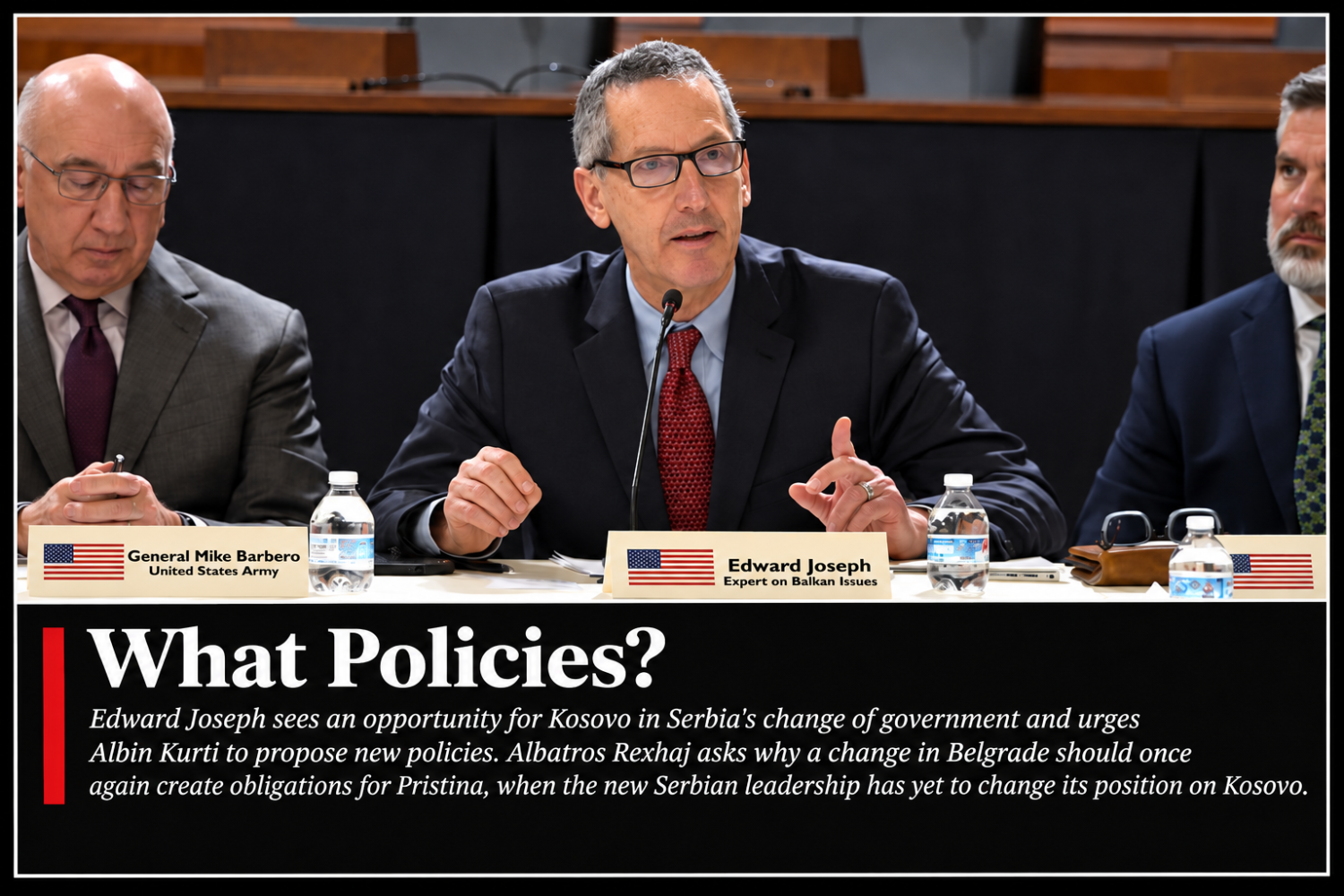
A response to my friend Edward Joseph, who sees in Belgrade’s new government a chance for Kosovo to make the next offer.
By Albatros Rexhaj | 11 November 2026
I have known Ed for years and I respect him, so I ask him as a friend. What policies?
He did not name one. I have heard this advice for twenty years and I am still waiting for the list.
The government changed in Belgrade and the homework went to Pristina. The German ambassador did the same in October, when he asked Kosovo for “concrete steps”. The problem sits in Belgrade and the steps are asked of us.
Kosovo made its offer long ago and wrote it into the Constitution. Ten seats in the Assembly are reserved for Serbs whatever the turnout. They are guaranteed a minister. Serbian is an official language of the state. No law touching the vital interests of the communities passes without a majority of the deputies who hold the minority seats, and the Serbs hold half of those. Their municipalities have expanded competencies and may take money from Serbia. Their monasteries stand inside protected zones. I know of no minority in Europe that holds more on paper.
But the guarantees work only for people who use them, and using them means acting as a citizen of Kosovo. A Serb in Kosovo whose salary, pension and school certificate come from Belgrade will do what Belgrade says. Everyone knows this from life. Who pays, decides.
I worked in UNMIK’s Political Office, and I know how this went. In 2001 the Serbs entered the provisional institutions, after Belgrade signed a paper with UNMIK. In 2004 they walked out, after the government in Belgrade called a boycott. UNMIK offered them their own pilot municipalities and they refused. This was the United Nations, with no Albanian in command and no Kurti to blame, bending over backwards, and it was not good enough either.
In 2013 the Serbs of the north voted in Kosovo’s elections for the first time, because Belgrade had signed in Brussels and told them to. In November 2022 they left the police, the courts, the Assembly and the town halls in a single day, on Srpska Lista’s instruction. For twenty-five years Belgrade has held the switch.
The hand on it today belongs to the Student List. Two weeks after winning, it sent six candidates and a group of students to Kosovo. They met the Metropolitan in Graçanica and the abbot in Deçan. They met no one else. Their own candidate from North Mitrovica had announced the day before that they will not work with Srpska Lista, the party holding nine of the ten Serb seats, meaning that they aspire to create either their own version of Srpska Lista or order a new boycot. One of them went home and wrote that Kosovo is “a constituent part of Serbia”.
They hide nothing. Three days before the vote their founder, Radomir Saičić, told Serbian state television that Kosovo is “temporarily occupied territory”. Occupied territory is territory you mean to take back. Their programme claims the power to decide here, and Michael Martens, reading it for the Frankfurter Allgemeine, wrote that such a claim could be realised only through a war. Saičić added that this does not mean they will rush into war now. That is a sentence about the calendar. They are keeping Vučić’s partners, Russia and China, and not one of them has said a word about stopping his weapons purchases. This publication answered them in October: we believe you. I believe them too.
Ed spoke before that weekend. I would like to know whether he would say the same after it.
On the way out they stopped in Prizren and took a photograph by the river, fists in the air. Prizren is my city. I was born there. In September 1991 Albanian pupils, I among them, were kept out of school. The Serbian boys we had played with in the neighbourhood walked in and said not a word. That was when I understood that to them we were something less than people.
Most of the young people in that photograph were born after 1999. They did not close my school, and I do not hold them guilty of anything. Guilt is not inherited. Knowledge is, when a country chooses to pass it on, and theirs did not. In September Ratko Mladić was buried in Belgrade with soldiers in uniform, and their movement said nothing. It has no words for Srebrenica. For what was done in Kosovo in 1998 and 1999 it has one word, “occupied”. The older candidates on the list remember those years perfectly well. They signed anyway.
This attitude is older than Milošević. In 1937 Vaso Čubrilović wrote a memorandum for the government in Belgrade on how to expel the Albanians. For these students, as for him, we are tenants. Jovo Bakić, who wants to be their interior minister, told Vijesti that “the Albanians from Kosmet too may have some benefits if we agree so” (i Albanci s Kosmeta mogu imati neke pogodnosti ako se tako dogovorimo). A landlord talks like that.
No policy made in Pristina can fix this. You cannot negotiate with a neighbour who thinks you are living in his house.
Ed is right that there is an opportunity. It belongs to Belgrade, and it costs one sentence: tell the Serbs of Kosovo that they are free to be citizens of the country they live in. Until a Serbian government says it, the pressure Ed promises us is addressed to the wrong capital.